A line cook clocks in at 6:53 for a 7:00 start, because the chef wants the station set before the doors open. She clocks out at 3:06 after the last ticket. The payroll report says 7:00 to 3:00. Nine minutes a day doesn't sound like much. Over a year it is most of two shifts.
That is time clock rounding, and in the US it is legal, within limits that a lot of small employers have never read. This piece explains the rule, the arithmetic and the cases, for owners and crew leads who run a time clock and for the people who punch it. It is a plain-language summary, not legal advice; state law can be stricter than the federal rule.
The federal rule in one paragraph
The rule is 29 CFR 785.48(b), part of the Department of Labor's guidance under the Fair Labor Standards Act. It says that recording start and stop times "to the nearest 5 minutes, or to the nearest one-tenth or quarter of an hour" will be accepted, "provided that it is used in such a manner that it will not result, over a period of time, in failure to compensate the employees properly for all the time they have actually worked." The same section says the practice is allowed because it "presumably" averages out. The whole permission rests on that word.
How the 7-minute rule works
Rounding to the nearest quarter hour splits each 15 minutes in half. A punch 1 to 7 minutes past the quarter goes back to it; a punch 8 to 14 minutes past goes forward to the next one. Hence the name.
Quarter hour (the 7-minute rule): 8:07 counts as 8:00; 8:08 counts as 8:15.
Tenth of an hour (6 minutes): 8:02 counts as 8:00; 8:03 counts as 8:06.
Nearest 5 minutes: 8:02 counts as 8:00; 8:03 counts as 8:05.
Done honestly, a punch is as likely to be rounded in the worker's favour as against them. Someone who clocks in at 8:07 gets paid from 8:00, and someone who clocks out at 4:53 gets paid to 5:00. Over weeks, the gains and losses are supposed to cancel.
When it doesn't even out
Rounding goes wrong when the punches are not random. On a real crew they rarely are. People arrive early because they are told to, or because the bus does; they leave late because the last table sat late or the concrete pour ran over. If the policy also says "don't clock in more than 7 minutes early" or "you can't clock out after 3:07 without approval", nearly every punch lands on the side that rounds against the worker.
A worked example
Take the line cook above: in at 6:53 (paid from 7:00), out at 3:06 (paid to 3:00). That is 13 minutes a day she is on the clock and not paid for.
Per day: 13 minutes.
Per week of five shifts: 65 minutes.
Per year of 50 working weeks: about 54 hours.
At $18 an hour: about $975 a year, for one person.
For a crew of eight on the same pattern: about $7,800 a year.
And if those hours fall in a week that already passes 40, the lost time should have been paid at time and a half. Nothing about this needs anyone to cheat. It only needs a rounding setting, a habit of arriving early, and nobody comparing the raw punches with the paid hours.
Rounding is allowed because it is supposed to cancel out. Check whether it does: compare the raw punches with the paid hours for a month.
Signs a policy is shortchanging people
The paid hours are lower than the raw punches for most people, most weeks. That is the test courts apply in one form or another.
The rules push punches to one side: early clock-in banned, late clock-out needs approval, but work starts at the first punch anyway.
Rounding only one way. Always down, or down at the start and down at the end. That is not rounding to the nearest anything and isn't covered by the rule.
Work happens off the clock. Setting up a station before punching in, answering the boss's texts after punching out. Rounding is a separate question; time spent working counts regardless.
What the courts have said
Federal courts have generally accepted rounding that is neutral on its face and in practice. In Corbin v. Time Warner (2016), the Ninth Circuit upheld a policy that rounded both ways, even though the employee who sued had lost a small amount over the period, because across the workforce it evened out.
California has gone further. In Donohue v. AMN Services (2021) the California Supreme Court held that employers may not round meal-period punches: a 30-minute meal break that the clock shows as 26 minutes is a short break, and rounding cannot fix it. In Camp v. Home Depot (2022) a California Court of Appeal went further still: where an employer's system has captured the exact minutes worked, it must pay for all of them, and rounding is not a defence. Mr Camp's own records showed he had lost 7.83 hours of pay to rounding, nearly a full shift. The California Supreme Court agreed to review that decision in February 2023; when we checked in October 2026 we could not find its final ruling. If you run crews in California, ask whoever does your payroll what the current position is before relying on rounding at all.
Other states have wage laws stricter than the federal ones, and the federal rule says nothing about them. The safe assumption is that rounding needs a reason, not that it is free.
Why exact punches are simpler now
Rounding made sense when a clerk added up punch cards by hand and quarter hours were easier to add. A phone time clock records the minute anyway, and payroll software multiplies minutes as easily as quarter hours. So the trade is now lopsided: rounding saves almost no work and brings a risk that nobody on the crew trusts the hours.
Pay the punches as recorded. If an early clock-in really isn't work (someone sits in the car with a coffee), say so in the policy and ask people to clock in when they start, rather than rounding it away.
Make the start of work the clock-in. Station setup, tool pickup and the safety briefing are work. If the chef wants the station set at 7:00, the shift starts earlier.
Fix mistakes in the open. A forgotten clock-out is corrected by a manager, with a reason, and the original punch stays visible. That beats rounding as a way to keep records tidy.
Let people see their own hours. Most disputes about pay are about not being able to check.
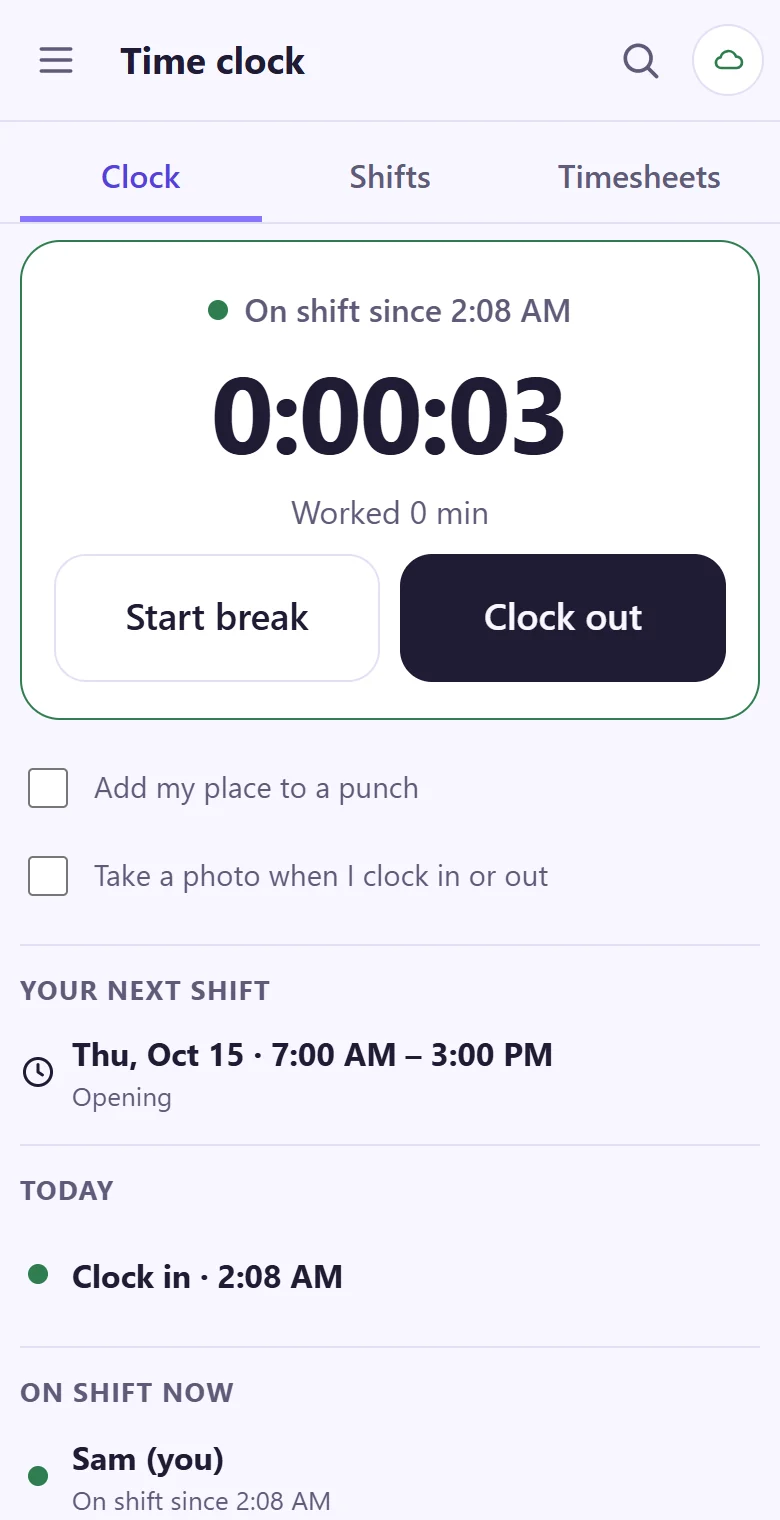
That is how the time clock in tick-tock-done works. The time of a punch is the server's clock, to the second; hours are added up from those punches without rounding. A manager can add, remove or change a punch, but each change carries a reason and the old punch stays in the record. Everyone sees their own hours, and the owner and managers see everyone's.
If you plan shifts too, the shift handover checklist covers what should pass between the people clocking out and in.
Run your crew's time clock on exact punches, with every correction and its reason kept.
See the time clockWhat this does not cover
This is not legal advice. It summarises a federal rule and a few well-known cases. Your state, your union agreement and your payroll provider may change the answer.
Breaks, overtime and travel time have their own rules. Rounding is only about where the start and stop punches land.
The numbers in the example are invented to show the arithmetic, not taken from a case.
We found no national data on how many small employers round, or how much it costs workers on average.
Sources
29 CFR 785.48, Use of time clocks (US Department of Labor rules under the Fair Labor Standards Act). Text (Cornell LII)
Camp v. Home Depot U.S.A., Inc. (2022) 84 Cal.App.5th 638. Opinion (Justia)
National Law Review, "California Supreme Court to address rounding employee time" (the 2023 grant of review). Article
CalChamber HRWatchdog, "California Supreme Court agrees to hear timekeeping rounding case" (2023). Article
Donohue v. AMN Services, LLC (2021) 11 Cal.5th 58 (no rounding of meal periods).
Corbin v. Time Warner Entertainment-Advance/Newhouse Partnership (9th Cir. 2016) 821 F.3d 1069 (neutral rounding upheld).