The kitchen is in. The client is cooking in it. And three weeks later there are still eleven small things open: a cabinet door that doesn't close flush, a missing switch plate, caulk to redo behind the sink, a paint touch-up in the hall. Each is twenty minutes of work. Together they hold back the last payment, tie up a crew lead's evenings and turn a happy client into one who sends long texts.
That tail is what a punch list (a snag list in the UK and Australia) is for. Done well, it closes a job in days. Done badly, it becomes a second, unpaid project. This piece is for small contractors, remodelers and trade crew leads; the same ideas work for a fit-out or a restaurant build.
What a punch list is, and what it isn't
A punch list is the list of work that still has to be finished or corrected before a job is complete. On a contract like the AIA A201 general conditions, used on many US commercial jobs, it comes at substantial completion: the point where the owner can use the space for what it was built for. The contractor submits a list of what is left, the architect inspects and adds anything missed, and the agreed list is attached to the certificate of substantial completion (the AIA G704). Signing that certificate usually starts the warranty period and releases part of the money held back as retainage.
Most small residential jobs have no architect and no G704, but the same three stages are there: a point where the client can use the room, a list of what's left, and a final sign-off that releases the last payment.
What belongs on it: work not finished (the trim in the closet), work not right (a tile that rings hollow), and damage done during the job (a gouge in the new floor).
What doesn't: new work. "While you're here, could you also..." is a change order with a price, not a punch item. Writing it on the punch list is how a three-day close-out becomes three weeks.
A punch list is a list of promises already made. Anything new goes on a change order.
Why the tail runs long
Nobody plans for the last 5% to drag; it drags for structural reasons that are easy to see once named.
The crew has moved on. The next job has started. Coming back for a switch plate means a drive, a parking problem and an hour lost for twenty minutes of work.
Every item belongs to a different trade. The electrician's two items, the painter's four, the plumber's one. Each waits for its trade's next free half-day.
Nobody owns the list. Items are "the crew's". So nobody is chasing the plumber.
The list keeps growing. Each walk turns up new things, because the client is now living with the work and noticing more. Some are real; some are new wishes.
Lines are vague. "Fix paint in hall" gets fixed, and the client points at a different patch.
Parts are missing. One backordered hinge holds up the sign-off for everything else.
Every line: where, what, done means, who, by when, photo
The fix for most of that list is how each line is written. A good punch item can be done by someone who has never seen the job, and checked by someone who wasn't there when it was written.
Where: room and spot. "Hall, left wall, 1 m from the bedroom door, at hand height".
What's wrong: "Two scuffs in the paint, about 5 cm each".
Done means: "Touched up in the same paint, no edge visible from 1 m".
Owner: one name, not a trade. "Luis (painter)", not "painting".
Due: a date. If it needs a part, the date the part arrives plus a day.
Photo: the problem now, with something in frame that shows where it is. Then a second photo of the same spot when it's done.
The photo does most of the arguing for you: it fixes which scuff the line meant, and the after photo shows it gone. What to photograph and how, for punch lists and the rest of the job, is in photo proof on tasks.
Shrink the list before the client sees it
Punch as you go. When a room or an area is finished, the lead walks it the same day and fixes what can be fixed while the trade is still on site. The painter is cheaper to keep for an hour today than to bring back next month.
Do your own walk first. A day or two before the client walk, walk the whole job with the list format above and clear everything you can. The list the client sees should be short, and their items should be ones you missed, not ones you knew about.
Order the parts now. Anything that needs a part goes on the list with the part already ordered, so the backorder starts the day you notice, not the day you're asked.
Walk it with the client once
One walk, with the client, the lead, and the list on a phone or a clipboard. Go room by room in the same order every time.
Write as you go, together. Read each new line back to the client before moving on. "Hall, two scuffs, left wall at the bedroom door, touch-up". If they nod, it's on the list as written.
Sort new wishes on the spot. "That's new work, I'll price it separately" said kindly at the walk is easier than the same sentence by text three weeks later.
Agree that this is the list. The walk ends with "these are the items; when they're done we'll walk it again and close". Anything found later is either warranty work or a new item, not a reason to reopen everything.
Give a date for the whole list. Usually the latest due date on it.
Close it
Each owner ticks their items with an after photo. The lead checks every tick (the photo makes most of that possible from a phone, but walk the ones that matter). Then a short final walk with the client, the list showing every line done, and a signature: on the G704 and the contractor's final payment application on a commercial job, or a one-line "punch list complete" with a date and the client's name on a residential one. That signature is what releases the final payment and starts the warranty, so ask for it on the day, in person.
Keep the list with its photos afterwards. When a warranty call comes in a year later, "the cabinet door was adjusted on the 14th, here's the photo" is a short conversation.
Putting it in a shared list
Paper punch lists get lost and can't hold photos. A shared task list works well: one list per job, one task per item, each assigned to a person with a due date and the before photo attached. A board with columns like Open, Fixed and Checked shows at a glance what is waiting on whom, and the client can see the same list if you want them to. Setting up those columns is in a task board for a five-person team.
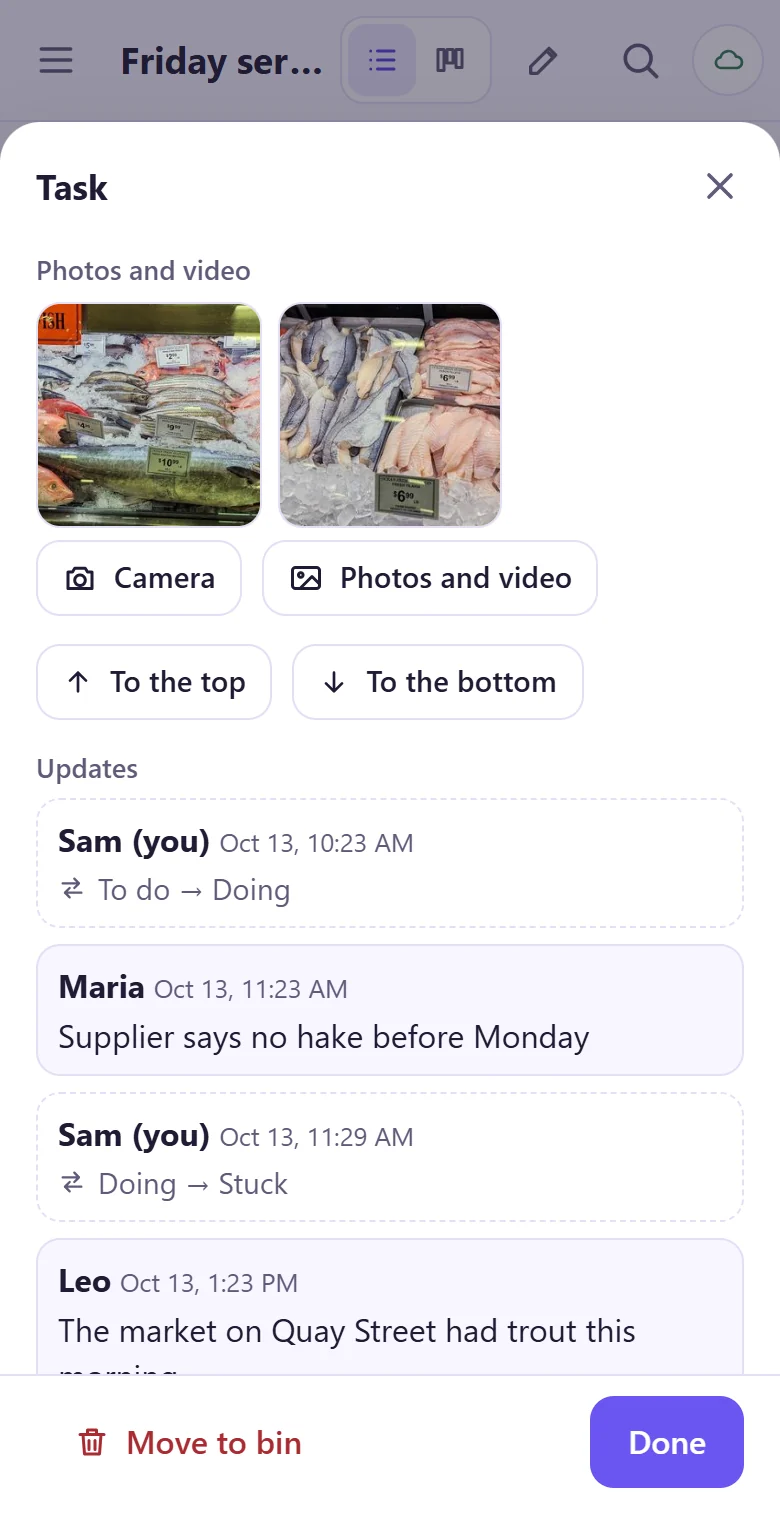
Make one list per job, one task per punch item, each with an owner, a date and a before photo.
See it for construction crewsWhat this does not cover
Your contract wins. Who prepares the list, how long the contractor has to finish it, and what retainage is held are set by the contract and by state law, and they vary. On an AIA contract, read sections 9.8 and 9.10 of the A201 and the G704 itself.
Retainage figures vary. Amounts of 5% to 10% are common on commercial work; many residential contracts hold back a final payment instead.
Warranty work is different. A defect that shows up after sign-off is a warranty claim under the contract's terms, not a reopened punch list.
We found no good data on how long close-out takes on small jobs, so this piece gives no figure; the 5% in the title is a manner of speaking.
Sources
American Institute of Architects, G704 Certificate of Substantial Completion (what the form records, warranty start and retainage). AIA Contract Documents
Learn Architecture, "Punch list in construction" (A201 section 9.8.2: contractor prepares the list, architect inspects and adds items). Article
Open Exam Prep, Virginia general contractor guide 6.3, "Site logistics, project closeout, punch lists, and warranties" (retainage ranges, final completion). Guide
Vanderbilt University Medical Center, Planning, Design and Construction, closeout procedure for construction managers (an owner's closeout steps). PDF