At 6:40 on a Tuesday the office manager calls: the alarm went off at 11:52 last night, the police came, and the city has sent a $150 bill. Your crew left at 11:45. Was the back door shut? Who armed it, with whose code? The crew lead says they set it like always. Nobody can show it. Two weeks later a new hire quits, and the office key they were handed never comes back.
Cleaning crews in offices at night hold something worth more than the cleaning contract: the keys and alarm codes to a client's building. This piece covers a handover that leaves a record: who holds which key or fob, one alarm code per person, an arming and lockup routine with a photo, what to do in the first 60 seconds of a false alarm, and what a lost key costs to fix, with a lost-key log you can copy.
False alarms by the numbers
The US Justice Department's problem-oriented policing guide on false burglar alarms (Rana Sampson, 2nd edition, 2011) puts it plainly:
94 to 98% of the alarm calls police respond to are false (higher in some places). In Dallas in 2004, 2.8% of 62,000 alarm calls were valid; in Salt Lake City in 1999, 0.3% came from a crime.
10 to 25% of all calls to police nationwide are false alarms.
About 20 minutes of police time per false alarm, usually for two officers.
The main cause is user error: wrong keypad codes, a door or window left open when the system is armed, and "inadequate employee training ... such as entering and exiting alarmed premises incorrectly". One UK study found user error caused about 50% of activations.
A night cleaning crew is exactly the employee use those lines describe: several people, an unfamiliar panel, the last ones out. Cities pass the cost back to the alarm owner, who passes it to the cleaning company:
Ann Arbor, Michigan: $130 per false alarm from July 2025, $150 from July 2026, $190 from July 2027 (Resolution R-25-174). No free ones.
Portland, Oregon: the first false alarm in a permit year is a warning; after that, fines from the city's fee schedule, and the no-response process for repeat locations (City Code 14B.10.080).
Los Angeles (2004, in the DOJ guide): police response suspended after two false alarms in a rolling 12 months.
A crew that trips the alarm twice a month at a client in a city like Ann Arbor costs that client $300 a month in fines at the 2026 rate. That is often more than the margin on the account.
Key control: who holds what
Fewer keys, fewer people. Ask the client for one key or fob per crew, not one per cleaner. The crew lead signs it out; the others go in with the lead.
Fobs and codes beat keys. A lost fob or a leaver's code is switched off in the access system the same day for nothing. A lost key to a building with keyed locks means a rekey (prices below).
Number everything. Each key gets a tag with a number, not the client's name or address. A key on a ring labelled "Smith Dental, 400 Main St, alarm 4417" is a burglary kit.
A key register, one line per key or fob: number, what it opens, client, issued to, date out, signature, date back. Check it against the keys in hand once a month and when anyone leaves.
A leaver hands back keys on the last shift, before the final pay conversation, and the lead checks the number against the register.
Alarm codes: one per person
Most commercial panels let the owner set many user codes, and the monitoring company's open and close reports show which code armed and disarmed the system and when. That only helps if each person has their own:
One code per person, never shared. Ask the client (or the alarm company, with the client's written OK) to set a code for each cleaner, or at least for each crew lead. A shared "cleaning code" tells you nothing at 11:52 p.m.
Know the passcode for the monitoring centre. It is a separate verbal word the operator asks for on the phone to cancel a dispatch. Each lead needs it on their phone, not on the key tag.
Delete a leaver's code the same day. Send the client a one-line email with the name and date; keep the reply.
Know the panel's timers. Panels built to the ANSI/SIA CP-01 false-alarm standard default to a 30-second entry delay (adjustable from 30 seconds to 4 minutes), an exit delay of at least 45 seconds (many ship at 60), and an abort window of about 30 seconds in which disarming stops the signal before it is sent. Many also restart the exit delay if someone comes back in, and switch to a stay mode if nobody leaves after arming. Ask the alarm company what your client's panel is set to and write it on the lockup card.
The lockup routine, with a photo
Do it in the same order every night, from the far end of the building to the exit. The last two items are the ones that cause false alarms.
1. Every room on the list done; vacuum and carts out of motion-sensor areas.
2. Windows shut and latched; blinds as the client wants them.
3. Interior doors as the client wants them (some must stay open for motion sensors, some closed).
4. Lights off except the ones on the client's list.
5. Coffee machine, space heaters and anything with a plug the client listed: off.
6. Every exterior door other than the exit: pushed and pulled to check it latched. Check the roll-up and the back door by hand.
7. Nobody left inside: the lead counts the crew at the exit.
8. Arm with your own code. Wait for the panel to confirm "armed" or the exit countdown to start. Photo of the keypad showing armed (or of the countdown).
9. Out, lock the door, pull it. Photo of the locked door with the time on it.
10. If the panel or the app gives no "armed" confirmation within the exit delay, go back in, disarm and repeat. Don't drive off on a guess.
The two photos and the time on them settle the call at 6:40 a.m. If the door was locked at 11:43 and the panel was armed by your lead's code at 11:44, the 11:52 activation was something else: a sensor, a balloon, an employee of the client who came back. The cleaning checklist piece covers photo proof for the clean itself.
A false alarm: the first 60 seconds
1. Disarm with your own code at once. Within the abort window, most panels never send the signal.
2. Call the monitoring centre (number on the lockup card) or answer their call. Give the client's account name, your name and the verbal passcode, and say it was a cleaning crew error. Ask them to cancel any dispatch and give you a reference number.
3. If police are already on the way, wait for them, with ID and your crew list. Leaving looks worse than the mistake.
4. Re-arm with the routine above, with the photos.
5. Tell the client the same night by text or email: the time, what happened, the cancel reference, and whether police came. They hear it from you before they see the fine.
6. Log it: date, time, cause, code used, reference, police yes or no. Two in a month at one site is a training problem or a panel problem; ask the alarm company to check the sensor that tripped.
What a lost key costs
A lost key to a keyed building means the client's cylinders get rekeyed: the locksmith changes the pins so old keys no longer work. One Phoenix locksmith's published business rates (ACME Locksmith, January 2026): $100 to $130 trip charge, $30 to $50 per standard commercial cylinder (rim, mortise, lever), $50 per high-security cylinder, $10 to $30 more per cylinder on a master key system, $10 to $20 more where there is no working key. Prices in other cities run higher or lower with local labour costs. At the middle of those ranges:
A small office suite, 2 exterior doors, no master key: $115 + 2 x $40 = $195, plus new keys for everyone who holds one.
A 10-door office on a master key system, the master lost: $115 + 10 x ($40 + $20) = $715.
The same office with high-security cylinders: $115 + 10 x ($50 + $20) = $815, and high-security keys are cut only by the dealer, at a higher price per key.
A lost fob: switched off in the access system the same day. $0 in locksmith fees, plus a replacement fob.
Who pays should be in the cleaning contract before the first night, not argued after the first loss. Common terms: the cleaning company pays for a rekey caused by its staff losing a key; it reports a loss within a set number of hours; the client may require a bond or insurance that covers key replacement. Ask your insurer whether your policy covers lock and key replacement and up to what amount.
The lost-key log
One line per loss or unreturned key. The FLSA and state wage laws limit what you may take from a cleaner's pay for a lost key (no deduction may cut pay below minimum wage, and some states ban such deductions outright), so this log is for the client and the contract, not payroll.
Columns: date found missing · key or fob number · what it opens · client · last holder · when last seen · reported to client (date, time, how) · action (fob off, rekey ordered, key found) · cost · paid by · closed (date).
Example line: Oct 21 · K-07 · rear door and suite 200 · Main St offices · R. (crew lead) · Oct 20, 23:40, on the ring at lockup · Oct 21 07:10, phone and email · rekey 2 cylinders ordered · $195 · cleaning company · Oct 23.
In tick-tock-done the lockup routine is a daily checklist for each site that starts fresh every night, with the name and time on every tick, items marked photo required for the keypad and the locked door, and a log of the week to send the client. The key register and the lost-key log fit as a list in the team with a task per key.
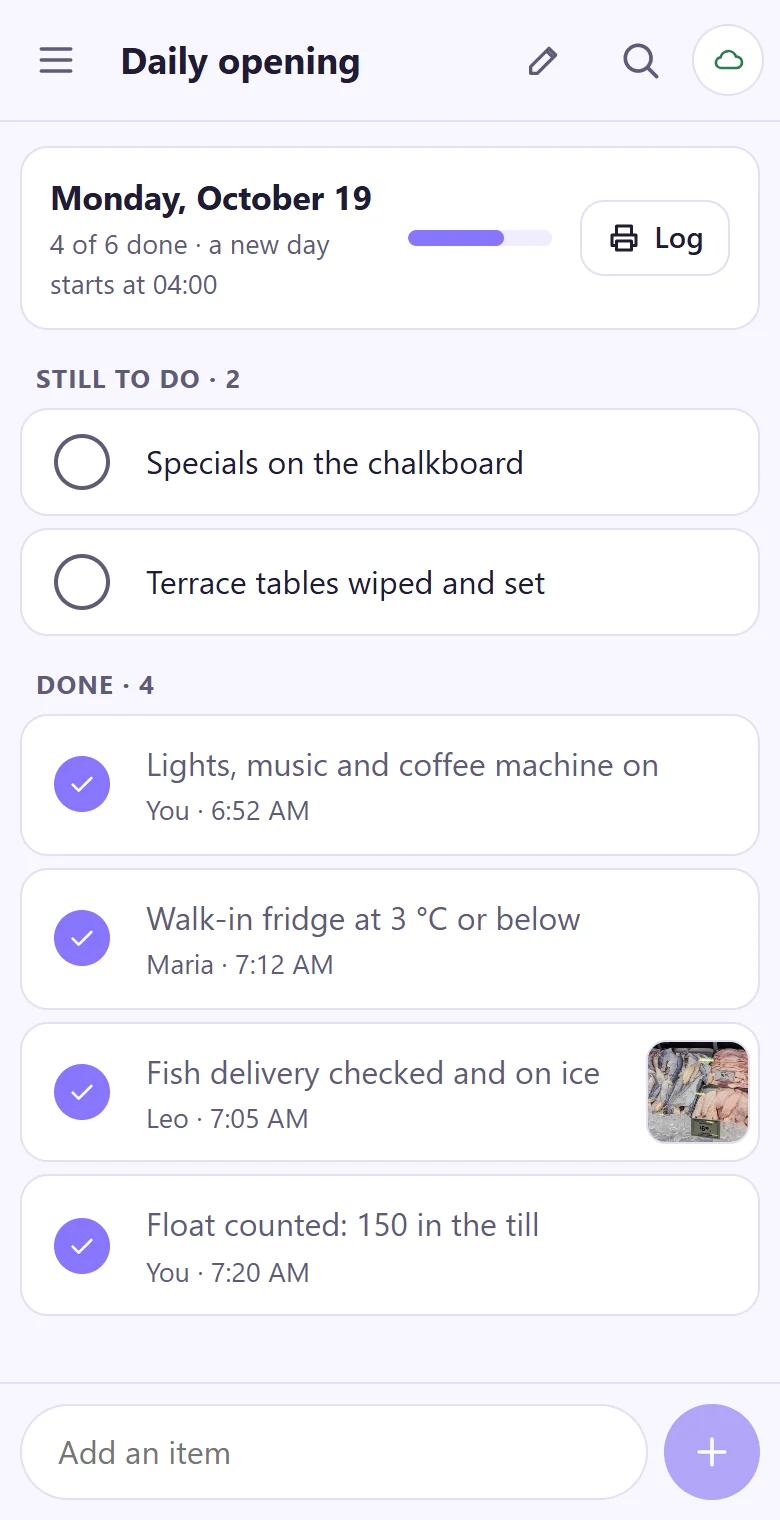
A checklist for each site that starts fresh every night, with who ticked what and when, a photo on the keypad and the locked door, and a log to send the client.
See the daily checklistsWhat this piece does not cover
Alarm fines vary city by city, and many cities require an alarm permit; the client holds it, but ask which city rules apply to each site.
The rekey prices are one locksmith's published Phoenix rates, not a national survey; get a quote for each building. We found no reliable national data on lost keys in cleaning companies.
The CP-01 timer values are from vendor and trade press summaries of the standard; older panels may not follow it, so ask the alarm company.
Fire alarms and fire doors follow different rules; never prop a fire door to save a trip.
The DOJ guide's 94 to 98% comes from studies in the 1990s and 2000s; verified-response policies have since cut police dispatches in some cities, but we found no newer national figure.
Sources
Rana Sampson, False Burglar Alarms, 2nd edition, Problem-Oriented Guides for Police No. 5, U.S. Department of Justice, COPS Office, 2011. popcenter.asu.edu
City of Ann Arbor Police, Alarm Fees (Resolution R-25-174). a2gov.org
City of Portland, City Code 14B.10.080, False alarm fines and warnings. portland.gov
Security Sales & Integration, "Standards Keep Your Alarm Panels Under Control" (ANSI/SIA CP-01 entry delay and abort window). securitysales.com
Alarm Grid, Honeywell L5100-SIA (CP-01 exit delay: 60-second default, 45-second minimum). alarmgrid.com
Ajax Systems, How to set up the ANSI/SIA CP-01-2019 compliant system (exit delay range, exit restart, unvacated premises). ajax.systems
ACME Locksmith, "What is the Cost to Rekey a Phoenix Business in 2026?", updated January 5, 2026. acmelocksmith.com