
The owner walks the kitchen on day four and says: "While you're in there, can you put an outlet on the island and move that wall a foot?" The lead says sure. Six weeks later the final invoice has $2,400 of extras on it, the owner remembers "a quick favour", and there is nothing on paper but a text that says "ok thx". Most small contractors have lost money this way. It is rarely because the owner is dishonest; two people remember a hallway conversation differently, and the price was never said out loud.
This piece is about getting the yes in writing before the extra work starts: what a field change order needs to hold, the notice periods in the standard AIA and ConsensusDocs contracts, what California requires on home jobs, what changes actually add to a job by the numbers, and a one-page template your lead can fill in on site in five minutes.
How often jobs change, by the numbers
AIA Contract Documents analysed 892,457 executed change orders from 18,229 completed US building projects over ten years ("The Truth about Change Orders", 2023). Per project, by final project value:
$0 to $500k: 1.70 change orders on average (middle 80% of projects: 1 to 3); cost change 3.20% on average, middle 80% from -8.02% to +15.88%.
$500k to $1M: 2.45 (1 to 5); cost +4.36%, middle 80% -4.32% to +13.95%.
$1M to $5M: 3.73 (1 to 8); cost +5.04%, middle 80% -2.39% to +15.19%.
$5M to $10M: 5.88 (1 to 13); cost +4.64%.
$10M to $50M: 7.93 (1 to 17); cost +4.37%.
Over $50M: 11.29 (1 to 27); cost +4.60%.
Two things stand out for small jobs. The spread is widest at the bottom: on jobs under $500k one in ten finished more than 15.88% over the signed price through change orders. And these are only the changes somebody wrote up and signed. A dataset built from executed change orders cannot count the outlet that went in on a handshake and never got paid. On a $60,000 remodel, 3.2% is $1,920, about the size of the extras in the opening story.
Why verbal changes go unpaid
Nobody said the price. "Can you move the wall?" is a request for work, not an agreement on money. The owner hears a favour; the contractor hears billable time.
The contract says written. Most written contracts, the AIA and ConsensusDocs forms included, say changes are made by a signed change order and claims need written notice by a deadline. Courts split on how strictly they enforce this, but the cases a contractor loses are often lost on paper. In Absher Construction v. Kent School District (Washington, 1995) claims not submitted in writing within the contract's 14 days were barred. In James Construction Group v. Westlake Chemical (Texas, 2022) the court applied substantial compliance but held that oral notice does not satisfy a contract that requires written notice.
Home improvement law. In California, a home improvement contract and any changes to it must be in writing and signed by the parties before the work they cover starts (Business and Professions Code 7159), and a change order is not enforceable against the homeowner unless it states the scope, the amount added or subtracted, and the effect on progress payments or the completion date (7159.6). A contractor may still recover for work done under unjust enrichment rules, which means a lawsuit instead of an invoice.
Memory fades in weeks. By the final invoice, the only record that counts is the one made on the day.
What a field change order holds
The AIA's G701 Change Order form, under A201-2017 section 7.2, is signed by owner, contractor and architect and states three things: the change in the work, the change in the contract sum, and the change in the contract time. California's 7159.6 asks for the same three on home jobs. A one-page field version for small work adds what a lead needs on site:
1. Job and number: job name or address, change order number (CO-01, CO-02 ...) and date.
2. Who asked: the owner's or client's name, and whether they asked for it or a hidden condition forced it (rot behind the drywall, a buried line).
3. Scope: what will be done, in plain words, with where and how much. "Add one 20 A GFCI outlet on the island, east face, run from panel circuit 14", not "electrical changes".
4. Price, one of three ways: a lump sum; time and materials at the rates in the contract, with a not-to-exceed amount; or unit prices (per outlet, per square foot).
5. Time: days added to the finish date, or "none".
6. Effect on payments: which progress payment the amount is added to.
7. Photos: before (what's there now) and, later, after.
8. Signatures and date: owner and contractor, before the work starts. On a job with an architect, theirs too.
9. Running total: original contract, change orders to date, new contract sum.
Pricing it: lump sum or time and materials
Here is the island outlet and the wall move from the opening, priced both ways. The rates are this example's, set in its contract: electrician billed at $95 an hour, carpenter at $78, materials at cost plus 15%.
Time and materials, estimated:
Electrician, 2 people x 3.5 h x $95 = $665.00
Carpenter, 1 person x 6 h x $78 = $468.00
Materials at cost $412.00 + 15% = $473.80
Permit revision (city fee) = $85.00
Drywall patch and paint, sub quote = $520.00
Estimate: $2,211.80; not to exceed $2,450. Time: +2 working days.
Lump sum: $2,300, +2 working days. The contractor carries the risk of the wall taking longer; the owner gets a number they can say yes to.
Use a lump sum when the scope is clear and you have done the work before. Use time and materials with a not-to-exceed when nobody knows what is behind the wall, and log the hours and receipts on the day. A T&M change order with no cap is the one owners refuse to pay at the end.
The running total
Original contract: $60,000.00
CO-01, island outlet and wall move: +$2,300.00, +2 days
CO-02, owner's tile upgrade: +$1,140.00, 0 days
CO-03, delete the pantry shelving: -$680.00, 0 days
New contract sum: $62,760.00 (+4.6%); finish date moved 2 working days.
A deduction is a change order too. Writing it up keeps the owner's trust and stops the question at the end about why the price didn't come down.
Notice periods in the standard contracts
If the change is the owner's request, you price it and get the signature before the work. If it is a claim (a hidden condition, a delay, a directive the owner won't price), the contract sets a clock:
AIA A201-2017: claims must be initiated by notice within 21 days after the event or after the claimant first recognizes the condition, whichever is later (15.1.3.1). Concealed or unknown site conditions: notice promptly, before the conditions are disturbed, and no later than 14 days after first seeing them (3.7.4). The owner and architect can also order the work by a Construction Change Directive when the price is not agreed (7.3); the contractor proceeds and the amount is settled later. Minor changes the architect orders may not change the price or time (7.4), and since 2017 the contractor has to say so if it thinks one does.
ConsensusDocs 200: written notice of a claim for more money or time within 14 days after the occurrence, or after the contractor first recognizes the condition, whichever is later; "except in an emergency, notice shall be given before proceeding with the Work"; written documentation within 21 days after the notice (8.4).
Your own contract: many small jobs run on a two-page proposal with no change clause. Add one line: "Changes to the scope, price or schedule are made only by a written change order signed by both parties before the changed work begins."
On site: the five-minute routine
1. Stop. When the owner asks for something not on the plans, the lead says: "Happy to. I'll write it up and price it so you can sign before we start."
2. Photograph what's there now.
3. Write the scope on the template in front of the owner, and the price if the lead is allowed to price; otherwise the office prices it the same day.
4. Sign. On paper, a PDF on the phone, or an emailed reply that says "approved, CO-01, $2,300, +2 days". An email reply is still writing; a thumbs-up emoji is weaker.
5. Then build. If the owner insists the work starts before the price is agreed, write "T&M, not to exceed $X" and get that signed. Log the hours on the day.
6. Bill it with the next progress payment, as the change order says.
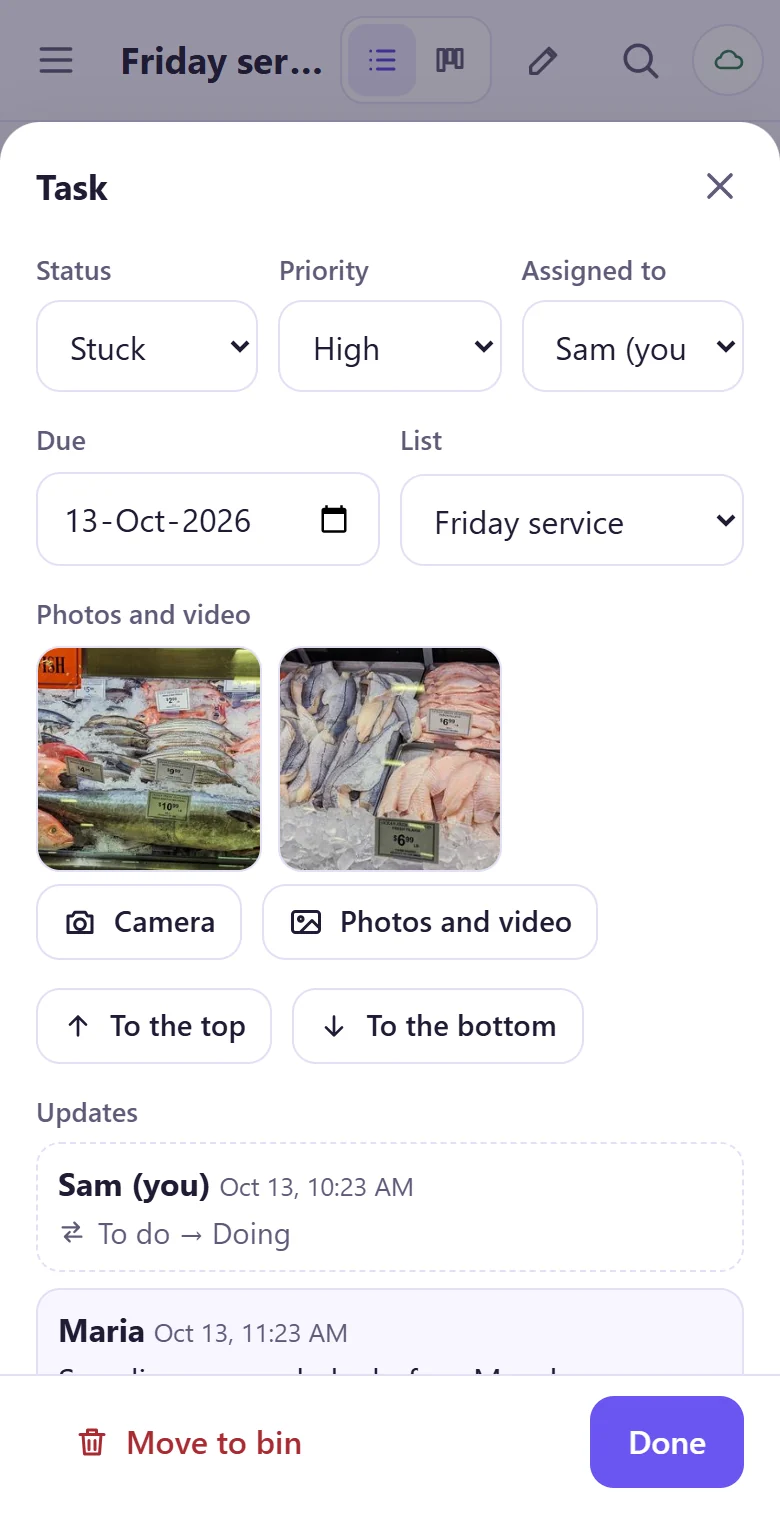
In tick-tock-done a change order is a task on the job's list: the scope in the title and note, the before photo and the signed page or screenshot of the approval on the task, the hours and receipts as updates, and the after photo when it is ticked done. The app has no signature field, so the signature lives on the photographed page or the approval email; the task keeps it with the job and shows who added it and when. The photo proof piece covers what makes a photo hold up, and the daily log is where the change goes on the day it happens.
Job lists with photos and notes on each task, a time clock for the crew and a daily log, for building crews.
See it for constructionWhat this piece does not cover
It is not legal advice. The AIA, ConsensusDocs and California rules are summarized as we read them in October 2026; quotes from the AIA and ConsensusDocs forms come from law firm summaries of them, so check your signed copy.
Other states have their own home improvement rules on written changes (New Jersey, New York and others); we only checked California's.
Public work (federal, state and city contracts) has its own change and claims procedures and much stricter notice enforcement.
The AIA benchmark counts executed change orders on contracts in AIA's database; jobs without written contracts, and the changes that never got written up, are not in it. We found no reliable figure for how much unpaid extra work small contractors absorb.
The prices in the worked example are this example's contract rates, not market averages.
Sources
AIA Contract Documents powered by Catina, "The Truth about Change Orders", Research Note, 2023 (892,457 change orders, 18,229 US projects; Tables 1 and 2). AIA Contract Documents
California Business and Professions Code 7159.6 (extra work and change orders). california.public.law
California Business and Professions Code 7159 (home improvement contracts and changes in writing, signed before work). california.public.law
Peckar & Abramson, "Snooze, You Lose? Enforcement of Notice and Timing Provisions" (ConsensusDocs 200 section 8.4 text; Absher, James Construction Group and other cases). pecklaw.com
Amundsen Davis, "Notice Requirements Under the Revised A201-2017" (claims notice, 15.1.3). amundsendavislaw.com