A four-floor office, three cleaners, 6 p.m. to 10 p.m. The lead works floor 1 and the lobby and can't be on floors 2, 3 and 4 at the same time. At 8:40 the next morning the property manager emails: "The third-floor men's room wasn't done last night." Was it? Nobody can say. The paper sheet on the closet door has every box ticked, in the same pen, at the same angle.
This piece is for owners and leads of commercial and home cleaning crews who need to know a building was cleaned without walking every floor themselves. It covers how to set the standard, how long each area should take (with the industry's own time figures), what goes on a list for each room, which items need a photo, how to report damage, and how a lead checks a whole building from a phone in about ten minutes.
What happens to a clean nobody checks
The best numbers on this come from hospitals, where cleaning is measured more carefully than anywhere else. In a study of 36 US acute care hospitals published in 2008, researchers put an invisible fluorescent mark on 14 kinds of high-touch objects in patient rooms before cleaning, then checked with a UV light afterwards. Of 20,646 marked surfaces, only 9,910 (48%) had been wiped. Light switches, door knobs and toilet grab bars were missed most; sinks and toilet seats, the things that look dirty, were cleaned most.
Then the hospitals showed their cleaners the results, retrained them on the missed objects and kept measuring. After that, 7,287 of 9,464 surfaces (77%) were cleaned. Nobody bought new chemicals or hired more staff. The difference was a clear list of what had to be touched and someone looking at whether it was.
Offices and homes are not hospitals, and nobody has run the same study on a janitorial crew. But the lesson carries: a crew cleans what is visible and what is checked. A list that names the light switches, plus a check that actually happens, is how you get the other half.
In 36 hospitals, cleaners wiped 48% of the marked surfaces. After they saw the results and the list of what was missed, 77%.
Step 1: agree what clean means
"Clean" means different things to the client, the lead and the newest cleaner. The facilities managers' association APPA uses five levels, written for schools and colleges but plain enough for any building. Picking one with the client, in writing, settles most arguments before they start:
Level 1, orderly spotlessness: floors shine with no buildup in corners or along walls; surfaces have no dust, streaks or fingerprints; washrooms gleam and smell of nothing; bins hold only today's waste.
Level 2, ordinary tidiness: floors clean, with up to two days of dust or streaks; marks and fingerprints visible only up close; washrooms and bins as level 1.
Level 3, casual inattention: floors swept or vacuumed but stains visible and dirt in the corners; walking lanes dull; obvious dust and fingerprints on surfaces.
Level 4, moderate dinginess: dull, stained floors with buildup; conspicuous dust and marks; bins with old trash that smell sour.
Level 5, unkempt neglect: dirty floors with gum and dust balls; heavy buildup; overflowing bins.
The levels come with staffing figures. For a classroom with hard floors, APPA's guidelines allow about 8,500 square feet per custodian per shift at level 1, 16,700 at level 2, 26,500 at level 3, 39,500 at level 4 and 45,600 at level 5 (a seven-hour shift of 420 productive minutes, as reproduced by De Anza College in 2026). So a client who wants level 1 and pays for level 3 hours is asking for three times the labor. Most office contracts land at level 2.
Step 2: time each area, so the list fits the shift
A list that can't be finished in the hours you have gets ticked anyway. The cleaning industry association ISSA publishes production rates for each task (its "612 Cleaning Times"). The rates below are the ones ISSA uses in its own worked examples (Brant Insero, ISSA, June 2022), plus the vacuuming rates the 612 edition (2014) carries over from 1999; check the book for your own equipment.
Mopping a hard floor with a 14-inch flat mop: 5,355 square feet an hour, so 1,000 square feet takes 11.2 minutes.
Light duty spot clean (empty and reline bins, spot wipe, spot dust, pick up debris): 3.62 minutes per 1,000 square feet.
Restroom by the fixture (bins, fixtures, mirrors, partitions, disinfect, restock, dust, sweep, wet mop): 3 minutes per fixture.
Backpack vacuum with a 12-inch tool: 8.25 minutes per 1,000 square feet; a 12-inch upright: 26.8 (Mickey Crowe, ISSA, May 2018).
A worked example: one office floor
One floor of 12,000 square feet: 9,000 square feet of carpeted offices and open plan, 2,000 of hard floor in corridors and the kitchenette, two restrooms with 8 fixtures each (toilets, urinals and sinks).
Spot clean the whole floor: 12 x 3.62 = 43 minutes.
Vacuum the carpet, backpack: 9 x 8.25 = 74 minutes.
Mop the hard floor: 2 x 11.2 = 22 minutes.
Restrooms: 16 fixtures x 3 = 48 minutes.
Kitchenette (counters, sink, microwave, fronts of the fridge and cupboards): 15 minutes, our estimate.
Total: about 202 minutes, about 3 hours 20 minutes per floor per night.
Four floors: about 13.5 hours of cleaning. The crew in the opening example has 12 (three people, four hours), so something is being skipped every night, and the list decides whether it is the right thing. With an upright vacuum instead of a backpack the carpet alone takes 241 minutes a floor and the four floors need about 25 hours. At the May 2025 median wage for janitors and building cleaners, $17.71 an hour (BLS), 13.5 hours is about $239 a night in wages alone, before taxes, supplies and travel.
Two things follow. The list for each room has to match those minutes: if the restroom gets 24 minutes, a 25-item restroom list won't be done. And when a client adds "wipe every desk" to the contract, the arithmetic tells you what it costs, which is a better conversation than a cleaner quietly skipping something else.
Step 3: one short list per room, with what done looks like
One long list for the building gets ticked from the top and abandoned halfway down. One list per area, in the order the crew walks, works better. Six to ten items each; every item says what done looks like, not just the action. These are starting points for an office; edit them for the building.
Restroom
Bins emptied and relined; no bag left on the floor.
Toilets and urinals cleaned inside and out, including the base and behind the seat hinge.
Sinks, taps and mirror: no water spots or streaks.
High-touch points disinfected: door handle on both sides, flush handles, tap handles, light switch, stall locks, grab bars.
Soap, paper towels and toilet paper refilled; a spare roll in each stall.
Floor swept and wet mopped, corners and behind the toilets included.
Photo from the doorway when done.
Offices and open plan
Bins and recycling emptied; liners replaced if dirty.
Carpet vacuumed, walking lanes and under the front edge of desks.
Clear desk surfaces wiped (don't move papers or screens).
Door handles, light switches and lift buttons wiped.
Glass doors and partitions: no handprints at hand height.
Chairs pushed in; windows and doors locked as found.
Kitchen or break room
Counters and table wiped and dry.
Sink empty, scrubbed and dry; no dishes left (or left in the agreed spot).
Microwave inside and out; fridge and dishwasher handles wiped.
Bins emptied; outside of the bin wiped.
Floor swept and mopped.
Photo of the counter and sink when done.
Lobby and entry
Entrance mats vacuumed or shaken out.
Glass on the entry doors: no prints.
Reception desk front and top wiped.
Floor mopped from the far end to the door.
Photo from the door when done.
For home cleaning, the same pattern works with kitchen, bathrooms, bedrooms and living areas, plus the client's own requests ("don't move the papers on the desk", "the dog stays in the garden") as the first item on that room's list. To build and print lists like these, the free checklist builder makes one per area.
Step 4: photos where they settle arguments
A photo of every item is too much: it doubles the time and nobody looks at 200 pictures. A photo of the finished room, taken from the doorway, is enough for most areas, and the rooms that cause complaints get one every time: restrooms, the kitchen, the lobby. Take it from the same spot each visit so a lead can compare nights at a glance. A dark, blurry or sideways photo is a reason to ask, not to accept.
A photo has a second job: it shows the state of the room when the crew left. If a tenant spills coffee across the carpet at 7 a.m., the 9:48 p.m. photo is the crew's defence. There is more on that in Photo proof on tasks.
Step 5: flag damage before you clean it
Cleaners see a building every night that the manager sees once a month: a dripping tap, a cracked toilet seat, a stained ceiling tile, a broken blind, a burned-out light. Each one should be its own item, with a photo, before the crew touches it, so it can't be blamed on the crew later and so it reaches the person who fixes it. Keep it to four details: where, what, a photo, and whether it is urgent (water on the floor is urgent; a scuffed wall is not). APPA counts burned-out lamps in its levels for a reason: they are the first thing a client notices.
Step 6: how a lead checks a building from a phone
With a list per area that has to be ticked one item at a time, plus a photo on the rooms that matter, the lead's check at the end of the night is a routine, not a walk:
1. Count. Each floor's areas: how many of how many items done. Anything below all of them gets a message before the crew leaves the building, not the next morning.
2. Look at the photos. Restrooms, kitchen and lobby on each floor: about twelve pictures for the four-floor example. Five seconds each.
3. Look at the times. A 30-item floor ticked within three minutes was ticked at the end, from memory. Ticks spread across the shift mean the list was used while cleaning.
4. Read the damage flags. Forward the urgent ones to the building manager the same night.
5. Walk one floor a week in person, in turn. In a four-floor building each floor gets a walk once a month. Score it against the agreed APPA level and check the items the list says are done, the light switches first.
6. Tell the crew what you found. The hospital study's jump from 48% to 77% came from feedback, not from the list alone.
And the property manager's email at 8:40 gets an answer by 8:45: the third-floor men's room list, every item ticked between 8:52 and 9:16 p.m., and the photo from the doorway.
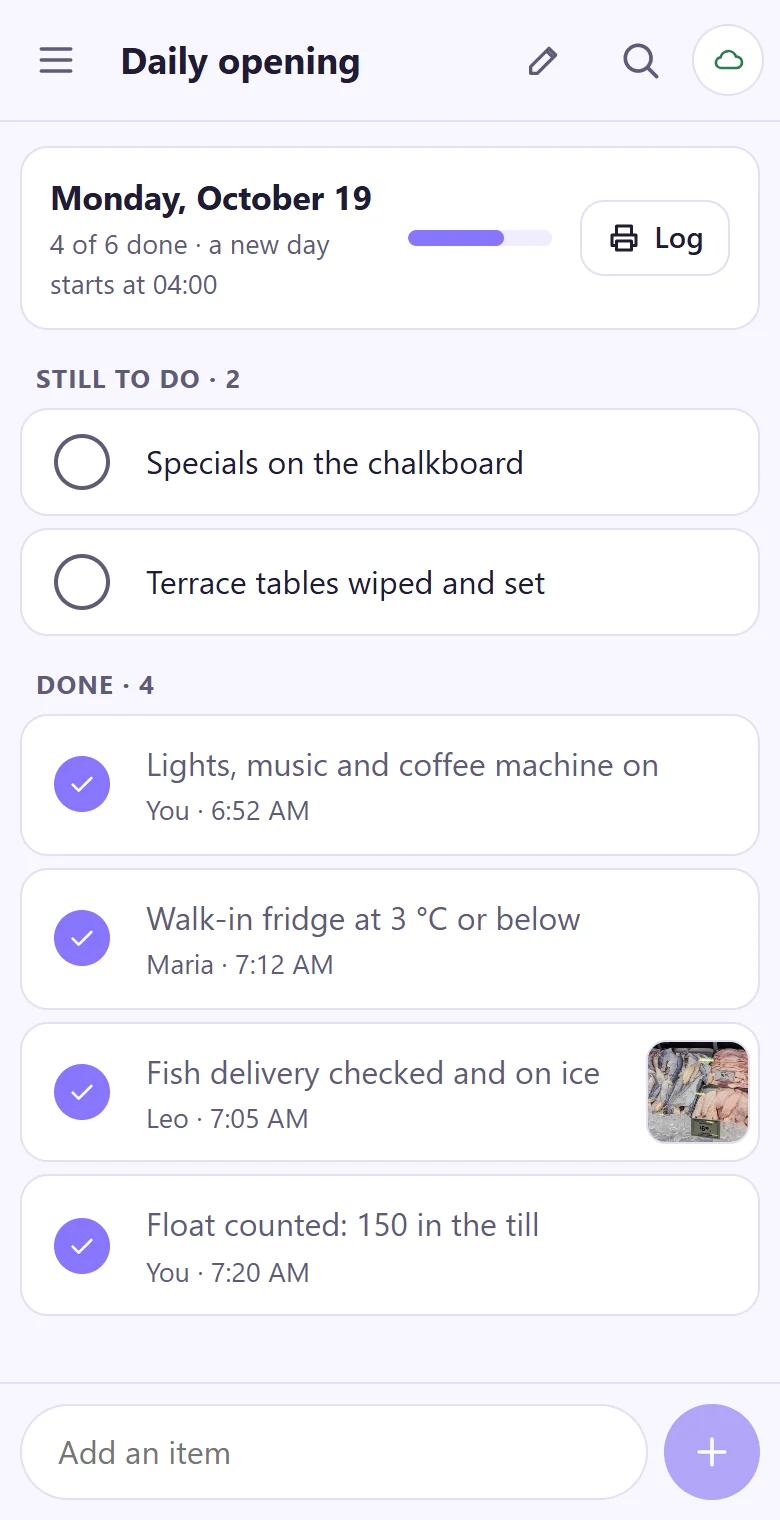
In tick-tock-done, each area can be its own daily checklist in the crew's team space. Every item is ticked one at a time on the cleaner's own phone, with the name and time saved, and the owner or a manager can mark items as photo required, so the tick needs a picture (photos need a connection; ticks are saved without one). The list starts fresh at the reset hour you choose, so last night's ticks don't carry over, and they stay in the log. The Log shows a day or the week up to it for each list: who ticked what and when, the photos as thumbnails and the missing ones marked, and it prints or saves as a PDF to send to the client.
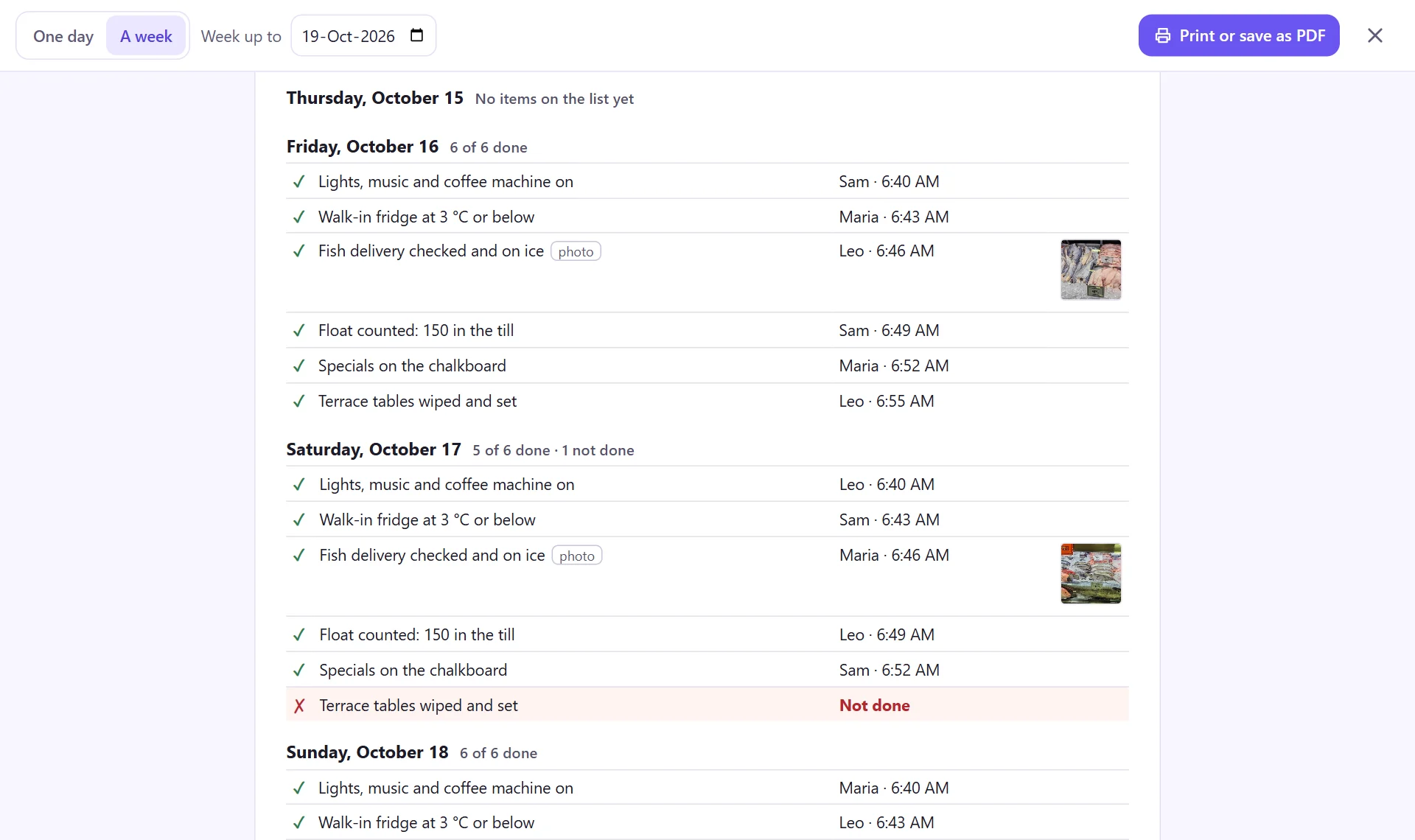
A checklist for each room that starts fresh every night, with who ticked what and when, photos where they matter, and a log to send the client.
See the daily checklistsKitchens use the same pattern for opening and closing; see Restaurant opening and closing checklists that actually get done.
What the research does not show
No study of office or home cleaning crews. The 48% and 77% figures are from hospital patient rooms in 2008, where staff, training and what counts as clean are different. We use them for the pattern, not as a number for your crew.
The time figures are examples. The ISSA rates are the ones ISSA uses to show the method, and the vacuum rates are the 612 edition's as reported by ISSA in 2018. Real times depend on furniture, equipment, the building's condition and the cleaner. Time your own crew on a few nights and use those.
The APPA staffing figures are for schools. They come from APPA's guidelines for educational buildings, as reproduced by a college in 2026; offices and homes aren't covered directly.
The worked example and the kitchenette time are ours. They are round numbers for a typical floor, not a quote.
Photos and lists don't prove a surface is disinfected. For that, hospitals use fluorescent markers or ATP swabs; a photo shows a room looks clean.
Sources
Carling PC, Parry MM, Rupp ME, Po JL, Dick B, Von Beheren S, et al. Improving cleaning of the environment surrounding patients in 36 acute care hospitals. Infection Control and Hospital Epidemiology 29(11): 1035-1041, November 2008. Abstract
Carling PC, Parry MF, Von Beheren SM. Identifying opportunities to enhance environmental cleaning in 23 acute care hospitals. Infection Control and Hospital Epidemiology 29(1): 1-7, January 2008. PubMed
De Anza College, APPA's cleaning standards (from APPA, Custodial Staffing Guidelines for Educational Facilities), updated March 2026. Page
Brant Insero, How to calculate cleaning times, ISSA, June 1, 2022. Article
Mickey Crowe, A journey through the cleaning times, ISSA, May 15, 2018 (vacuum rates in the 1994, 1999 and 2014 editions). Article
U.S. Bureau of Labor Statistics, Occupational Outlook Handbook, Janitors and building cleaners (median pay May 2025). Page