Jo has a family thing on Saturday and asks Dana to take the 8-hour shift. Dana says yes, they tell the lead, and Saturday is covered. Nobody broke a rule on purpose. But Dana was already down for 40 hours that week, so the swap just created 8 hours of overtime the restaurant has to pay, and if Dana closed Friday at midnight and opens Saturday at 6, a city scheduling law may add a rest premium on top.
Most small crews swap shifts by text, and most of the time that is fine. This piece sets out the few rules that keep it fair and legal: who may swap with whom, what a swap does to overtime and rest between shifts, what the scheduling laws in Oregon, Seattle and New York City say about trades the workers start themselves, and a written log that settles arguments later. It is for hourly, non-exempt crews in the US: restaurants, cleaning crews, small building firms.
Swap, cover or pick up: three different things
A swap (trade): Jo works Dana's Wednesday, Dana works Jo's Saturday. Both keep their hours for the week, give or take the shift lengths.
A cover: Dana takes Jo's Saturday and gives nothing back. Jo loses 8 hours, Dana gains 8.
A pick-up: the manager posts an open shift (someone called out, or the week got busier) and someone takes it.
The difference matters. A trade usually leaves the week's totals where the schedule put them. A cover moves hours from one person to another and is where overtime comes from. A pick-up of a shift the employer offered is, under the scheduling laws below, an employer change rather than a worker's swap, and can carry a premium.
Who may swap with whom
Five checks, in this order. A swap that fails one goes to the lead instead of straight onto the schedule.
1. Same role, same skills. A dishwasher can't cover a line cook's station unless they work it already. On a site, the person who takes the shift needs the same tickets the job needs: forklift or aerial lift certification, confined-space training, a food handler card where the county asks for one.
2. Age. Federal child labor rules (29 CFR 570.35) limit 14- and 15-year-olds to 3 hours on a school day, 18 hours in a school week, 8 hours on a non-school day and 40 in a non-school week, between 7 a.m. and 7 p.m. (9 p.m. from June 1 to Labor Day). A 15-year-old host cannot take a 5-to-11 close, whatever they agree between them. Under-18s also stay off the hazardous jobs (slicers, dough mixers, power tools in the hazardous orders).
3. No overtime created, unless the lead says yes first. The worked example below shows what one cover costs.
4. Rest between shifts. A swap that leaves less than 10 hours between a close and the next open (11 in New York City fast food) is a clopening. See the earlier piece on clopening shifts for what it does to a crew; the laws below put a price on it.
5. Both names, both shifts, in writing, before the first of the two shifts starts.
A worked example: the cover that cost $76
A cafe's workweek runs Sunday 00:00 to Saturday 23:59. Dana and Jo are line cooks at $19 an hour. The posted schedule:
Dana: Monday to Friday, 7:00 to 15:30 with a 30-minute unpaid meal, 8 hours a day: 40 hours.
Jo: Wednesday to Saturday, 8 hours a day: 32 hours.
Jo asks Dana to cover Saturday. Under the FLSA every hour over 40 in the workweek is paid at 1.5 times the regular rate, and a private employer cannot leave the covered hours out of the count. The "trading time" rule that does that (29 CFR 553.31, FLSA section 7(p)(3)) is for state and local government employees only.
As scheduled: Saturday costs 8 x $19 = $152 (Jo, straight time).
After the cover: Dana works 48 hours; Saturday is all overtime: 8 x $28.50 = $228.
The difference: $76 for one shift, about 50% more. Jo's week drops to 24 hours.
The same request as a trade: Dana takes Jo's Saturday and Jo takes Dana's Wednesday. Dana: 40 hours, Jo: 32 hours, no overtime, cost unchanged at $152. The lead's only question is whether Jo can run Dana's station on Wednesday.
In California the daily rule counts too: 1.5x after 8 hours in a workday and 2x after 12 (Labor Code 510). A cover that makes a double (Dana's 8-hour day shift plus Jo's 5-hour close the same day, 13 hours) costs 4 hours at 1.5x and 1 hour at 2x, even in a 30-hour week. If the cover is Dana's seventh day in a row in the workweek, the first 8 hours of it are 1.5x as well. The overtime piece has the other daily overtime states, and the overtime week check adds up a planned week for you.
What the scheduling laws say about worker-initiated swaps
Predictive scheduling laws make employers post schedules 14 days ahead and pay a premium when they change them later. All three below exempt trades the workers arrange between themselves, with conditions. They cover large chains only, so a five-person independent cafe is usually outside them; a franchise location of a big brand often is not.
Oregon (ORS 653.412 to 653.485)
Who: retail, hospitality and food service employers with 500 or more employees worldwide (ORS 653.422).
Premium for employer changes: one extra hour of pay for added time or a moved shift; half pay for each scheduled hour not worked when hours are cut (ORS 653.455(2)).
The swap exception: no premium when "an employee mutually agrees with another employee to employee-initiated work shift swaps or coverage" (653.455(3)(b)). The employer may require swaps to be preapproved, and may help by pointing out who might be available, but may not arrange the swap itself.
Rest: working within 10 hours of the end of the previous day's shift needs the worker's request or consent, and those hours are paid at 1.5x (ORS 653.442). The statute does not take a swap out of that rule.
Seattle (Secure Scheduling, SMC 14.22)
Who: hourly workers at retail and food service establishments with 500 or more employees worldwide; full-service restaurants also need 40 or more full-service locations.
Premium: one hour of pay for added hours or a moved shift; half the hours not worked when someone is sent home early.
The swap exception: the Office of Labor Standards lists "mutually agreed upon work shift swaps or coverage among employees" among the cases with no additional pay; the employer may require approval and may help employees find a match.
Rest: hours worked between a close and an open less than 10 hours apart are paid at 1.5x.
New York City fast food (Fair Workweek Law)
Who: fast food establishments that are part of a chain of 30 or more locations nationally, franchisees included.
Premiums for employer changes made less than 14 days before the first day of the schedule (DCWP FAQ, September 2023):
Less than 14 days' notice: $10 per change (added hours or no change in hours); $20 when hours are cut.
Less than 7 days: $15; $45 when hours are cut.
Less than 24 hours: $15; $75 when hours are cut.
The swap exception: no premium "when employees voluntarily trade shifts with one another": a worker drops a shift in the scheduling app and another picks it up, or two workers agree offline and tell the manager. In the offline case the manager must change the schedule and "record in writing that the reason is a voluntary trade and identify the shifts and the employees who traded", with written consent from the worker who fills in.
What is not a swap: the manager asking someone to fill in or trade, the app asking for volunteers, or a worker picking up an open shift the employer posted. Those owe the premium even with written consent, and DCWP warns employers not to have workers sign papers that call these changes employee requests.
Clopenings: less than 11 hours between a close and the next day's open needs written consent and a $100 premium per clopening worked. The FAQ's trade exception is written for schedule change premiums; it does not say a trade removes the clopening rule, so plan as if it doesn't.
The same Friday-to-Saturday cover under each law
Now say Dana is on the Friday close, 16:00 to 24:00, and takes Jo's Saturday opener, 6:00 to 14:00, as a cover the two of them arranged (for this example Dana's week stays at 40 hours: Dana gives Jo the Thursday shift). Rest between shifts: 6 hours. At $19 an hour:
Federal law only: no premium. $152 for Saturday.
Oregon or Seattle: the hours worked inside the 10-hour rest window (6:00 to 10:00, 4 hours) are paid at 1.5x: 4 x $9.50 = $38 extra, $190. No schedule-change premium, because it was the workers' swap.
New York City fast food: no schedule-change premium if it is a documented voluntary trade, but Dana's written consent and the $100 clopening premium: $252.
If the manager had asked Dana to come in instead: add the change premium on top, $15 in New York City for less than 7 days' notice, one hour's pay ($19) in Oregon or Seattle.
Approval or just notice?
Both are legal for a private employer. What decides it is the cost of a bad swap:
Notice is enough when the swap is a like-for-like trade between people in the same role, neither ends up over 40 hours (or over 8 in a day in California, Alaska and Nevada), and no rest gap drops under 10 hours. Most swaps on a small crew are like this.
Approval first when the swap is a cover (hours move between people), it involves a minor, a certification, or a clopening, or the workplace falls under one of the scheduling laws. Oregon and Seattle let you require preapproval in writing; New York City needs the written record anyway.
Whichever you pick, write it down in two or three lines and post it where the schedule is. "Ask the lead" with no rule behind it is how one cook ends up covering for everyone and another never gets a Saturday off.
A swap policy in eight lines
1. Swaps are allowed between people in the same role who can do the station or job on their own.
2. Post the swap with both names and both shifts before the first of them starts.
3. A like-for-like trade needs notice to the lead; a cover (hours move from one person to another) needs the lead's yes.
4. No swap may take anyone over 40 hours in the workweek (or 8 in a day where the state counts daily) without the lead's yes.
5. No swap may leave less than 10 hours between shifts (11 in NYC fast food) without the worker's written consent.
6. Under-18s swap only into shifts that fit their hours limits.
7. The person who takes a shift owns it: a no-show on a swapped shift counts against them, not the person who gave it away.
8. Every swap goes in the swap log.
The swap log
Keep it with the schedule, one line per swap. The FLSA asks you to keep each person's hours by workday and workweek (29 CFR 516.2) for at least two years for time cards and three for payroll records (516.5 and 516.6); a swap log explains why the hours moved. In New York City fast food the written record is part of the swap exception itself.
Columns: date posted · shift given (day, times, role) · given by · taken by · trade or cover · the shift given back, if a trade · approved by (or "notice only") · overtime created (hours) · rest gap under 10 h (yes/no, consent on file) · note.
Example line: Oct 20 · Sat Oct 25 06:00-14:00, line · Jo · Dana · trade · Dana's Thu Oct 23 to Jo · notice only · 0 h · 6 h gap, consent on file · Jo's family event.
In tick-tock-done the week's plan sits in the Shifts tab, a member can tap their own shift to ask for a different one, and an approved change opens the shift for someone else to take. The app does not yet run swaps between two people on its own, so the log above is a list in the team or a note on the week's task; the time clock then shows what each person actually worked against the plan.
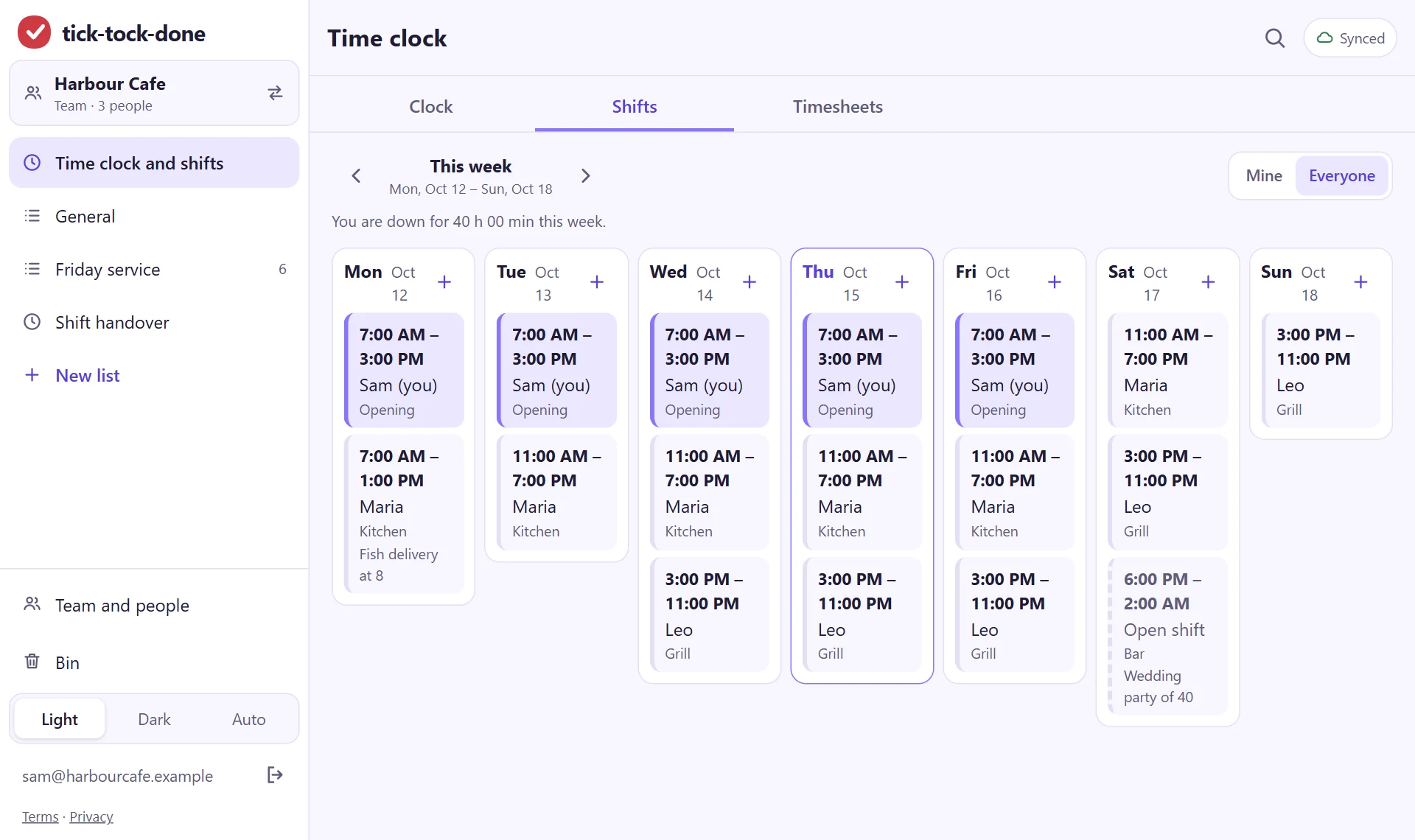
A week's shift plan, requests to change a shift, a time clock on each phone and weekly timesheets, for restaurant and building crews.
See it for restaurantsWhat this piece does not cover
It is not legal advice. It summarizes the FLSA, California's daily overtime, and the Oregon, Seattle and New York City scheduling rules as we read them in October 2026.
Other scheduling laws (San Francisco, Emeryville, Berkeley, Los Angeles, Chicago, Philadelphia, Evanston) have their own swap and rest rules; check yours before using the numbers above.
Union contracts often set their own swap rules and seniority, which win over a house policy.
Public employers can use the FLSA trading-time rule, which lets swapped hours stay out of overtime; private employers cannot.
We found no good data on how often small crews swap or how often a swap causes overtime; the cost figures here are worked examples, not averages.
Sources
ORS 653.455 (predictability pay and its exceptions, including employee-initiated swaps or coverage). oregon.public.law
ORS 653.442 (rest between work shifts, 1.5x). oregon.public.law
ORS 653.422 (employers covered: 500 or more employees worldwide). oregon.public.law
City of Seattle Office of Labor Standards, Secure Scheduling (coverage, 14 days' notice, predictability pay, 10-hour rest at 1.5x). seattle.gov
City of Seattle Office of Labor Standards, Secure Scheduling legislation chart (exceptions: mutually agreed upon work shift swaps or coverage). seattle.gov
NYC Department of Consumer and Worker Protection, Fair Workweek Law FAQs for fast food employers, September 15, 2023 (premium table, voluntary trades, clopenings). nyc.gov
29 CFR 553.31 (trading time, public agency employees). Cornell LII
29 CFR 778.104 and 778.105 (each workweek stands alone; the fixed workweek). eCFR Part 778
29 CFR 570.35 (hours and times of work for 14- and 15-year-olds). eCFR
29 CFR 516.2, 516.5, 516.6 (records to keep and for how long). eCFR Part 516
California Labor Code 510 (daily overtime, seventh day). California Legislative Information