A Saturday night ends with $1,840 in tips: $440 in cash and $1,400 on cards. Three servers, a bartender, a busser and a runner worked the floor; two cooks and a dishwasher made it possible. The owner wants the kitchen to get a share, the sous chef who ran the pass wants one too, and one server thinks the bartender gets too much. Some of those are fair questions. Two of them, in some states, would cost the owner far more than the pool.
This piece sets out who can share tips under federal law since the 2018 change, how the tip credit decides whether the kitchen may join, the states that ban the tip credit, three worked splits of the same night with every person's share, and how to post the split so nobody argues about it. It is for owners and leads of small US restaurants, cafes and bars.
What changed in 2018, 2020 and 2021
Before 2018 a tip pool could include only employees who "customarily and regularly" receive tips: servers, bartenders, bussers, runners, hosts in some cases.
March 2018: the Consolidated Appropriations Act amended FLSA section 3(m) to say an employer may not keep employees' tips "for any purposes", including allowing managers or supervisors to keep any portion of them, whether or not the employer takes a tip credit.
The 2020 rule (in force since April 2021) read that change into the regulations: an employer that pays the full minimum wage in cash and takes no tip credit may run a mandatory tip pool that includes back-of-house staff, "such as dishwashers and cooks". An employer that takes a tip credit may only pool among customarily tipped workers.
The 2021 rule defined who counts as a manager or supervisor for the tips ban (the duties test below), and let them keep tips a customer gives them directly for service they "directly and solely" provide.
August 2024: the Fifth Circuit vacated the separate 2021 "80/20/30" dual jobs rule on side work (Restaurant Law Center v. Department of Labor). That rule is about how much non-tipped side work a tip-credit server may do, not about who shares the pool.
Who may be in the pool
Always allowed: servers, bartenders, bussers, food runners, barbacks, and hosts and sommeliers who deal with guests. They are customarily tipped.
Allowed only with no tip credit (everyone paid at least the full minimum wage in cash): cooks, dishwashers, prep staff, and other back-of-house workers.
Never allowed to take from the pool: the employer (owner) and any manager or supervisor who meets the duties test: primary duty is managing the business or a department; directs the work of at least two full-time employees or the equivalent; and can hire or fire, or their recommendations on it carry weight. A shift lead who runs the floor but cannot hire or fire, and directs fewer than two full-time equivalents, usually is not a manager for this rule. A kitchen manager who hires the cooks is.
May give to the pool: managers may contribute; they just may not take.
Breaking the rule is expensive. The employer owes the tips that went to the wrong people, any tip credit it took, and an equal amount in liquidated damages (29 USC 216(b)), plus a civil money penalty of up to $1,409 per violation for keeping tips (29 CFR 579.1, 2025 adjustment).
The tip credit, and the states that ban it
Under the FLSA an employer may pay a tipped employee $2.13 an hour in cash and count up to $5.12 of tips toward the $7.25 minimum, if tips actually make up the difference and the employer has given the worker the required notice. Seven states ban the tip credit: everyone gets the full state minimum before tips (US Department of Labor, rates effective July 1, 2026):
Washington: $17.13
California: $16.90
Oregon: $15.55 standard; $16.80 Portland metro; $14.55 non-urban counties
Alaska: $14.00
Nevada: $12.00
Minnesota: $11.41
Montana: $10.85 (businesses with gross annual sales over $110,000)
In these seven states a restaurant takes no tip credit by law, so under federal law the kitchen may be in a mandatory pool. Elsewhere it is the owner's choice. Some examples of states that allow a credit:
Texas: $2.13 cash, $5.12 credit (federal rates)
Arizona: $12.15 cash, $3.00 credit
Illinois: $9.00 cash, $6.00 credit
Michigan: $5.49 cash, $8.24 credit
District of Columbia: $10.30 cash, $8.10 credit
Hawaii: $14.75 cash, $1.25 credit, only if pay plus tips is at least $7.00 above the minimum
In a tip-credit state, putting the cooks in the pool means giving up the credit for every tipped worker. In Texas that is $5.12 an hour more in cash: for the 35 floor hours in the Saturday below, $179.20 for one night, about $9,300 a year if every Saturday looks like that. Not taking the credit but including the cooks is a legal choice; taking the credit and including the cooks anyway is the expensive mistake.
Some states are stricter than federal law about who may share. New York (Labor Law 196-d) and Massachusetts (the Tips Act, G.L. c. 149 section 152A) limit pools to staff who serve guests, so the kitchen stays out even without a tip credit. Check your state's own rule before adding the kitchen.
Overtime for a tip-credit worker
Overtime is figured on the full minimum wage, not the cash wage: 1.5 x $7.25 = $10.875, minus the same $5.12 credit, so $5.76 an hour in cash for each overtime hour under federal rules. The overtime piece covers the weekly and daily thresholds.
One Saturday, three splits
Tips: $440 cash + $1,400 on cards = $1,840. The employer may take the card processor's actual fee off the card tips, and no more (DOL Fact Sheet 15). At 2.9%, that is $40.60, leaving $1,799.40 to share. The crew and the hours each worked, from the time clock:
Servers A, B, C: 6 hours each
Bartender: 7 hours
Busser: 5 hours
Runner: 5 hours
Cooks A and B: 7 hours each
Dishwasher: 6 hours
The sous chef (who hires and fires the cooks) and the floor manager: not in the pool.
Split 1: by hours, whole crew (no tip credit, e.g. Washington)
55 hours in all. $1,799.40 / 55 = $32.716 an hour for everyone.
Each server (6 h): $196.30
Bartender (7 h): $229.01
Busser (5 h): $163.58
Runner (5 h): $163.58
Each cook (7 h): $229.01
Dishwasher (6 h): $196.30
Rounded to the cent this pays out $1,799.39; the cent left over goes to the first name on the list. Simple, easy to check, and the kitchen likes it. The floor usually does not: a server who carried the section gets the same per hour as the dishwasher.
Split 2: by points x hours, whole crew (no tip credit)
Points per role: server 1.0, bartender 1.0, busser 0.5, runner 0.5, cook 0.4, dishwasher 0.3. Each person's share = points x hours. Total: 37.4 point-hours, so $1,799.40 / 37.4 = $48.11 per point-hour.
Each server (6.0 point-hours): $288.67, or $48.11 an hour
Bartender (7.0): $336.79, $48.11 an hour
Busser (2.5): $120.28, $24.06 an hour
Runner (2.5): $120.28, $24.06 an hour
Each cook (2.8): $134.71, $19.24 an hour
Dishwasher (1.8): $86.60, $14.43 an hour
Rounded to the cent this pays out $1,799.38; the 2 cents left over go to the first name on the list. In Washington those tips come on top of at least $17.13 an hour in wages, for everyone.
Split 3: by points x hours, floor only (tip credit taken, e.g. Texas)
Same points, cooks and dishwasher out. 30 point-hours, $1,799.40 / 30 = $59.98 per point-hour.
Each server: $359.88
Bartender: $419.86
Busser: $149.95
Runner: $149.95
In Texas those servers were paid $2.13 an hour in cash; their tips ($59.98 an hour) cover the $5.12 credit many times over. The cooks are paid their own wage, with no share of the tips.
Posting the split
A pool works when every person can check their own line. Write a short policy, have each person sign it when they start, and post each night's or week's split where the schedule hangs:
1. Who is in: the roles, and that managers and the owner take nothing.
2. How it is split: by hours, or the points per role, and what happens to rounding.
3. Where the hours come from: the time clock, not the schedule.
4. Card fees: the actual percentage taken off card tips, if any.
5. When it is paid: that night in cash, or on the next paycheck. The FLSA requires card tips to be paid out no later than the regular payday.
6. The posted sheet each night: total cash, total card, fee, pool, hours or point-hours per person, share per person, and who checked it.
7. Records: keep the sheets with the payroll records, at least three years (29 CFR 516).
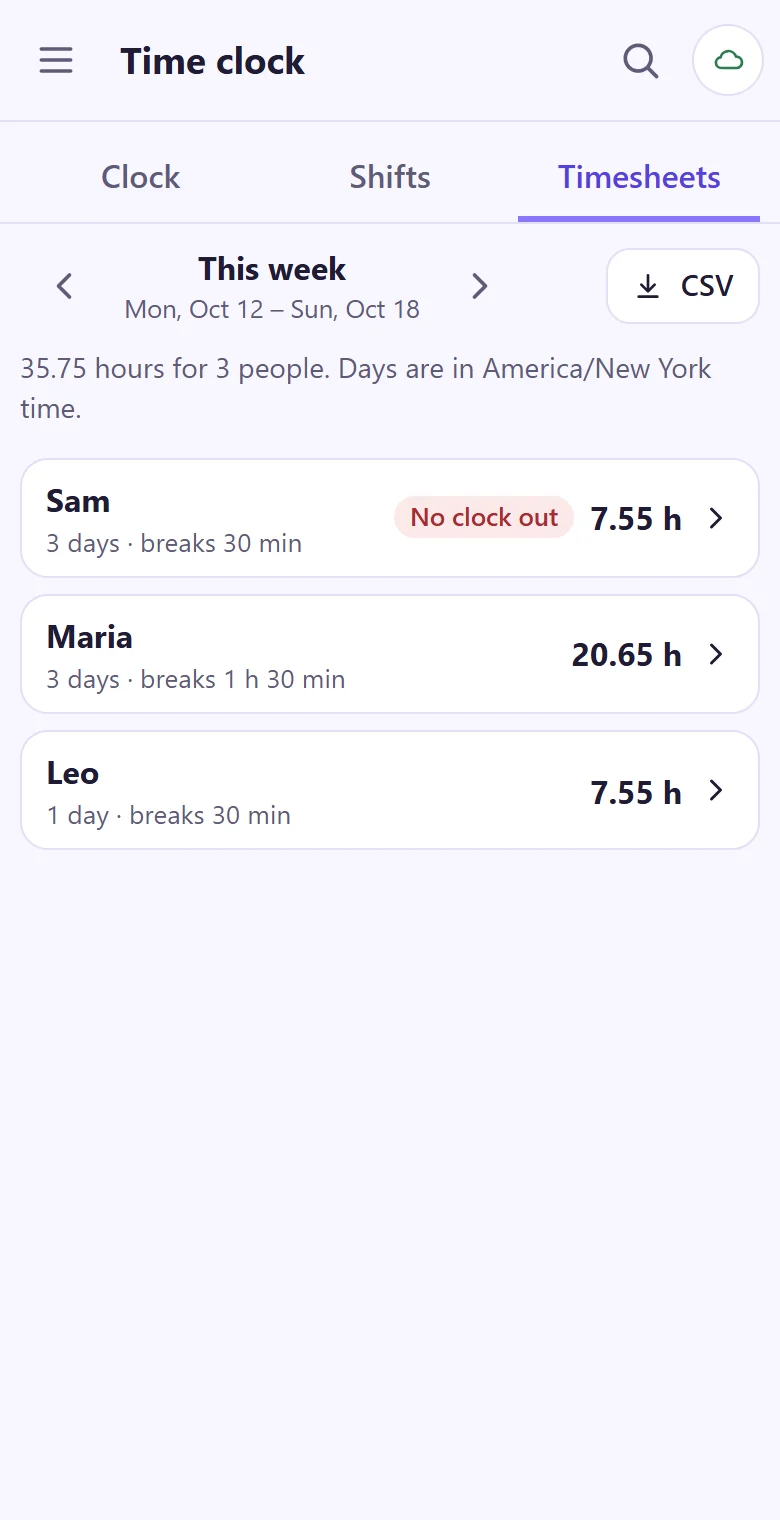
In tick-tock-done the time clock gives each person's hours for the night or the week, and the timesheet exports them as a CSV for the split. The app does not hold tips or pay, so the split itself sits in a spreadsheet or on the posted sheet, with a photo of it on the night's closing checklist if you want it in one place.
A time clock on each phone, a week's shift plan and timesheets you can export, for restaurant crews.
See it for restaurantsWhat this piece does not cover
It is not legal advice. It summarizes the FLSA tip rules and DOL's state table as we read them in October 2026; state and city rules (and union contracts) can be stricter.
Service charges are not tips: a mandatory 18% charge on a large party belongs to the employer unless state law says otherwise (some states require disclosure or pass-through).
Tip credit states with special rules (New York's food service rates by region, Hawaii's $7.00 test, Michigan's phased increase to 2031) need their own reading.
The points and the night's figures are examples, not norms; we found no reliable survey of how US restaurants split pools by role.
The $1,409 penalty is the 2025 adjustment; DOL updates it each January, so the 2026 figure may be slightly higher.
Sources
US Department of Labor, Fact Sheet #15: Tipped employees under the FLSA (tip pools, managers, card fees, tip credit notice). DOL
US Department of Labor, Minimum wages for tipped employees, rates effective July 1, 2026. DOL
29 CFR 531.50 to 531.60 (tips, tip pooling, managers and supervisors). eCFR Part 531
29 CFR 579.1 (civil money penalty for keeping tips: $1,409 per violation, 2025). Cornell LII
Federal Register, January 10, 2025: Federal Civil Penalties Inflation Adjustment Act annual adjustments for 2025. Federal Register
Littler, "Fifth Circuit Vacates DOL's 80/20/30 Rule for Tipped Employees", August 2024. littler.com
29 USC 203(m) and 216(b) (tips; liquidated damages). Cornell LII