In 1982 a contractor on a Veterans Administration job asked for 43 extra days for bad weather, to get out of the liquidated damages for finishing late. It had no daily job logs. It offered weather records from a station 75 miles away instead. The board turned the claim down: without contemporaneous daily logs, nothing showed what the weather was on the site or what it did to the work (Lucerne Construction Corp., VABCA No. 1494).
Forty years on, the pattern is the same. Delay claims, weather days, change orders and back charges are argued months after the fact, and the side with a written record from the day it happened usually wins. This piece is about that record: what goes into a construction daily log, how federal and state jobs define it, which contract clocks it feeds, and a template a foreman can fill in at the gate in about five minutes. It is written for small contractors and site leads in the US, as of October 2026; it is not legal advice.
What the strictest daily reports ask for
Private contracts rarely spell out a daily report. Federal and state jobs do, and their forms are a good checklist for anyone. The Unified Facilities Guide Specification used on Army Corps, Navy and Air Force construction, UFGS 01 45 00 (Quality Control, August 2023 edition), asks for two reports "for each day that work is performed": a production report signed by the superintendent and a quality control report signed by the QC manager. Three rules in it are worth copying on any job:
Account for every calendar day for the life of the contract, including days with no work (at least one report for every 7 days without work).
Fill every space. "Use N/A if nothing can be reported", so a blank can't later be read as "we forgot".
Hand it in by 10:00 a.m. the next working day. A report written a week later is a memory, not a record.
The minimum contents under UFGS 01 45 00 sections 1.12.2 and 1.12.3: contractor and subcontractor names and areas; equipment with hours worked, idle or down for repair; work performed with its location and who did it; inspections; tests and results; materials received and how they were stored; submittals reviewed; safety checks; instructions given or received; trades on site, number of people, weather and delays. The remarks also record visitors, conflicts in the drawings, field changes and meetings. The companion scheduling spec (UFGS 01 32 01.00 10) ties the two together: actual start and finish dates in the schedule must match the dates in the daily reports, or the schedule update is rejected.
State highway departments are just as strict. New Jersey's DOT construction manual wants "an entry for every calendar day, regardless of whether the Contractor is working or not", with the reason for no work or slow progress. Washington's inspector's daily report (form 422-004) records the weather morning and afternoon and a reason on any day with no work.
The eleven lines of a daily log
Boiled down for a small general contractor or trade crew, a day's log has eleven lines. Each has a reason, and each is something a claim or a dispute has turned on.
1. Date, job, who wrote it. One log per job per calendar day, signed or named.
2. Weather, morning and afternoon. Temperature, rain or snow, wind, ground conditions, and whether the weather stopped or slowed work: which activity, from when to when.
3. Crew on site. Each company and trade, the number of people and their hours. Your own crew by name if you can; your time clock already has it.
4. Equipment. What was on site and its hours: working, idle, or down for repair. Idle equipment on a stopped job is a cost you can claim only if it was written down.
5. Work done. By area and activity, in the words of the schedule ("Level 2 east, hung drywall, grid lines C to F").
6. Deliveries. What came, how much, its condition, where it was stored, and what was late or short.
7. Inspections and tests. Who inspected what, the result, and any re-inspection called for.
8. Visitors. Owner, architect, engineer, inspectors, utility crews, with times.
9. Instructions and changes. Who told you what, and when: a verbal direction to move a wall or work around a missing detail is the start of a change order.
10. Delays and problems. Start time, end time, cause, which work it held up, who was told. One line per delay, not one line per week.
11. Safety and photos. Incidents, first aid, near misses, toolbox talks; and the photos taken today, by area.
Write what you saw, with times and numbers. "Rain, lost the morning" loses arguments that "0.4 in. rain 6:00 to 10:30, excavation stopped, 4 laborers and the excavator idle 4 hours" wins.
Weather days: why the log needs numbers
Every standard contract gives more time for weather, but only for weather that was abnormal and that actually hit the work. The AIA's general conditions (A201-2017, section 15.1.6.2) say a claim for adverse weather "shall be documented by data substantiating that weather conditions were abnormal for the period of time, could not have been reasonably anticipated, and had an adverse effect on the scheduled construction". Federal contracts excuse delay from "unusually severe weather" (FAR 52.249-10), which courts define as weather that is unusual for that place at that time of year (Broome Construction v. United States, 1974).
That is two things to prove, and the log carries the second one. The first, what is normal, comes from NOAA's climate normals for the nearest station (the 1991 to 2020 normals, published in 2021). Many specifications turn them into a table of expected bad days per month. The Tennessee Board of Regents' weather delay section (01 26 20) is a clear example: it counts a day as an adverse weather day if any of these happened and it stopped half or more of the day's scheduled work:
Rain over 0.10 inch.
Cold: not above 32°F by 10:00 a.m.
Wind: sustained over 25 mph.
Snow: more than 1 inch on the ground.
And it sets the days already priced into the contract time:
Jan 12 · Feb 11 · Mar 8 · Apr 7 · May 7 · Jun 6
Jul 7 · Aug 5 · Sep 4 · Oct 5 · Nov 6 · Dec 11
A worked example
Take a job under that spec that is pouring footings in March. The baseline is 8 adverse weather days. The foreman's log shows 13 days in March with rain over 0.10 inch or a hard freeze, and on 11 of them it records that the footing crew stood down for more than half the day; on the other 2 the crew moved to work inside the trailer and kept going. The claim is 11 minus 8 = 3 days, not 13 and not 5. If the contract carries liquidated damages of $750 a day (our example figure), those 3 days are worth $2,250 at the end of the job; without the log they are worth nothing, because the contractor can't show which days stopped which work.
The board decisions say the same. In All-State Construction (ASBCA No. 50513, 2004) the contractor got 54 days of unusually severe winter weather back against the Navy's liquidated damages, on records of what the cold did to the work. In Lucerne, with no logs, it got none.
The notice clocks the log has to feed
Most contracts lose a claim on paper, not on the merits: notice in writing within a set number of days of the event, or of when you first noticed it. The daily log is where that date comes from. The deadlines in the forms small contractors meet most often:
AIA A201-2017, claims: written notice within 21 days after the event, or after you first recognize the condition, whichever is later (section 15.1.3.1), by certified mail or courier with proof of delivery (section 1.6.2).
AIA A201-2017, concealed or unknown conditions: notice before the conditions are disturbed and no later than 14 days after first seeing them (section 3.7.4; it was 21 days in the 2007 edition).
ConsensusDocs 200: written claim notice within 14 days, then the backup within 21 days after the notice (section 8.4).
Federal, changes (FAR 52.243-4): no adjustment for costs incurred more than 20 days before you gave written notice of a change made without a written order; and 30 days to assert your right after a written change order.
Federal, delays and default (FAR 52.249-10): written notice of the causes of a delay within 10 days from its beginning.
Federal, differing site conditions (FAR 52.236-2): written notice promptly, before the conditions are disturbed.
Read the FAR 52.243-4 line twice: it is not a deadline for the claim, it is a look-back on the money. If the superintendent tells the crew to reroute ductwork on the 1st and nobody writes to the contracting officer until the 30th, the costs from the first 10 days are gone. A log line on the 1st ("PM directed reroute of duct at grid 4, verbal, 9:15") plus a same-day email is what starts the clock in your favor.
What makes a log believable
Boards and courts weigh logs written on the day far above anything reconstructed later. Three older decisions, from a digest of construction board cases, show where the line falls:
Missing from the log means it didn't happen. In Norair Engineering (ENG BCA No. 3981, 1980) the contractor claimed rail traffic cost it up to 4.5 hours a day on a subway job, but its daily logs never mentioned it. The board: it is "not credible" that a contractor would lose that much time every day without noting it.
Each delay separately. Where both sides caused delays, the contractor "must segregate and document each individual delay occurrence" (Pittman Construction v. United States, Claims Court, 1983). A weekly summary that says "delays from owner and weather" can't be split later.
Records of part of the work can carry the rest. In Harrison Western/Franki Denys (ENG BCA No. 5577, 1990) the contractor had kept detailed labor records for the first third of a repetitive piece of extra work; the board let it extend them to the remainder.
The same digest notes claims lost for lack of photos (Granite Construction, IBCA No. 1500-8-81, 1982, a differing site condition with no photographs) and for cost records too thin to support anything but a total cost claim, which boards rarely accept.
Photos: date, place, original file
A photo backs a log line only if it can be tied to a day and a place. The federal photo spec (UFGS 01 32 33.00 10, May 2025) asks for the date and time and a geotag in the file's metadata, an index by date, location and direction, and photos of utilities and hidden work before slabs, backfill or cover-up. Keep the original files, uncropped. A phone does the metadata by itself if location is on for the camera; the habit to build is the photo before cover-up, every time, and a log line that says which photos were taken where. More on using pictures as proof: Photo proof on tasks.
How long to keep the logs
Federal contracts: at least 3 years after final payment, and until any appeal, litigation or claim is finally resolved (FAR 52.215-2).
AIA A201-2017: claims can be brought up to 10 years after substantial completion (section 15.1.2), so keep private-job logs at least that long; state statutes of repose differ.
Injuries: the OSHA 300 log and 301 forms are kept 5 years after the year they cover (29 CFR 1904.33); a recordable case is entered within 7 calendar days (1904.29). The daily log's safety line is where those entries start.
Why it pays even without a claim
Most jobs never reach a claim. The log still saves hours. In the PlanGrid and FMI survey Construction Disconnected (2018, 600 respondents, 500 in the US, sponsored by a software vendor), people in construction said they spent about 5.5 hours a week looking for project data and information, almost 5 hours on resolving conflicts and almost 4 on rework, about 35% of their time on what the report calls non-optimal activities. Rework caused by poor project information alone was put at $14.3 billion a year in US labor costs. A daily log that answers "when did the drywall arrive" or "who signed off the rough-in" in one search is the cheapest part of fixing that.
It also makes the end of the job shorter. The punch list goes faster when every inspection and every change is already dated: see Construction punch lists.
Five minutes at the gate: a template
The log gets written when it is short and done at the same moment every day. Two habits make it stick: a weather line at midday (it is easy to forget by evening whether the rain started at 10 or at 1) and the rest at the gate before leaving. Copy this, one per day per job:
Job / date / written by:
Weather AM / PM: temp … °F, rain … in, wind … mph, ground …. Work stopped? which activity, from … to …
Crew: company / trade / people / hours (one line each)
Equipment: item / hours worked / idle / down
Work done: area / activity / % or quantity
Deliveries: what / quantity / condition / stored where / late or short?
Inspections and tests: who / what / result / re-inspection?
Visitors: name / company / time in and out
Instructions and changes: who said / what / time / written notice sent? (date)
Delays: from … to … / cause / work held up / who was told
Safety: incidents / first aid / near misses / toolbox talk topic
Photos: count / areas / anything photographed before cover-up
Fill every line, with N/A where nothing happened. On a day with no work, write one line saying why.
Keeping the log in tick-tock-done
In tick-tock-done a daily checklist starts fresh every morning, so the eleven lines above can be a team checklist named "Daily log" for each job, and none of them gets skipped. Each tick records who ticked it and when, a manager can make a line need a photo (the rain gauge, the delivery ticket, the work before cover-up), and the printed log for the day or the week lists every line with its name, its time and its photo thumbnails. The figures and the who-said-what go as updates on the job's task, which are dated and named too. The crew's hours come from the time clock each person uses on their own phone, so the crew line matches the timesheet.
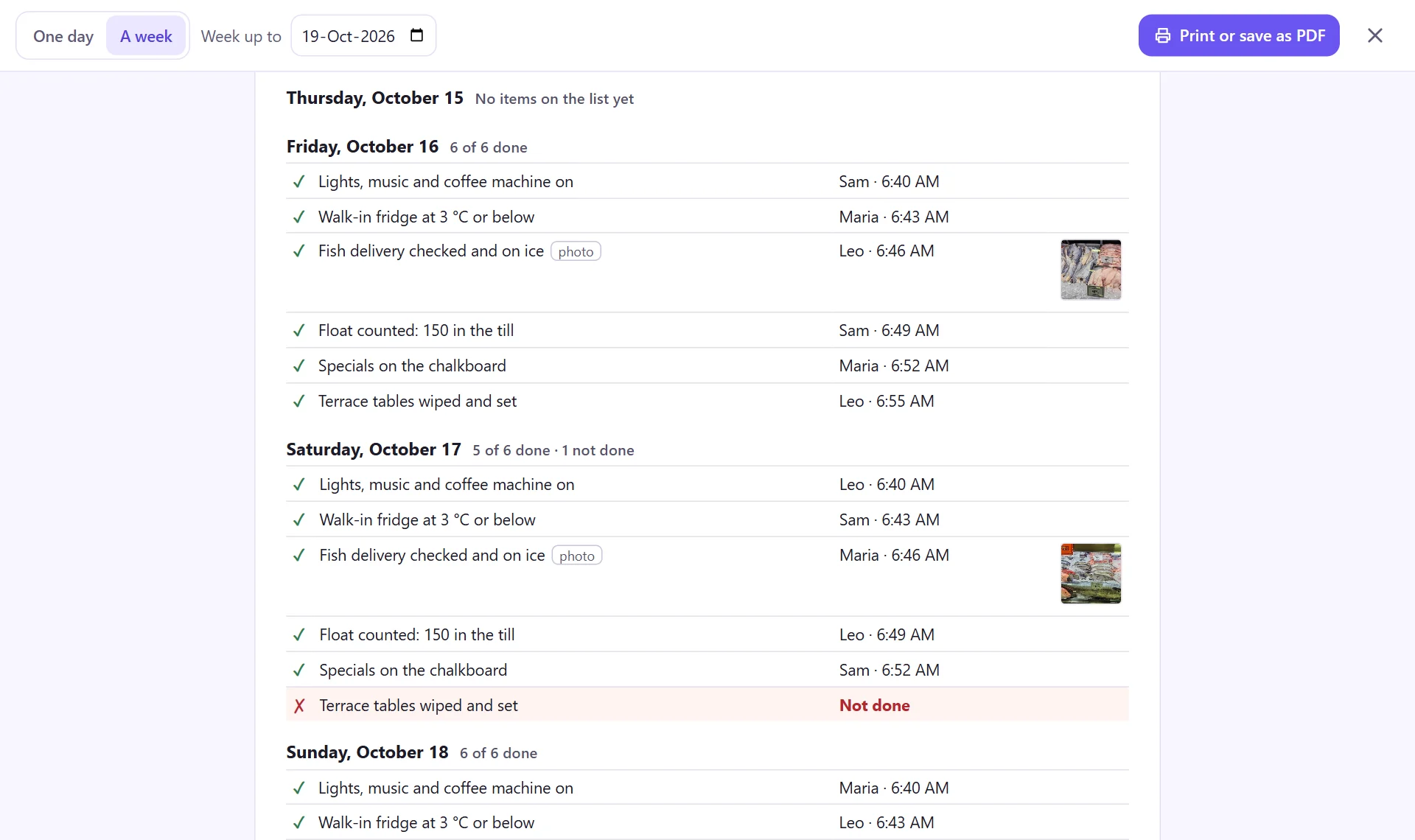
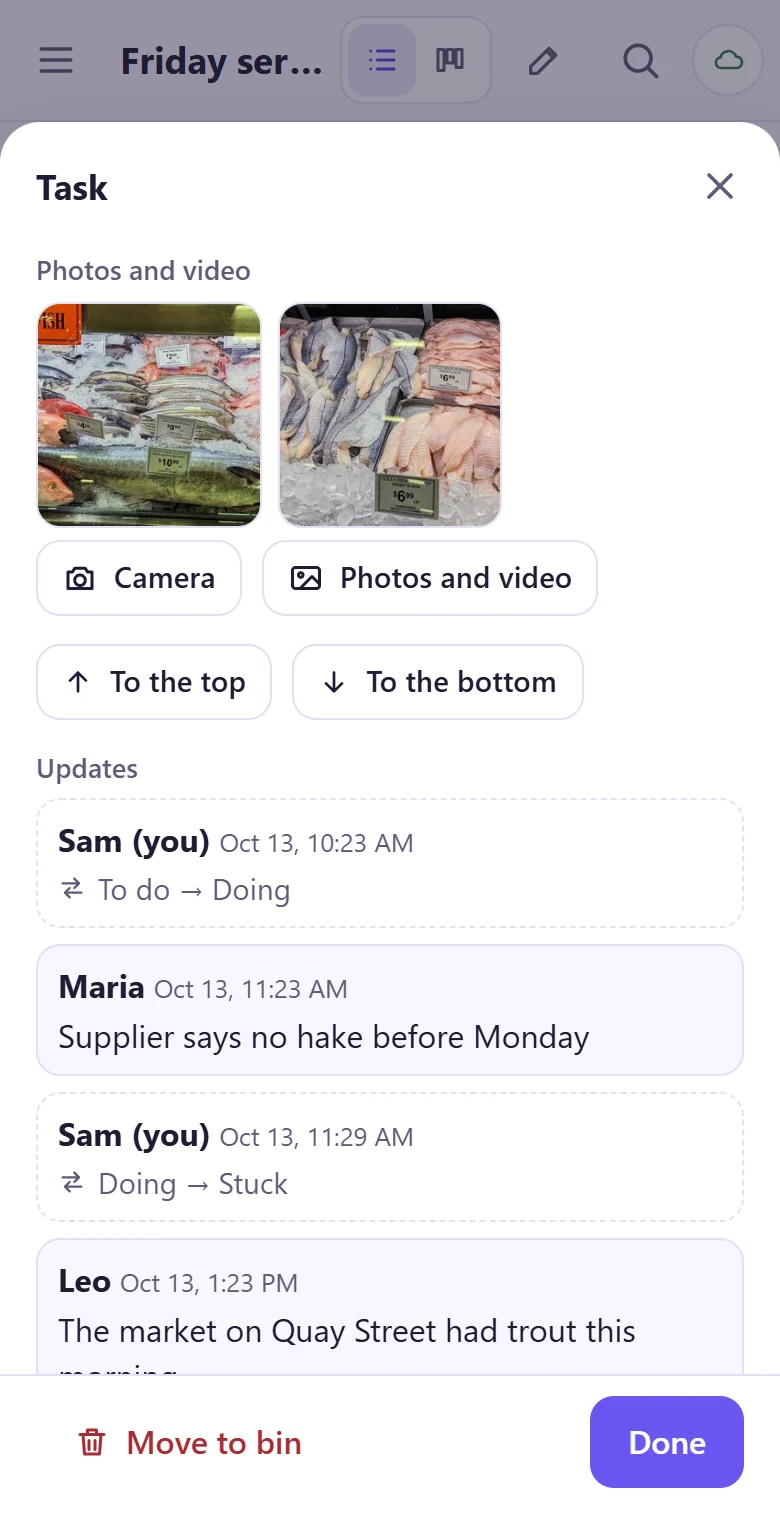
What it does not do: it does not pull weather data or fill in the weather line for you, and it is not a claims system. It keeps the day's record in one place, dated and named, which is the part that is usually missing.
A daily log checklist for each job, with photos, names and times on every line, and the crew's hours from the time clock.
See it for constructionWhat this piece does not show
It is not legal advice. Contract clause numbers are from the AIA A201-2017, ConsensusDocs 200 and current FAR texts as we read them in October 2026; your contract may change them, and state law adds its own rules.
The board decisions are old and summarized. Lucerne, Norair, Pittman, Granite and Harrison Western are 1980s and 1990 decisions taken from a published digest; we did not read every original. They show how records are weighed, not what a court would decide on your facts.
The weather table is one owner's specification (Tennessee Board of Regents, 2015), shown as an example of how the baseline works; your job's baseline comes from your contract and your nearest NOAA station.
The $750 a day is our example figure, not a typical rate.
We found no reliable data on how long a daily report takes to write. The five minutes is our target for the template above, not a measured figure. The Construction Disconnected survey was sponsored by a software vendor.
Sources
UFGS 01 45 00 Quality Control (August 2023, change 3), sections 1.12.1 to 1.12.3. WBDG
UFGS 01 32 01.00 10 Project Schedule, section 3.3.12. WBDG
UFGS 01 32 33.00 10 Photographic Documentation (May 2025). WBDG
New Jersey DOT, Construction Procedures Handbook, section 3B (daily diary). NJDOT
Washington State DOT, Inspector's Daily Report, form 422-004. WSDOT
AIA A201-2017 notice provisions (sections 1.6.2, 3.7.4, 15.1.2, 15.1.3.1), summarized by Amundsen Davis. Article
AIA A201-2017 section 15.1.6.2 and ConsensusDocs 200 weather provisions, Berger Singerman. Article
ConsensusDocs, "Snooze you lose: enforcement of notice and timing provisions" (section 8.4). ConsensusDocs
FAR 52.243-4 Changes. acquisition.gov · FAR 52.249-10 Default (Fixed-Price Construction). acquisition.gov · FAR 52.236-2 Differing Site Conditions. acquisition.gov · FAR 52.215-2 Audit and Records. acquisition.gov
Board decisions on documentation (Lucerne, Norair, Pittman, Granite, Harrison Western), digest of Construction Claims Monthly. Digest
All-State Construction, ASBCA No. 50513 (2004), Trauner Consulting. Article · Broome Construction v. United States (1974), Cohen Seglias. Summary
NOAA NCEI, U.S. Climate Normals 1991 to 2020. NCEI
Tennessee Board of Regents, Section 01 26 20 Weather Delays (July 2015). PDF
29 CFR 1904.29 and 1904.33, OSHA recordkeeping. eCFR
PlanGrid and FMI, Construction Disconnected (2018), reported by Construction Dive. Construction Dive