The prep cook gets in at 6:45 to sharpen knives and fill the line with mise en place, then clocks in at 7:00 when the kitchen manager arrives with the tablet. The site crew meets at the yard at 6:30, loads the trailer, drives to the first job and starts the clock at 7:15. At 11:00 they move to the second job across town. Nobody writes the drive down because "driving isn't work".
Under federal law, all three of those stretches are hours worked. This piece goes through what counts and what doesn't for hourly crews in kitchens, on building sites and in cleaning: setup before the shift, travel during the day, waiting, short breaks and training, with the rule behind each one and the arithmetic of what the missing minutes add up to. It is a plain-language summary of the federal rules as of October 2026, not legal advice; some states, California first, count more.
The rule underneath: suffer or permit
The Fair Labor Standards Act defines "employ" as "to suffer or permit to work". The Labor Department's rules on hours worked are in 29 CFR Part 785, and Fact Sheet #22 sums them up. Three ideas do most of the work:
Work you didn't ask for still counts. "Work not requested but suffered or permitted to be performed is work time that must be paid for by the employer" (Fact Sheet #22; 29 CFR 785.11 to 785.13). If a manager knows the cook comes in early to set up, or could know, the time is paid. The fix is to stop the early work or pay for it, not to have a rule against it that nobody enforces.
The workday starts with the first principal activity. Anything "integral and indispensable" to the job is a principal activity (29 CFR 785.24, and the Supreme Court in Steiner v. Mitchell, 1956). Once the first one starts, everything until the last one ends is the workday, including walking and waiting in between (IBP v. Alvarez, 2005).
Commuting and some before and after steps are not work. The Portal-to-Portal Act of 1947 leaves out the ordinary trip from home to work and activities that are only "preliminary" or "postliminary". The Supreme Court held in Integrity Staffing Solutions v. Busk (2014) that a post-shift security screening was not paid, because the job was filling orders, not passing a screening.
The clock should start where the work starts. If the first real task happens before the punch, the punch is in the wrong place.
Activity by activity: what is paid
This is the federal position for an hourly (non-exempt) worker, with the rule for each line. Where a line says "depends", the test that decides it is in the section below.
Setting up a station, warming up equipment, loading the truck at the shop: paid. Integral to the job (29 CFR 785.24: the lathe operator who oils and cleans the machine at the start of the day).
Changing into a uniform at home: not paid. Changing into protective gear the job requires, on site: paid when it is integral to the work (785.24; the chemical plant example). A union contract can exclude clothes changing under section 203(o) (Sandifer v. U.S. Steel, 2014).
Waiting in line to punch in: not paid on its own (785.24 calls checking in and out not ordinarily integral). Waiting after the first task has started: paid (Alvarez).
Driving from home to the first site: not paid, ordinary commuting (785.35).
Reporting to the shop or yard to get instructions, tools or the van, then driving to the site: paid from the shop (785.38).
Driving from one job site to the next during the day: paid (785.38; Fact Sheet #22: "travel from job site to job site during the workday, is work time").
Waiting for the client to open the building, for the concrete truck or for the last table to leave: paid. Engaged to wait (785.15).
Sent home until 5 p.m., told when to come back: not paid. Waiting to be engaged: completely relieved and long enough to use (785.16).
On call at the restaurant or on site: paid. On call at home, free to do your own thing: usually not paid (785.17).
Coffee or smoke break of 5 to 20 minutes: paid (785.18).
Meal break of 30 minutes or more, completely off duty: not paid. Eating at the station while watching the oven: paid (785.19).
A required training, meeting or safety talk: paid unless all four tests hold: outside normal hours, truly voluntary, not directly related to the job, no other work done at the same time (785.27).
Answering the manager's texts about tomorrow's order at home: paid when it is work the employer knows about (785.11 to 785.13). Reading the posted schedule: not work.
Waiting: engaged to wait or waiting to be engaged
This is the line kitchens and cleaning crews get wrong most often, and the regulations draw it with two phrases.
Engaged to wait (paid). The time "belongs to and is controlled by the employer" (785.15). The examples in the rule are a messenger waiting for an errand, a factory worker waiting while a machine is fixed, and a repairman waiting for the customer to get the premises ready. A cleaning crew that arrives at 6:00 p.m. and waits until 6:25 for the last office worker to leave is engaged to wait. So is a cook told to stay until the walk-in delivery shows up.
Waiting to be engaged (not paid). The worker is "completely relieved from duty", "definitely told in advance" that they may leave and when to come back, and the time is long enough to use for their own purposes (785.16). The server sent home at 2:30 and told to be back at 5:00 for dinner is waiting to be engaged. The difference is control: who decides what the person can do with that time.
The test is about the facts, not the label. Calling 25 minutes at the loading dock a "break" doesn't make it one if the crew can't leave because the elevator could come at any moment.
Travel during the day: the case that cost $198,275
In October 2021 the Labor Department announced that Leone Electric, an electrical and HVAC contractor in Clifton, New Jersey, paid $198,275 in back wages to 93 workers. The investigators found the company had left the time technicians, construction managers and drivers spent traveling between job sites out of their weekly hours. Counted properly, their weeks went past 40 hours, and the overtime was owed. That is about $2,130 per worker. Similar findings were announced against a Florida electrical contractor in 2020 (driving between work sites not recorded) and a California floor-covering company in 2015.
Overtime is how travel time turns expensive. Most crews already work close to 40 hours on site; the drive between sites is what pushes the week over, and every one of those minutes is owed at time and a half.
What the missing minutes add up to: two worked examples
A kitchen: 15 minutes of setup before the punch
A prep cook paid $18.00 an hour is scheduled 7:00 to 3:30 with a 30-minute unpaid meal break, five days: 40 hours on the clock. She comes in 15 minutes early every day to set up her station before clocking in. The manager knows.
Unpaid time per week: 15 minutes x 5 days = 75 minutes = 1.25 hours.
Rate owed: all of it is past 40 hours, so time and a half: $18.00 x 1.5 = $27.00.
Per week: 1.25 x $27.00 = $33.75.
Per year (50 working weeks): $1,687.50.
Back pay for two years (the FLSA limit for an ordinary violation, 29 U.S.C. 255): $3,375.00.
Plus an equal amount as liquidated damages (29 U.S.C. 216(b)): $6,750.00 for one cook.
Four cooks who all do it: $27,000. If the violation is found willful, the look-back is three years: $10,125 per cook.
A site crew: two moves a day between jobs
A laborer paid $24.00 an hour works 8 hours a day on site, five days. Each day the crew moves twice between jobs, about 25 minutes each move, and the clock is paused for the drive.
Unpaid time per week: 2 x 25 minutes x 5 days = 250 minutes = 4.17 hours.
Rate owed: past 40 hours, so $24.00 x 1.5 = $36.00.
Per week: 4.17 x $36.00 = $150.00.
Per year (48 working weeks): $7,200 per laborer; $21,600 for a crew of three, before liquidated damages.
The fix costs the same as the claim: paying it as you go costs exactly the $150 a week. What it saves is the doubling, the lawyer and the investigation.
For scale: the Wage and Hour Division recovered about $259 million in back wages for almost 177,000 workers in fiscal year 2025, about $1,465 per worker, the most since 2019. Food service alone accounted for 4,088 resolved violations and over $42 million (Labor Department figures, January 8, 2026, as reported by HR Dive).
Where the clock-in has to be
If the workday starts with the first principal activity, the punch belongs right there. In practice:
Kitchen: the clock-in happens before the apron goes on and the station gets set, not when the manager arrives with the tablet. If people arrive early and start working, either let them punch or tell them to wait outside the kitchen until their start time, and mean it.
Building crews: if the crew meets at the yard to load tools or get the day's plan, the clock starts at the yard. If people drive straight from home to the site, it starts on site. The drive between sites stays on the clock: no clock-out in the truck.
Cleaning crews: the clock starts on arrival at the building if the crew has to wait there to be let in. Driving between two buildings in one evening is travel between job sites.
Rounding is a separate question. Once the punch is in the right place, rounding it to the nearest five, six or fifteen minutes is allowed only if it doesn't shortchange people over time; see Time clock rounding: the 7-minute rule. Which breaks can be unpaid is in Meal and rest breaks, state by state.
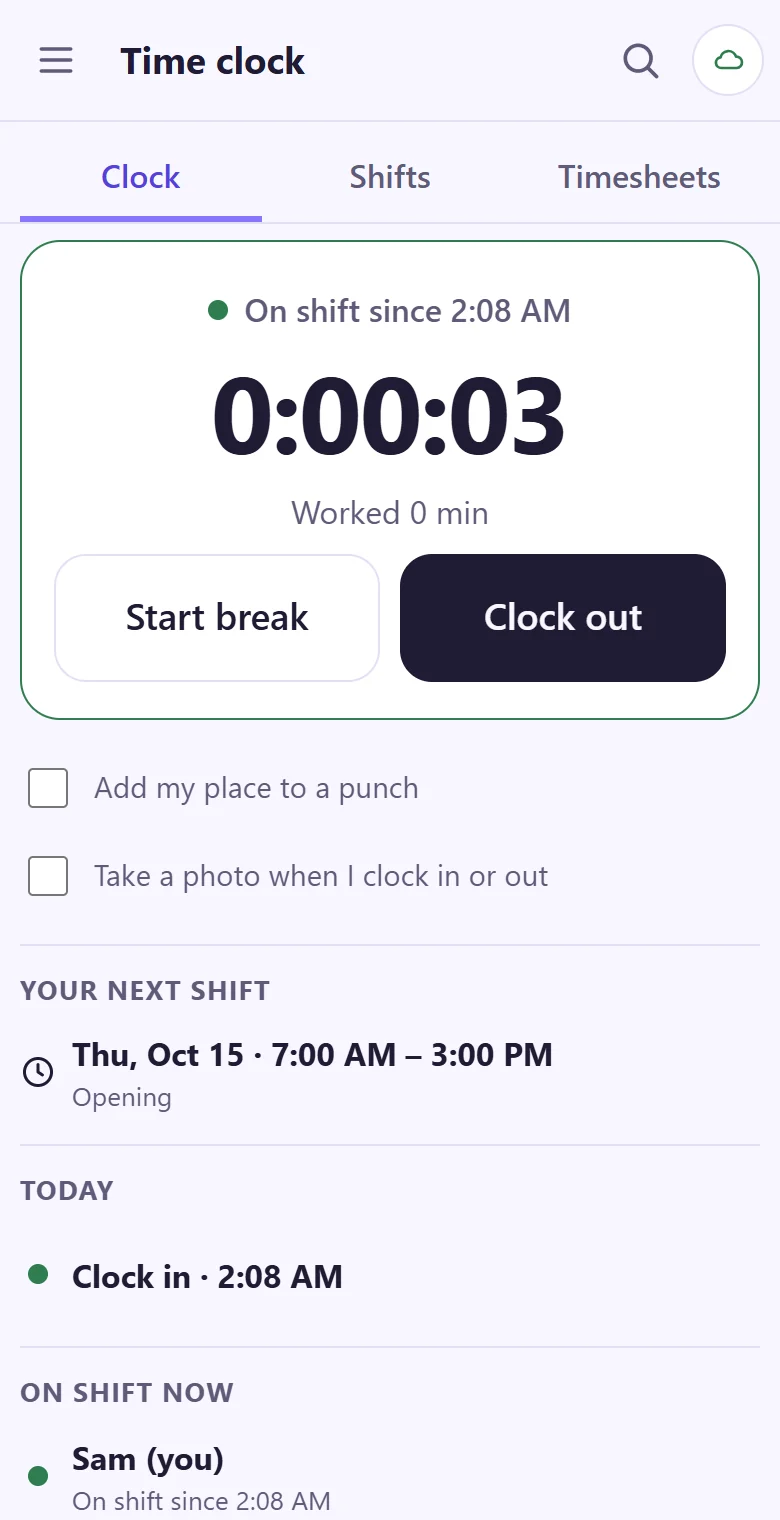
In tick-tock-done, each person clocks in from their own phone, so the punch can happen where the work starts: at the station, at the yard or at the building door. A break is its own punch, the day's line shows time worked and breaks, and a manager can add a forgotten punch with a reason while the original stays on the record. The weekly timesheet shows who is at or past 40 hours before payroll, and it's the easiest place to spot a crew whose drives between jobs never show up.
To check one of your own days, list what the crew did with the minutes in our hours worked checker: it marks each activity paid or not with the rule above, shows the paid time that is off the clock and works out what it adds up to over a week, overtime included.
Clock in from any phone where the work starts, with breaks, fixes that keep the original punch, and weekly timesheets.
See it for constructionStates that count more
Federal law is the floor. A few states count time the FLSA does not:
California counts time the employer controls, even when no work is done. In Morillion v. Royal Packing (2000), farm workers who had to ride the company bus from a meeting point to the fields were owed for the ride. The California Supreme Court also refused to adopt the federal "de minimis" excuse for small amounts of regularly unpaid time (Troester v. Starbucks, 2018: a few minutes of closing tasks after clocking out each night).
Other states have their own rules on reporting time (paying a minimum when someone is sent home early), split shifts and on-call pay; this piece does not list them. Check your state labor department's page before setting a policy.
What this summary does not cover
It is not legal advice. It summarizes the federal rules (29 CFR Part 785, Fact Sheet #22, last revised July 2008) and a few court decisions as of October 2026.
Exempt and salaried staff follow different rules; this is about hourly, non-exempt crews.
Overnight and out-of-town travel, sleeping time on 24-hour shifts and union contracts with their own terms are left out or only touched on.
The worked examples are ours, with round numbers; actual claims add interest, legal fees and sometimes state penalties, and the outcome of any one case depends on its facts.
We did not find data on how common off-the-clock setup is in small kitchens or crews; the enforcement figures are totals across all violations, not just hours-worked ones.
Sources
U.S. Department of Labor, Wage and Hour Division, Fact Sheet #22: Hours worked under the Fair Labor Standards Act (revised July 2008). Fact sheet
29 CFR Part 785, Hours worked, sections 785.11 to 785.13, 785.15 to 785.19, 785.24, 785.27, 785.35, 785.38. 785.38 text · 785.15 · 785.16 · 785.24
U.S. Department of Labor news release, Leone Electric back wages for 93 workers (October 7, 2021). Release · NJBIZ coverage. Article
HR Dive, DOL wage and hour violations, 2025 data (January 8, 2026). Article
U.S. Department of Labor news release on fiscal year 2025 enforcement (January 8, 2026). Release
Integrity Staffing Solutions, Inc. v. Busk, 574 U.S. 27 (2014). Opinion
IBP, Inc. v. Alvarez, 546 U.S. 21 (2005). Opinion
Sandifer v. United States Steel Corp., 571 U.S. 220 (2014). Opinion
Morillion v. Royal Packing Co., 22 Cal.4th 575 (2000), and Troester v. Starbucks Corp., 5 Cal.5th 829 (2018). Morillion · Troester, summary by Farella Braun + Martel
29 U.S.C. 255 (two- and three-year limits) and 216(b) (liquidated damages). 255 · 216