The sheet is taped inside the office door. Forty lines, a column of boxes for each day of the week, and by Thursday every box has the same neat tick in the same pen. Nobody is lying exactly. The closer did most of it, most nights, and filled in the sheet on the way out. Then one morning the walk-in is at 47°F, and the sheet says it was checked.
A checklist that is ticked is not the same as a checklist that is done. This piece is about closing that gap: how to write opening and closing lists that a tired crew will really work through, and that give you something to show when it matters.
What two hospital studies say about ticked boxes
The best evidence on checklists comes from operating theatres. In 2009 a team led by Alex Haynes tested a 19-item surgical checklist from the World Health Organization in eight hospitals around the world. Complications fell from 11.0% to 7.0% of operations and deaths from 1.5% to 0.8%. The staff in that study had chosen to take part and were trained and watched.
Then the province of Ontario made the same kind of checklist mandatory. David Urbach and colleagues (2014) compared more than 100,000 operations in 101 hospitals in the three months before with a similar number in the three months after. Hospitals reported near-total compliance. Deaths went from 0.71% to 0.65%, a difference too small to tell from chance, and complications did not move. A commentary in the same journal gave the likely reason: in many theatres the checklist was being ticked, not used.
The same paper form produced a large effect in one setting and nothing measurable in another. The difference was whether people did the checks or recorded that they had. A kitchen is not an operating theatre, and nobody has run these trials in restaurants, but the failure in your office door sheet is the Ontario one.
Six rules for a checklist that gets done
1. One list per station, with one owner
A single forty-line list belongs to everybody, which means the closer does it all or nobody does. Split it by station: line, prep and walk-in, dish, front of house, bar, manager. Each list has one owner for the shift, named by role on the rota ("closing line cook"), so it still works when the person changes. Six short lists get done. One long one gets ticked.
2. Keep each list short enough to do in one go
Atul Gawande's book on checklists passes on the advice of Boeing's checklist writer: keep a list to somewhere between five and nine items, on the things most likely to be missed and most costly when they are. Nobody needs a line that says "turn on lights". Keep the lines that have gone wrong before, and the ones that would hurt someone or close you down.
3. Ask for a number or a photo, not a tick
"Walk-in checked" can be ticked from the car park. "Walk-in: __ °F" cannot; you have to open the door and read it. Wherever a line can be answered with a reading, ask for the reading. Where it can't, ask for a photo: the clean flat-top, the locked back door, the stocked hand sink. A photo takes five seconds, carries its own time, and ends the morning argument about who left what.
4. Put the list where the work is, in the order of the walk
Write each list in the order a person walks the station, so they never double back. And have it at the station: on the phone in their pocket or on the wall by the pass, not in the office.
5. A line that fails becomes a task with a name on it
The reach-in is at 44°F. Writing "44" is not the end of it. Somebody has to move the food, call the engineer and check again in an hour. A failed line should turn at once into a task with an owner and a time, on the list the next shift will see. Otherwise the checklist records problems without fixing them. (How to pass open items to the next shift is covered in Shift handovers that don't drop tasks.)
6. The close sets up the open, and the opener checks the closer
A good close is the first half of tomorrow's open. The opener's list starts by confirming the closer's: was the food covered, labelled and dated, is the floor dry, is the walk-in at temperature. Two people who know the other will look do better work than one person and a sheet. The manager reads yesterday's lists every day, and says so.
If a line can be ticked from the car park, rewrite it so it can't.
What an inspector looks at first
Rules differ by state and country, so check your own health department's code. In the United States most are based on the FDA Food Code, and it shapes how an inspection starts. The inspector asks for the person in charge. That person has to be there during all hours of operation, has to be able to answer questions about food safety, and is responsible for making sure staff are routinely checking hot and cold holding temperatures. An opening list with real numbers on it is the easiest way to show that.
The FDA has also sent its own specialists into hundreds of randomly chosen restaurants to see what goes wrong most. In the 2017-2018 round, the practices most often out of line were cold holding, employee handwashing and cooling food properly. Cooking temperatures were the best controlled. Restaurants with a well-developed food safety management system, which in practice means written procedures, training and checks, had less than half as many problems as those without one.
So build your lists around the Food Code numbers those three depend on:
Cold holding: 41°F (5°C) or below.
Hot holding: 135°F (57°C) or above.
Cooling cooked food: from 135°F to 70°F (21°C) within 2 hours, and down to 41°F within 6 hours in total.
Date marking: ready-to-eat food that needs refrigeration and is kept more than 24 hours is marked, and used or thrown out within 7 days.
Hand sinks: soap, paper towels and nothing stored in the bowl, at every one.
Opening checklist, by station
Start from this and cut it to fit. The words in brackets are the proof to ask for.
To build your own lists from these, use the opening and closing checklist builder: pick the stations, keep or cut the starting lines, mark each line as a tick, a reading or a photo, and print one page per station or copy the lists as text. It runs in your browser.
Manager or person in charge
Read last night's closing lists and the handover note; open items have an owner today.
Staff in and fit to work: nobody with vomiting or diarrhoea handles food (initials).
Deliveries due today, and who receives them and takes temperatures.
Float counted and tills ready (amount).
Today's specials, 86'd items and allergens told to front of house.
Prep and walk-in
Walk-in cooler and freezer temperatures (numbers).
Every reach-in and prep fridge on the line (numbers).
Date labels: anything at or past its day is thrown out (count binned).
Raw meat and fish below ready-to-eat food on the shelves (photo).
Prep list written from pars and what is left from yesterday.
Line
Hand sink stocked: soap, towels, clear bowl (photo).
Sanitiser buckets made and tested with a strip (reading).
Probe thermometer cleaned and checked in ice water: 32°F / 0°C (number).
Equipment on and up to temperature; hot wells at 135°F or above before food goes in (number).
Boards, knives and cloths set by colour or task.
Dish
Machine filled and run once; wash and rinse readings to the plate on the machine (numbers).
Chemicals connected and not empty.
Three-compartment sink set: wash, rinse, sanitise (strip reading).
Front of house and bar
Toilets clean and stocked (photo).
Tables, floors and entrance; outside lights and signs.
Bar fridges at temperature (numbers); ice well cleaned, scoop stored out of the ice.
Card machines and the ordering screens working.
Closing checklist, by station
Line
Hot food being kept: into shallow pans and cooling, start time and temperature written down (time, number).
Everything else covered, labelled and dated, into the walk-in.
Fryers off, oil filtered or changed; grill, flat-top and hoods cleaned (photo).
Gas off at the appliances; pilots as your equipment requires.
Sanitiser buckets emptied, cloths to laundry.
Prep and walk-in
Cooling food checked at 2 hours: 70°F or below (number). If not, reheat or throw out, and say which.
Walk-in and freezer temperatures and doors shut (numbers).
Nothing stored on the floor; raw below ready-to-eat.
Order for tomorrow sent, or passed to the manager.
Dish
Machine drained, filters and arms cleaned, door left open.
Sinks emptied and cleaned; floor drains cleared.
Bins out, liners in, bin area closed.
Front of house and bar
Tables and chairs wiped, floor swept and mopped.
Bar: garnishes dated or binned, soda guns and drip trays cleaned, fridges shut.
Toilets checked and locked.
Manager or person in charge
Tills counted, cash in the safe (amount).
The day's temperature readings looked at; any failed line has a task and an owner.
Handover note for the opener: what is open, what is broken, what is short.
Back door, walk-in and front door locked; alarm set (photo of the back door).
Setting it up on a phone
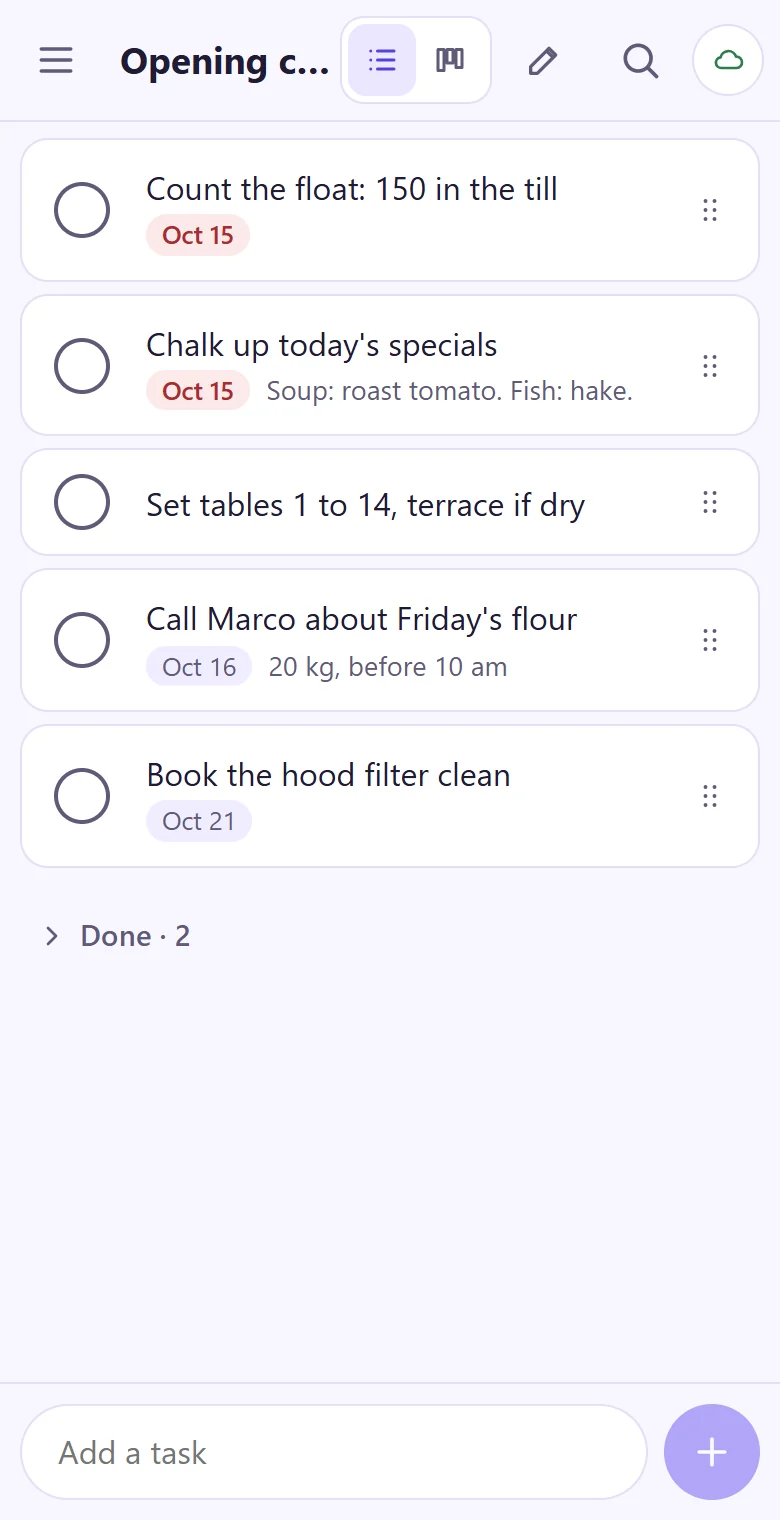
In a team in tick-tock-done, make one list per station for the open and one for the close, with the lines in walking order. Put the proof in the line itself ("Walk-in °F:") so the reading goes in the note, and add a photo to the job where a picture is the proof. A failed line gets a comment and a new task with a name on it.
Whatever you use, paper included, run it for two weeks and then cut. Any line that never fails and would not hurt anyone moves to a weekly list. What is left is the list people will really do.
What the research does not show
No trial has tested checklists in restaurants. The surgical studies show that the same checklist can work or do nothing depending on how it is used; applying that to kitchens is a reasoned guess.
The FDA study counts practices, not illness. It shows which rules restaurants most often miss, and that written systems go with fewer misses. It can't prove the systems cause the difference; well-run restaurants may simply have both.
The numbers above are the US model code. Your state, county or country may set different limits. Your inspector's version is the one that counts.
Photos and readings can be faked too. They make it harder and more obvious, which is the point, but the daily look by a manager is what keeps a list honest.
Make one short list per station, with a reading or a photo on every line that can have one.
Open tick-tock-doneRelated: A task board for a five-person team and Shift handovers that don't drop tasks.
Sources
Haynes, A. et al. (2009). A surgical safety checklist to reduce morbidity and mortality in a global population. New England Journal of Medicine 360(5), 491-499. doi:10.1056/NEJMsa0810119
Urbach, D. et al. (2014). Introduction of surgical safety checklists in Ontario, Canada. New England Journal of Medicine 370(11), 1029-1038. doi:10.1056/NEJMsa1308261
Leape, L. (2014). The checklist conundrum. New England Journal of Medicine 370(11), 1063-1064.
Gawande, A. (2009). The Checklist Manifesto. Metropolitan Books.
US Food and Drug Administration. Food Code 2022: 2-101.11 and 2-103.11 (person in charge), 3-501.14 (cooling), 3-501.16 (hot and cold holding), 3-501.17 (date marking).
US Food and Drug Administration. Retail Food Risk Factor Study, report on fast food and full-service restaurants, 2017-2018. Summary: Food Poisoning Bulletin, June 2023
Cover: clipart from Openclipart, released under CC0 (public domain).