Friday dinner, a six-cook line, doors at 5. The prep cook came in at 11 and it is now 4:40. Has she had a meal break? Does she have to? If she eats a sandwich standing at her station with one eye on the oven, does that count? And the dishwasher who stepped out for ten minutes at 3: should that come off his hours?
Owners of restaurants and building crews ask these questions every week, and the honest answer is that it depends on the state. This piece walks through what federal law says (less than most people think), which states require a meal break or paid rest breaks for adults and what their numbers are, the extra rules for workers under 18, and how to record breaks on a time clock so the hours you pay match the law. It is a summary written in October 2026, not legal advice; the last section says where to check.
What federal law says: no break rule, but a pay rule
The Fair Labor Standards Act does not require employers to give any meal or rest break to adult workers. What it does decide is which breaks are paid:
Short rest breaks are hours worked. The Labor Department's rule (29 CFR 785.18) says rest periods of about 5 to 20 minutes are common in industry and must be counted as hours worked. If you allow a ten-minute coffee break, it is paid time, even though no federal law made you allow it. Docking a crew member ten minutes for it is a wage violation.
Real meal breaks can be unpaid. A bona fide meal period, typically 30 minutes or more, need not be paid (29 CFR 785.19), but only if the worker is completely relieved from duty. A cook who eats at the station and keeps an eye on the oven, a site hand told to stay by the gate for deliveries, or a cashier eating behind the counter is still working, and that time is paid.
So under federal law alone, the rule for a crew is simple: you don't have to give breaks, a short break is paid, and an unpaid meal break means the person is truly off. Most states add nothing to that. About twenty add more.
An unpaid meal break only counts if the person is really off. Eating at the station is still working.
States that require a meal break for adults
The Labor Department keeps a table of state meal rules (last revised January 2023; Illinois changed its rule that same month, included below). These are the ones that matter most for restaurant and construction crews. Each rule has its own exemptions, often for union contracts, short shifts or particular trades, so read the state's own page for yours.
California: 30 minutes, off duty, before the end of the fifth hour; a second 30 minutes before the end of the tenth. The first can be waived by mutual consent on a shift of 6 hours or less; the second only if the shift is 12 hours or less and the first was not waived. A missed or late meal break costs one extra hour of pay at the regular rate for that day.
Washington: 30 minutes, given between the second and fifth hour, for any shift over 5 hours; paid if the worker has to stay on site or be on call.
Oregon: 30 minutes, fully relieved, on a shift of 6 hours or more, timed by shift length.
Colorado: 30 minutes on a shift over 5 hours; when the work makes a real break impossible, the person must be allowed to eat on duty and is paid for it.
Nevada: 30 minutes on a shift of 8 continuous hours (employers with two or more people at the site).
Illinois: 20 minutes, starting no later than the fifth hour, for a shift of 7.5 hours or more, plus another 20 minutes for each further 4.5 hours (since January 2023, the One Day Rest in Seven Act). Restroom breaks do not count toward it.
New York: 30 minutes for a shift over 6 hours that spans the midday hours (a one-hour noon period in factories), an extra 20 minutes between 5 and 7 p.m. for a shift that started before 11 a.m. and runs past 7, and a midway break for long shifts that start overnight.
Massachusetts: 30 minutes for every 6 hours, free of duties and free to leave.
Connecticut and Delaware: 30 minutes for a shift of 7.5 hours or more, somewhere after the first two hours and before the last two.
Kentucky: a reasonable meal period, usually 30 minutes, between the third and fifth hour.
Tennessee: 30 minutes unpaid on a scheduled shift of 6 hours or more, not in the first hour. Tipped servers may waive it in writing.
Also on the list: Maine (30 minutes after 6 hours, with exceptions for very small crews), Minnesota (enough time to eat on a shift of 8 hours), Nebraska (30 minutes per 8 hours, but only in factories and workshops), New Hampshire (30 minutes after 5 hours, unless eating while working is allowed), North Dakota (30 minutes on shifts over 5 hours when two or more people are on duty), Rhode Island (20 minutes in 6 hours, 30 in 8), West Virginia (20 minutes for 6 hours, where people can't otherwise eat), Vermont ("reasonable opportunities" to eat and use the toilet) and Maryland (retail employers with 50 or more staff only; restaurants are excluded).
Texas, Florida, Georgia, Arizona, Pennsylvania, Ohio, New Jersey and most of the South and Midwest have no meal break rule for adults at all. The federal pay rules above still apply there.
States that require paid rest breaks
Rest breaks are rarer. Only these states require them for most adults, and they are paid:
California, Colorado, Nevada, Oregon, Washington: 10 minutes for every 4 hours worked. California, Colorado, Nevada and Oregon also count the "major fraction" of 4 hours, so a 6-hour shift gets one break and a 7-hour shift gets two. California and Nevada don't require one if the day is under 3.5 hours. Washington adds that nobody works more than three hours without a rest break. California charges one extra hour of pay for each day a rest break is missed, on top of the meal premium.
Kentucky: 10 minutes for every 4 hours, on top of the meal period.
Minnesota: enough time to use the restroom within each 4 hours.
Illinois: two 15-minute breaks, only for hotel room attendants in Cook County.
Workers under 18
Federal child labor rules limit the hours a 14- or 15-year-old can work but set no break. States fill the gap, and several with no adult rule have one for minors. A few examples: Pennsylvania requires a 30-minute meal period for each stretch of five consecutive hours of work for anyone under 18; Michigan says a minor may not work more than five hours without a documented 30-minute break, and the break should show in the shift records; New Jersey has a 30-minute rule for minors too (its threshold changed in a 2022 amendment, so check the current text); New York applies its meal rules to everyone. If you hire high-school students for summer weekends, look up your state's rule for minors separately: it is often stricter than the adult one.
Construction crews: where the rules bend
Building sites get special treatment in a few states, mostly through union contracts. California and Washington both let a collective bargaining agreement in construction set its own meal arrangements; California also drops the "suitable place to eat" requirement for on-site construction but still requires water, soap and towels for washing hands. A non-union crew in those states follows the ordinary rule. And on a site where the crew eats in the truck while a delivery could arrive any minute, the federal "completely relieved" test is the one most often failed: if someone has to watch the gate, that half hour is paid.
Recording breaks on the time clock
Most break disputes are about records, not rules. A few habits keep them clean:
Punch the meal break, not the coffee break. An unpaid meal break should be a break punch: out at 1:02, back at 1:34. A paid ten-minute rest break should stay on the clock, because federal law counts it as worked. Punching it out takes paid minutes off.
Let the punch show the timing. In California, Washington and Illinois the time of the meal break matters as much as its length. A first break punch at 2:15 on a shift that started at 9:00 is late in California, and the record shows it.
Look at the week, not the day. A weekly view of each person's breaks shows the cook who never takes one before the dinner rush long before a claim does.
Fix with a reason, don't edit. If someone forgot to punch back from lunch, add the missing time with a note rather than rewriting the punch. A record that keeps the original and the fix is far stronger than a clean one nobody can explain.
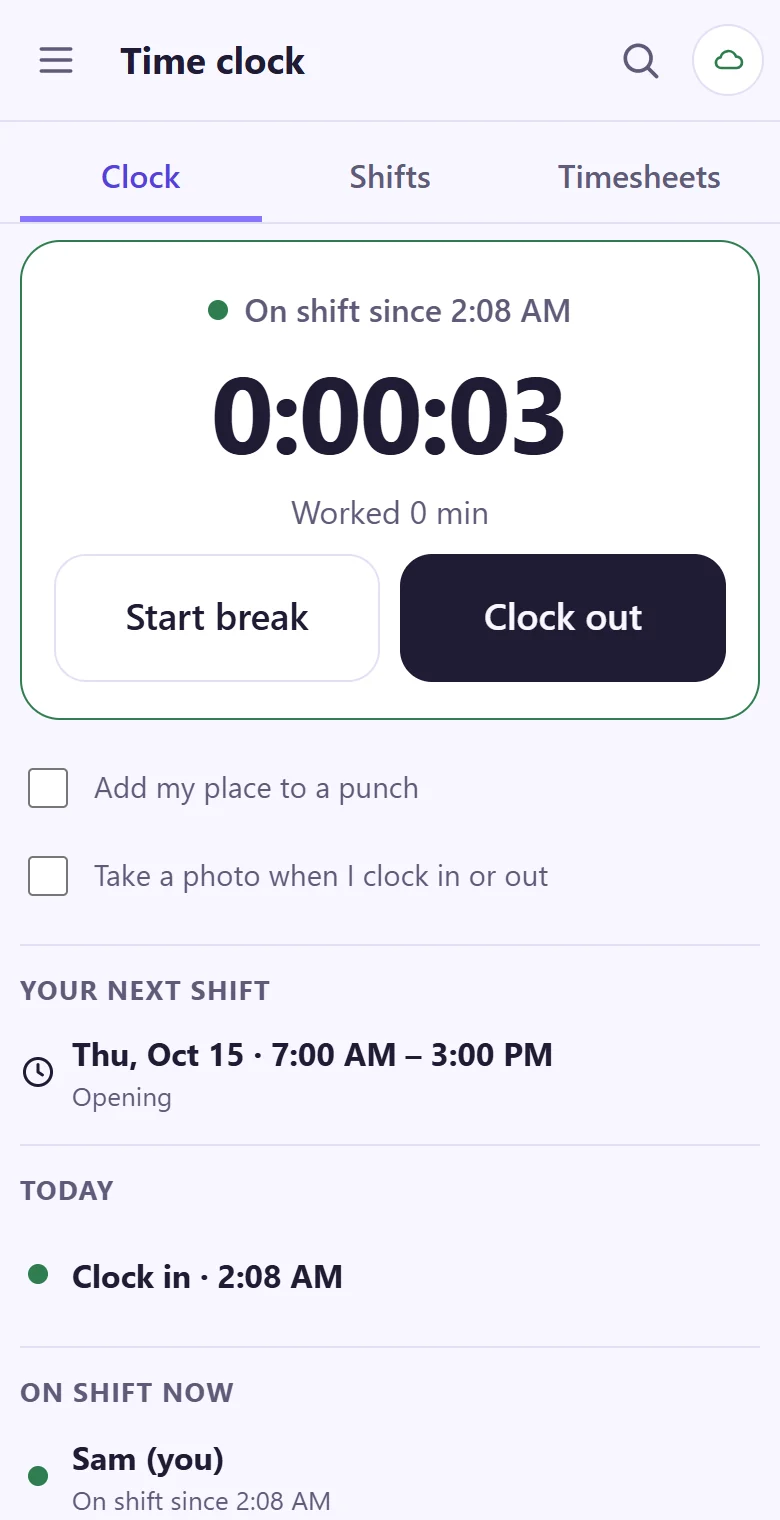
In tick-tock-done the time clock has its own break punch: Start break and back again between clock in and clock out, and the day's line shows the time worked and the breaks. The owner or a manager can add a missing punch with a reason while the original stays on the record, and breaks show per person on the weekly timesheet. If you plan shifts in the same app, it is easy to see which shifts cross your state's five- or six-hour line. For the gap between shifts rather than inside one, see Clopening shifts; for how punch times turn into paid minutes, Time clock rounding.
Clock in, take a break and clock out from any phone, with breaks on the timesheet and fixes that keep the original punch.
See it for restaurantsWhat this summary does not cover
It is not legal advice. The state list is ours, written in October 2026 from the Labor Department's tables (last revised January 2023) and state pages. States change these rules: Illinois did in 2023 and New Jersey in 2022. Check your state labor department's current page before you set a policy.
Exemptions are left out. Almost every state rule has exceptions (union contracts, short shifts, particular industries, managers and other exempt staff), and we name only the ones most relevant to kitchens and sites.
Cities can add more. Some cities have their own rules on scheduling and rest between shifts; this piece covers state rules only.
Breaks and health. We have not looked at research on whether breaks reduce injuries or mistakes on shift; this piece is about what the law requires and how to record it.
Sources
U.S. Department of Labor, Wage and Hour Division, Minimum length of meal period required under state law for adult employees in private sector (revised January 2023). Table
U.S. Department of Labor, Minimum paid rest period requirements under state law for adult employees in private sector. Table
U.S. Department of Labor, Fact Sheet #22: Hours worked under the FLSA. Fact sheet
29 CFR Part 785, sections 785.18 (rest) and 785.19 (meal). Text
California Division of Labor Standards Enforcement, Meal periods FAQ. Page
Illinois Department of Labor, One Day Rest in Seven Act. Page
Pennsylvania Department of Labor and Industry, young workers' rights (May 2025). Release
Michigan Department of Labor and Economic Opportunity, Breaks, meal and rest periods. FAQ
Wilentz, Goldman & Spitzer, Changes in work hours and working papers for New Jersey minors (October 2023). Article