Leo closes the grill on Saturday. The last plates go out at 10:40, the hood filters and the flat-top take until 11:45, and he clocks out at 11:52. He is down to open on Sunday at 7:00. On the rota that looks like a normal pair of shifts. On the clock it is 7 hours and 8 minutes between leaving the kitchen and walking back in.
That pattern has a name, the clopening: a closing shift followed by the next morning's opening shift. This piece is for owners and crew leads who write the rota in restaurants, cafes, shops and on building sites. It covers what the gap actually leaves for sleep, what the research on short rests between shifts found, which US cities and states put a number on it, and rota patterns that keep the close and the open apart.
Do the sleep arithmetic
A gap between shifts is not a night's sleep. Take a 10-hour gap, the number most US rules use, and subtract the parts of it nobody can sleep through:
Commute home and back: 30 minutes each way, so 1 hour.
Winding down after a busy close: about 45 minutes. People rarely fall asleep the minute they get in after a rush.
Getting up, washing, dressing, eating: about 30 minutes.
What is left for sleep: about 7 hours and 45 minutes at best, from a 10-hour gap. From Leo's real 7 hours, it is under 5.
These are round numbers for a typical crew member, not measurements; plug in your own commute. The point is that the gap a rota shows is the most rest anyone could get, and the real figure starts from the clock-out, not the scheduled end. A close that runs 50 minutes over takes those minutes out of the night.
What the studies found
Researchers call a gap of under 11 hours between two shifts a quick return. Most of the evidence comes from hospitals, because hospitals keep good payroll and sick-leave records and their nurses work rotating shifts.
Sick leave. Øystein Vedaa and colleagues at the University of Bergen followed 1,538 nurses and nursing assistants at Haukeland University Hospital in Norway. More than 80% had quick returns during the year, about three a month on average. Quick returns predicted sick leave in the following month, with about 21% higher odds; night shifts did not. The authors' conclusion was blunt: quick returns are rarely needed to staff a ward, so take them out of the schedule.
Injuries. Harald Nielsen and colleagues linked the payroll records of 69,200 Danish hospital employees from 2008 to 2015 to injury records. Compared with the usual 15 to 17 hours between shifts, a gap of 11 hours or less came with about 39% more injuries (incidence rate ratio 1.39), and the extra risk sat mostly in the first two days after the quick return. That is the period when the sleep debt is still being paid off.
Neither study is about kitchens or sites, and both are observational: people who get quick returns may differ from those who don't. But the pattern, short sleep followed by more mistakes and more sick days, is what anyone who has worked a clopening would expect, and in a kitchen or on a site the mistakes involve knives, fryers, ladders and vans.
The rota shows the most rest anyone could get. The real rest starts at the clock-out.
The rules in the US (and the 11-hour benchmark)
There is no federal US rule on rest between shifts for adults. A handful of states and cities set one, mostly as part of fair workweek or secure scheduling laws, and mostly for large chains. As we read the official pages and summaries in October 2026:
Oregon (statewide): retail, hospitality and food service employers with 500 or more employees worldwide. 10 hours of rest after the end of the previous day's shift; a worker can ask for or agree to less, and the hours worked inside those 10 hours are paid at time and a half.
Seattle: retail and food service employers with 500 or more employees worldwide (full-service restaurants also need 40 or more locations). Time and a half for hours worked between a close and an open separated by less than 10 hours.
Chicago: the Fair Workweek Ordinance covers several industries, restaurants among them. Workers may decline a shift that starts less than 10 hours after the last one ended; if they work it, the pay is 1.25 times the regular rate. Rules effective June 1, 2026 say the premium applies even when the worker asked for the schedule.
New York City (fast food): two shifts over two days with less than 11 hours between them need the worker's written consent and a $100 premium on top of the pay for the hours.
Philadelphia: 9 hours of rest between certain shifts, unless the worker consents in writing and gets an extra $40 for each such shift.
European Union: the Working Time Directive gives every worker at least 11 consecutive hours of rest in each 24 hours. It is where the 11-hour line in the research comes from.
Other cities (Los Angeles, San Francisco, Berkeley and Emeryville among them) have their own versions, with different thresholds and coverage. If you run a five-person cafe, you are probably not covered by any of these laws. They are still a useful benchmark: 10 hours is the floor the law sets for big employers, and 11 is what the researchers measured against. This is a summary, not legal advice; check the city's own page before you rely on a number, because these ordinances get amended.
Why clopenings keep happening
Nobody sets out to schedule them. They come from a few ordinary pressures:
The person who can close can also open. Keys, alarm codes, the till float, the safe. If only two people know them, those two get both ends of the day.
A swap made in the group chat. Someone trades their Sunday morning for a Saturday night, and nobody looks at the Friday close next to it.
The worker asks for it. More hours, or a free afternoon. It is a real preference, and some laws let people agree to it. It is still a short night.
Shifts are named, not timed. "Close" and "open" are labels. A "mid" that ends at 10 p.m. followed by a 6 a.m. delivery is a clopening in all but name.
Rota patterns that keep the close and the open apart
Check the gap, not the labels
For each person, look at the end of each shift and the start of the next one, and work out the hours between them. Mark anything under 10 hours; aim for 11 or more. A paper rota hides this because it is laid out by day, and the gap sits across two columns. Do the check after every swap, not only when the rota is first written. Our rest between shifts checker does it for a week of shifts: put in each person's start and end times, pick 10, 11 or 9 hours, and it lists every short rest, shortest first.
Give each person a direction for the week
Put people on early shifts or late shifts for a whole week (or a run of days) and change direction on the day off, not mid-week. If someone has to move from lates to earlies, put the day off between them. On a seven-day operation this means two small groups, openers and closers, swapping every week or two, rather than everyone doing a bit of everything.
Make opening possible without the closer
Most clopenings exist because the opener needs something only the closer has: the keys, the codes, or the knowledge of what was left half done. Give a second person keys and codes, and make the close end with a written handover the opener can read: what is prepped, what ran out, what broke, what is due first thing. Our shift handover checklist covers what that note should hold, and the restaurant opening and closing checklists piece covers the lists themselves.
Start the closer later
If the closer has to be in the next day, bring them in at 10 or 11 instead of 7, and let someone who was off the night before do the open. A late start costs the rota nothing and turns a 7-hour gap into a 10- or 11-hour one.
If someone asks for one, set limits
Once a week at most, never two nights running, never before a day of driving, ladders, heavy lifting or knife-heavy prep, and with the actual clock-out, not the scheduled one, as the start of the rest. In a city with a rule, get the consent in writing and pay the premium.
Doing this in tick-tock-done
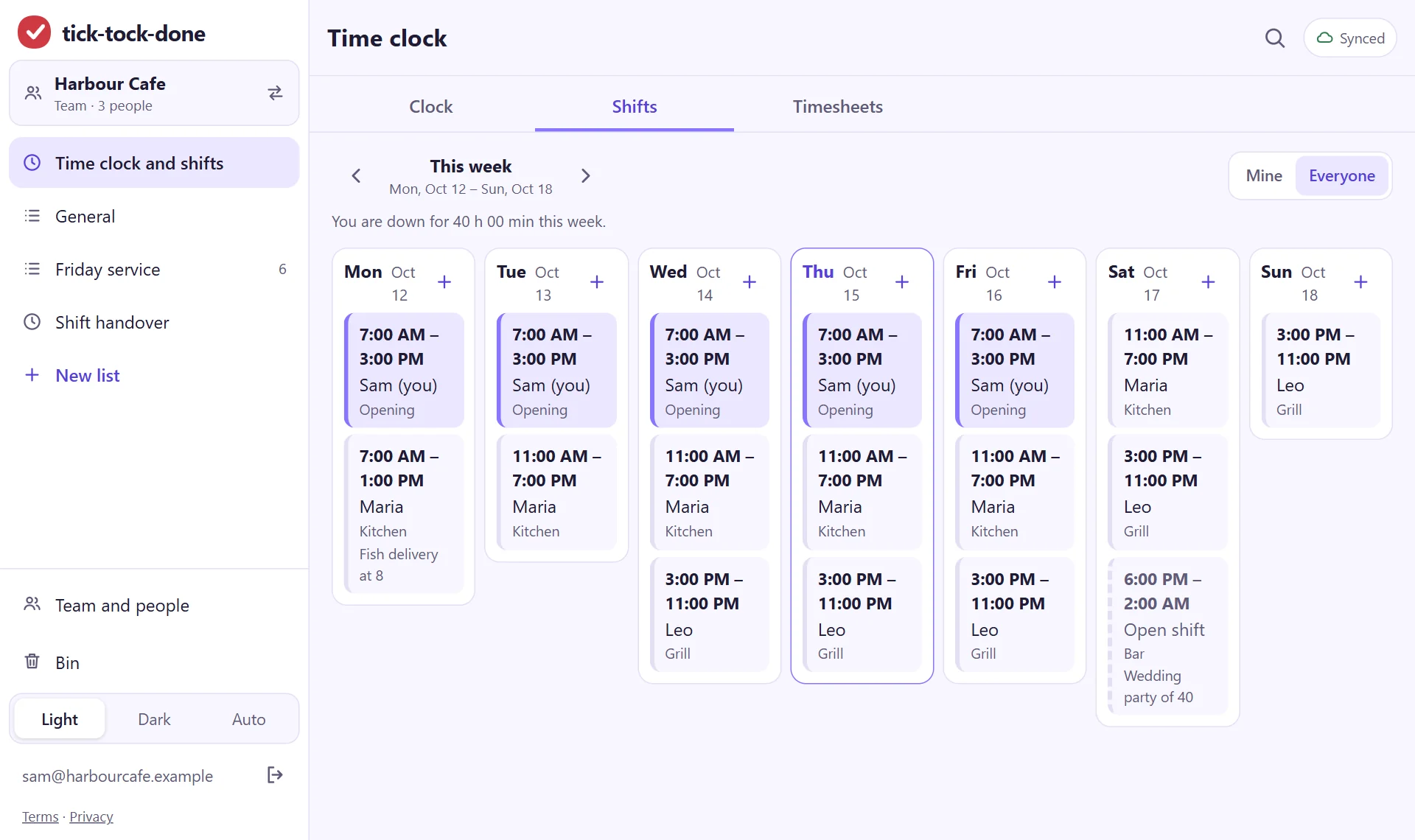
In tick-tock-done the shift plan for a team sits next to the time clock. The week view shows everyone's shifts by day, so a Saturday 11 p.m. finish and a Sunday 7 a.m. start for the same person sit side by side. The time clock keeps the real clock-out to the second, which is when a rest period actually starts, and a shift handover list gives the closer somewhere to write what the opener needs.
Plan your crew's shifts and time clock in one place, with handovers the opener can read.
See it for restaurantsWhat the research does not show
The studies are on hospital staff, mostly nurses, in Norway and Denmark. We found no comparable study of restaurant, retail or construction crews, whose shifts, commutes and work differ.
They show association, not proof. The Danish study compared injury rates after short and normal gaps across the same workforce, which helps, but neither study assigned schedules at random. A Norwegian trial that does (hospital units randomised to schedules without quick returns) has been registered; we could not find its results.
People differ. Some sleep easily after a late close; some lie awake. An average risk says little about one person.
The legal summary is ours, written in October 2026 from city and state pages and law-firm notes, and it is not legal advice. Thresholds, premiums and who is covered change; check the current text for your city.
Sources
Vedaa Ø. et al., quick returns and sick leave among nurses at Haukeland University Hospital (2016), as reported by Canadian HR Reporter. Article
Nielsen H.B. et al., "Short time between shifts and risk of injury among Danish hospital workers: a register-based cohort study", Scandinavian Journal of Work, Environment & Health 45(2):166-173 (2019). Article
Protocol for a cluster randomised trial of schedules without quick returns (STAMI). Page
Oregon Bureau of Labor and Industries, Predictive scheduling. Page
Seattle Office of Labor Standards, Secure Scheduling Ordinance. Page
Kaufman Dolowich, "Chicago amends Fair Workweek rules" (June 2026). Article
NYC Department of Consumer and Worker Protection, Fair Workweek settlements with fast food franchisees (2021). Press release
City of Philadelphia, Fair Workweek poster. PDF
Directive 2003/88/EC concerning certain aspects of the organisation of working time, Article 3 (daily rest). Text