Maya works the counter at a sandwich chain in Portland. On Thursday evening she finds out she is on for Saturday morning, and that her Monday shift is gone. She had already said yes to a family lunch on Saturday, and she had counted on Monday's six hours for rent. Nobody meant any harm: a delivery moved, a manager guessed the weekend would be busy. But for Maya the schedule is the plan for her whole week, and it changed with two days' notice.
A growing list of US cities and states now say large employers in food service and retail must post schedules two weeks ahead and pay extra when they change them later. These laws are called predictive scheduling, fair workweek or secure scheduling laws. This piece is for owners and crew leads who write the rota. It covers what each law asks and who it covers, the one randomised experiment on stable schedules (at Gap), a worked month of change pay, and how a five-person cafe can post two weeks ahead without being made to.
What the laws ask
The laws differ in detail but share the same shape:
Post the schedule 14 days ahead. In writing, covering every shift and on-call shift, before the first day it covers.
Pay for later changes the employer makes. Usually one extra hour of pay for adding time or moving a shift, and half pay for the hours cut when a shift is shortened or cancelled. New York City uses fixed dollar amounts instead.
Let people say no. A worker can turn down hours that were not on the posted schedule.
Tell new hires what to expect. A written estimate of the hours (or a regular schedule) when someone starts.
Rest between shifts. Most also set a minimum gap between a close and an open; our piece on clopening shifts covers those rules.
Changes the worker asks for are exempt. A swap the worker starts, a shift they ask to leave early, or a closure for a storm or a power cut does not trigger change pay.
Who is covered, law by law
As we read the official pages and summaries in October 2026. All of these cover large employers or chains; the threshold is the number of employees or locations worldwide unless it says otherwise.
Oregon (statewide): retail, hospitality and food service, 500 or more employees worldwide. 14 days' notice. One extra hour of pay at the regular rate when the employer adds more than 30 minutes, adds a shift, or moves a shift's date or times; half the regular rate for each scheduled hour not worked when it cuts or cancels. A voluntary standby list, which people join in writing, is exempt.
Seattle: retail and food service with 500 or more employees worldwide; full-service restaurants also need 40 or more full-service locations. 14 days' notice. One hour of pay for adding hours or moving a shift; half pay for hours lost when someone is sent home early or an on-call shift is not called in.
Los Angeles (city, retail): retail employers with 300 or more employees worldwide, for people working at least 2 hours a week in the city; in force since April 1, 2023. 14 days' notice. One hour of pay for a change that adds more than 15 minutes or moves a shift; half pay for hours cut.
Chicago: seven industries, restaurants among them. Employers with 100 or more employees worldwide, or 250 for restaurants (which also need 30 or more locations) and non-profits; workers earning up to an income ceiling the city adjusts each July ($32.50 an hour in the base rule). 14 days' notice. One hour of pay for each shift with added hours; under 24 hours' notice of a cut, half pay for the hours lost. Amended rules effective June 1, 2026 confirm that changes the worker starts are exempt.
Philadelphia: retail, hospitality and food service with 250 or more employees and 30 or more locations worldwide. 14 days' notice (10 in the first year). One hour of pay for added hours or a moved shift; half pay for hours cut. For tipped workers the rate is set each year: $17.88 an hour from July 1, 2026 to June 30, 2027.
New York City (fast food): chains with 30 or more locations nationally, franchises included. 14 days' notice of a weekly schedule, and a regular schedule for each worker. Fixed premiums per change, below.
New York City (retail): 20 or more employees in the city. A different rule: no on-call shifts, and no cancelling, adding or changing a shift with less than 72 hours' notice, unless the worker agrees in writing to added time.
San Francisco: formula retail with 40 or more establishments worldwide and 20 or more employees in the city, since 2015. Two weeks' notice and predictability pay for later changes.
Emeryville: retail with 56 or more employees worldwide, and fast food with 56 or more worldwide and 20 or more in Emeryville. Two weeks' notice, pay for changes, and time and a half for hours worked with less than 11 hours of rest.
Berkeley: in force since early 2024. Two weeks' notice and predictability pay for last-minute changes; coverage depends on the industry and the headcount, so check the city's page.
The pattern is clear: if you own one cafe or a small independent shop, you are probably not covered. If you run a franchise of a big brand, check carefully, because several laws count the whole brand. This is a summary, not legal advice; thresholds and rates change, so read the official page for your city before you change how you pay.
New York City's fast food premiums
New York City puts a dollar figure on each change, by how late it comes, counted back from the first day of the weekly schedule (not the day of the shift). From the city's fast food FAQ:
Less than 14 days' notice: $10 per change that adds hours or moves a shift with no change in hours; $20 per change that cuts hours or cancels a shift.
Less than 7 days' notice: $15 to add or move; $45 to cut or cancel.
Less than 24 hours' notice: $15 to add or move; $75 to cut or cancel.
A clopening (a close and the next day's open less than 11 hours apart) needs written consent and a $100 premium.
The city's own example: a schedule starting Monday, July 27 has a Thursday shift cancelled. Notice on or before Sunday, July 12 costs nothing; between July 13 and 19, $20; between July 20 and 25, $45; on or after July 26, $75. A worker agreeing to the change does not remove the premium; a change the worker asked for does.
A schedule is a plan for the worker's whole week, not just the store's.
A worked month of change pay
Two made-up examples, to show the size of the numbers. They are illustrations, not measurements.
A fast food franchise in New York City
One store, four weekly schedules, these changes:
Week 1: two people get 3 extra hours each, with 10 days' notice. 2 x $10 = $20.
Week 2: one shift moves from Tuesday to Wednesday, same hours, with 5 days' notice. $15.
Week 3: two shifts are cut by 2 hours each, with 3 days' notice, because the forecast was too high. 2 x $45 = $90.
Week 4: one shift is cancelled the evening before, for a slow forecast. $75. One closer is asked to open the next morning with 9 hours between, and agrees in writing. $100.
The month: $300 in premiums, on top of the pay for the hours worked. Two items (the late cut and the clopening) are $175 of it.
A large chain cafe in Oregon
One barista on an assumed $18.00 an hour, one month:
A shift extended by 2 hours after the schedule is posted: one extra hour, $18.00, plus the 2 hours worked.
A shift moved from 7:00 to 9:00, same length: $18.00.
A shift cut by 3 hours: half pay for the 3 hours, $27.00.
A 6-hour shift cancelled: half pay for the 6 hours, $54.00.
A close followed by an open 8 hours later, at the barista's request: the 2 hours worked inside the 10-hour rest window are paid at time and a half, so $18.00 extra.
The month: $135 for one person. Across a crew of 15 with a similar month, that is about $2,000, which is why chains covered by these laws tend to stop changing the posted schedule.
In both cases, the cheapest change is the one made before the schedule goes up. Cuts and cancellations cost the most, so whoever writes the schedule has a reason to plan lean and add hours later, rather than over-schedule and cut.
What the Gap experiment found
The best evidence on stable schedules is a randomised experiment at Gap, run by Joan Williams (UC Hastings), Susan Lambert (University of Chicago) and Saravanan Kesavan (UNC) in 28 stores around San Francisco and Chicago, from November 2015 to August 2016. 19 stores were picked at random to change how they scheduled; 9 carried on as before.
One detail matters for this article. Before the pilot started, Gap required every US store, control stores included, to post schedules two weeks ahead and to stop on-call shifts. So the experiment did not test two weeks' notice; it tested what came on top of it in the 19 stores:
Shift swaps by app without a manager in the middle.
The same start and end times across the days of the week.
Core scheduling: the same days and times for each person from week to week.
Part-time plus: a soft promise of 20 or more hours a week to a core group.
Extra staff on the floor at fixed busy times in 13 of the stores.
The results, against the control stores:
Median sales: up 7%, in an industry where 1 to 2% is a good year. The authors estimate $2.9 million in extra revenue across the 19 stores over 35 weeks, against about $31,200 spent on the extra staff.
Labour productivity: up 5%, about $6.20 more in sales per hour of work. The authors think this came from experienced staff staying longer; overall retention did not change.
Sleep: a follow-up report on health found sleep quality improved by 6 to 8% in the treatment stores, the most robust health effect. Before the change, 47% of associates said their schedule got in the way of their sleep.
What made the schedule unstable: only 30% of the week-to-week swing in payroll hours came from changes in customer traffic. The rest came from late shipments, last-minute promotions and visits from head office.
Managers mostly managed the two-week rule: nearly 90% of schedules were posted at least two weeks ahead in the first three quarters of 2016. Gap still cut its own rule from two weeks to ten days when the study ended.
What happened when Seattle made it law
Kristen Harknett, Daniel Schneider and Rebecca Irwin (Shift Project, PNAS 2021) surveyed workers at large retail and food chains in Seattle before and after the Secure Scheduling Ordinance took effect, and compared them with workers in other cities. The law made schedules more predictable and stable, and workers reported more happiness, better sleep quality and more economic security. It did not change their reports of psychological distress.
Two weeks ahead in a five-person cafe
None of these laws is likely to apply to you, but the reasons behind them do: the people who work for you have children, second jobs, classes and rent. A schedule they can plan around is one of the cheapest things you can give them. Steps that work at small scale:
Build a core week and change only the edges
Write one standard week: who opens, who closes, who works the weekend. Keep it the same from week to week, and only change it for holidays, someone's time off and known events. Most weeks the new schedule is the old one plus a few edits, so posting it early takes minutes.
Post on a fixed day, two weeks out
Pick a day, say every Monday, and post the week that starts 14 days later. If two weeks is too far at first, start at one week and move a few days further out each month.
Schedule lean, then offer extra hours
Cutting a shift costs a worker the most, so schedule for a normal week and add hours when the bookings, the weather or a catering order come in. Offer the extra hours to the people who want more, first.
Keep a standby list of volunteers
Ask who wants to be called for extra shifts at short notice, and keep it voluntary. Oregon's law does the same: a standby list people join in writing.
Let people swap among themselves
Most changes come from the crew, not the owner. Let people swap shifts with someone who can do the job, as long as it does not create a clopening or overtime, and record the swap on the schedule.
Keep a change log, and put your own price on changes
Write down every change after posting: what, who, when, and who asked. Once a month, look at how many there were and why. Some owners pay a small bonus for a short-notice change, even when no law says so; it keeps the person who writes the schedule honest. The Gap study found most instability came from upstream, so look at deliveries and promotions before you blame demand.
Watch the gaps between shifts as well. A change that moves a close later can create a short rest before the next open: our clopening piece and the piece on split shifts cover those patterns.
Doing this in tick-tock-done
In tick-tock-done a team's shift plan sits next to the time clock, in a week or month view, so you can plan two or more weeks ahead and everyone sees their own shifts. Crew members ask for time off or a different shift from the shift itself, and the owner or a manager approves it; approving time off turns those shifts into open shifts someone else can take. The app does not work out predictability pay or the New York premiums for you, and it does not keep a separate log of edits to the plan, so keep your change log alongside it.
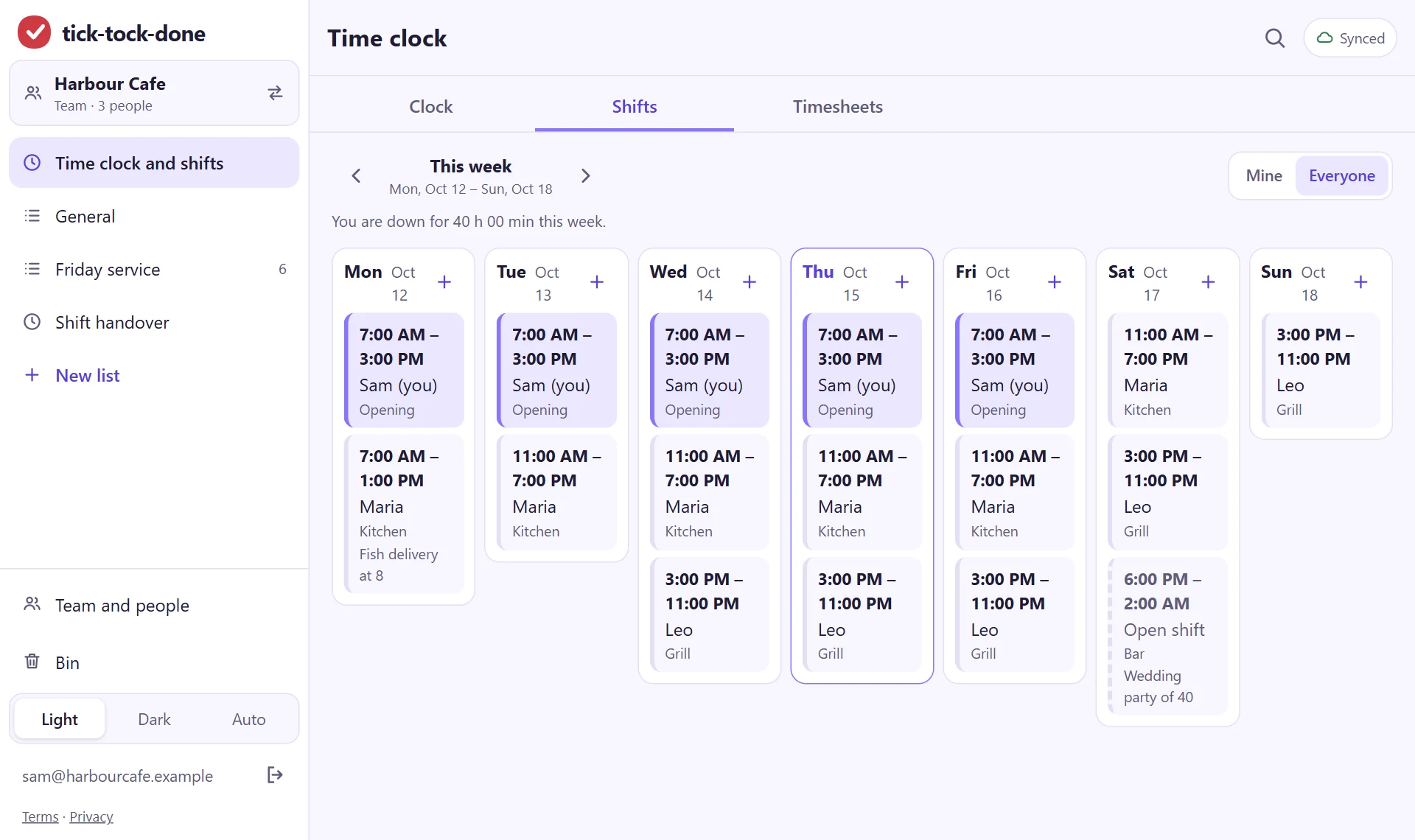
Plan your crew's shifts weeks ahead and handle time-off and swap requests in one place.
See it for restaurantsWhat the research does not show
The Gap experiment did not test two weeks' notice. Every store, control stores included, already posted two weeks ahead. The 7% and 5% came from the extra practices on top of it (consistent shifts, app swaps, a floor of hours, extra staff at busy times), measured together, in one retailer's stores in two cities. We cannot say which practice did what, or whether the same would happen in a restaurant.
The health effects were modest. The Gap health report found few average effects on workers' health and well-being apart from sleep, and the authors say the change in stability itself was modest.
The Seattle study is a before-and-after comparison, not a randomised trial. It compared Seattle with other cities, which helps, but other things changed in Seattle at the same time, and the workers were reached through social media ads.
Our worked month is made up. The rates are from the laws; the changes, the hourly rate and the crew size are ours.
The law summary is ours, as of October 2026. We read the official pages for Oregon, Seattle, Los Angeles, Emeryville and Berkeley, New York City's fast food FAQ and Philadelphia's 2026 tipped rate notice, and law-firm summaries for Chicago's June 2026 rules and San Francisco. Thresholds and rates change; check the official page before you rely on them.
Sources
Oregon Bureau of Labor and Industries, Predictive scheduling. Page
Seattle Office of Labor Standards, Secure Scheduling Ordinance (SMC 14.22). Page
City of Los Angeles, Office of Wage Standards, Fair Work Week information. Page
Kilpatrick Townsend, "Chicago amends Fair Workweek rules: effective June 1, 2026" (May 2026). Article
City of Philadelphia, Department of Labor, Fair Workweek tipped rate predictability pay, effective July 1, 2026 to June 30, 2027. PDF
Ogletree Deakins, "Philadelphia passes Fair Workweek employment standards for retail, hospitality and food service establishments". Article
NYC Department of Consumer and Worker Protection, Fair Workweek Law FAQs for fast food (September 15, 2023), schedule change premium amounts. PDF
Davis Wright Tremaine, "New York City passes wide-ranging legislation dictating how retail and fast food establishments schedule workers" (2017). Article
CalChamber, San Francisco Retail Workers Bill of Rights. Page
City of Emeryville, Fair Workweek Ordinance. Page
City of Berkeley, Workforce standards and enforcement. Page
Williams J.C., Lambert S.J., Kesavan S. et al., Stable Scheduling Study report (WorkLife Law, 2018). PDF
Williams J.C., Lambert S.J., Kesavan S. et al., Stable Scheduling Study: health outcomes report (2022). SSRN
University of Chicago News, "Stable work schedules mean better sleep for retail workers". Article
Harknett K., Schneider D., Irwin V., "Improving health and economic security by reducing work schedule uncertainty", PNAS 118(42):e2107828118 (2021). Summary