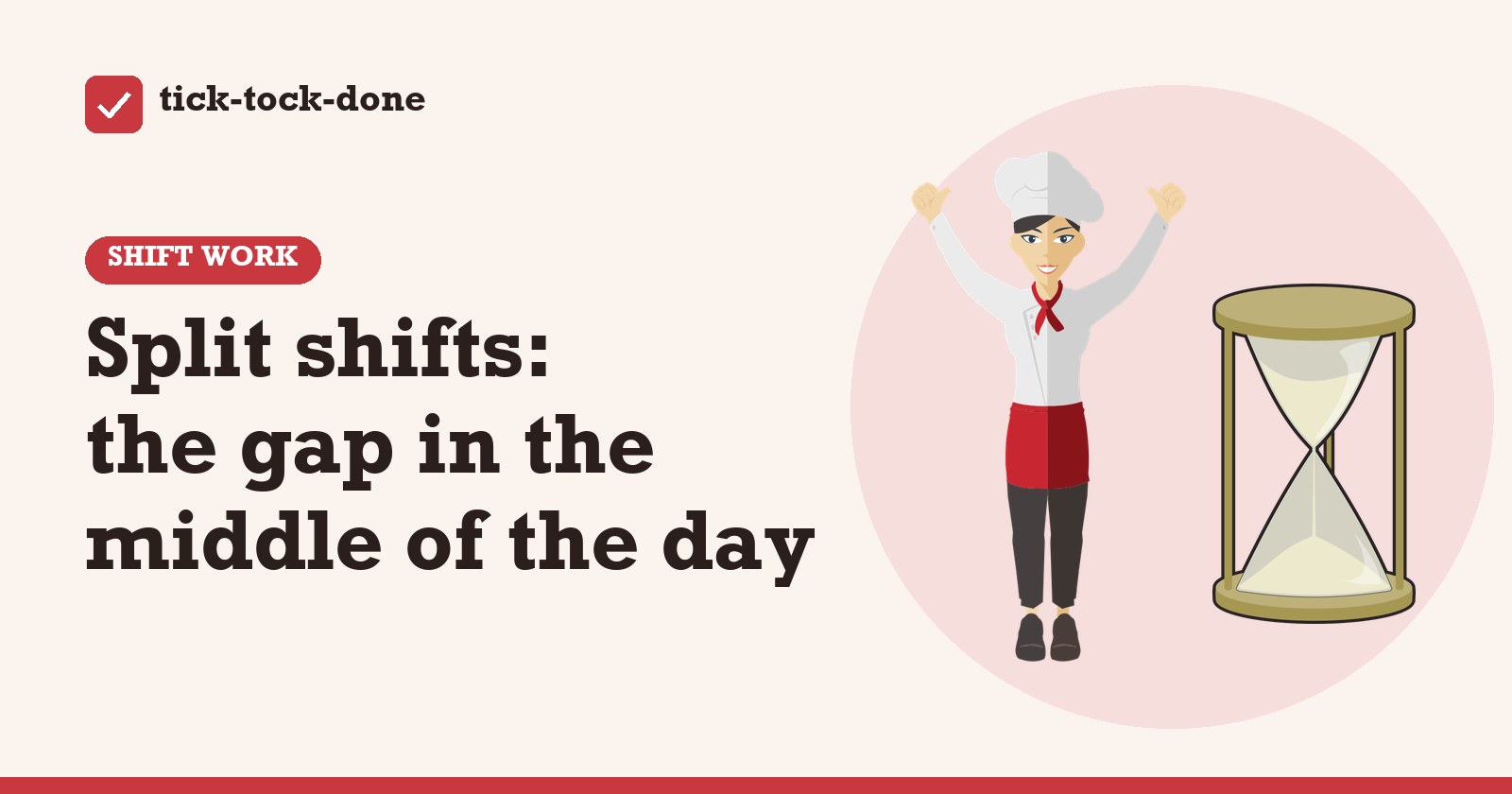
Ana works the line at a bistro on Long Island. On Tuesday she comes in at 11:00, works lunch, and clocks out at 3:00 when the dining room empties. She clocks back in at 5:00 for dinner and leaves at 10:00. That is 9 hours of paid work, 2 hours off in the middle, and 11 hours between walking in and walking out. She lives 6 miles away, so on a split day she drives the route four times instead of twice.
That pattern is a split shift: one working day cut in two by an unpaid gap the employer sets, almost always the quiet hours between lunch and dinner. This piece is for owners and crew leads who write the rota for restaurants and cafes. It covers what the gap costs the person working it, the two US states that put a price on it (New York and California, with worked figures at 2026 rates), a worked week, and when a split is fair.
What the gap costs the person working it
The gap is unpaid, but it is not free time in the usual sense. Two or three hours is too short to do much far from work and too long to sit in the car. Take Ana's Tuesday:
Paid work: 9 hours (11:00 to 3:00, 5:00 to 10:00).
The gap: 2 hours, unpaid.
Extra commute: a second round trip, 12 miles and about 40 minutes of driving.
What is left of the gap at home: about 1 hour 20 minutes, between parking and leaving again.
Her working day, door to door: she leaves at 10:40 a.m. and is home at 10:20 p.m., about 11 hours 40 minutes for 9 hours of pay, against 9 hours 40 minutes for a straight 9-hour shift with the same 20-minute drive each way.
Put a price on the second trip. The IRS business mileage rate for 2026 is 72.5 cents a mile; it is meant to cover the whole cost of running a car (fuel, wear, insurance, depreciation), not just petrol. Twelve extra miles is about $8.70 a day, $43.50 for a five-day week of splits, and about $2,260 over 52 such weeks. On a bus the cost is two more fares and usually more time. Most of that is invisible to whoever writes the rota, because it happens after the clock-out.
These are illustrative figures for one person, not measurements; plug in your own crew's distances. Some people live close enough to go home and like the break. For others the gap is spent in a parked car or a coffee shop, paying to wait.
On a split day the clock says 9 hours. The day says nearly 12.
New York: one extra hour when the day spans more than 10
New York's Hospitality Industry Wage Order covers restaurants and hotels. Its spread of hours rule, 12 NYCRR 146-1.6, measures the day from the start of work to the end of work, gaps included. On any day that spread is more than 10 hours, the employee gets one extra hour of pay at the basic minimum hourly rate.
Four details matter for a restaurant:
It counts the gaps. The order's own examples: 7 a.m. to 10 a.m. plus 7 p.m. to 10 p.m. is 6 hours worked but a 15-hour spread; 11:30 a.m. to 3 p.m. plus 4 p.m. to 10 p.m. is 9 and a half hours worked but a 10 and a half hour spread. Both earn the extra hour.
It applies whatever the person earns. In restaurants and all-year hotels the rule covers every employee, "regardless of a given employee's regular rate of pay" (146-1.6(d)). A cook on $22 an hour is owed it as much as one on the minimum. (The general wage order for other industries is narrower; this piece covers hospitality only.)
It is paid at the full minimum, not the tipped wage. A server paid the tipped cash wage still gets the hour at the basic rate, and meal or lodging credits cannot be set against it (146-1.6(b)).
It does not raise the overtime rate. The extra hour is not pay for time worked, so it is left out of the regular rate for overtime (146-1.6(c)).
The basic minimum hourly rates for hospitality in 2026, from the Department of Labor's poster (effective January 1 to December 31, 2026):
New York City: $17.00 an hour, so the spread of hours pay is $17.00 a day.
Long Island and Westchester: $17.00, so $17.00 a day.
Rest of the state: $16.00, so $16.00 a day.
For comparison, the tipped food service cash wage: $11.35 (NYC, Long Island, Westchester) and $10.70 (rest of state). The spread of hours hour is not paid at these.
The order also requires time records to show arrival and departure for anyone working a split shift or a spread over 10 hours, so a paper rota with "lunch" and "dinner" ticked is not enough.
California: the split shift premium
California's Wage Order 5 covers the public housekeeping industry, which includes restaurants, bars, cafeterias and hotels. It defines a split shift as "a work schedule which is interrupted by non-paid non-working periods established by the employer, other than bona fide rest or meal periods", and section 4(C) says that when someone works one, "one hour's pay at the minimum wage shall be paid in addition to the minimum wage for that workday". People who live at the workplace are excluded.
Three things make it different from New York's rule:
It is about the gap, not the length of the day. Any unpaid break longer than a bona fide meal period, set by the employer for its own needs, makes the day a split shift, however short the day is. The Labor Commissioner's example is a restaurant worker on 10:00 to 1:30 who comes back at 4:00 for dinner. A gap the worker asks for, for their own reasons, does not.
Pay above the minimum counts towards it. The premium is a floor, not an add-on. The Labor Commissioner's formula: the day's pay must be at least (hours worked + 1) times the minimum wage. Anything the person earns above the minimum for the day's hours counts.
The minimum is the higher of state and local. The state minimum for 2026 is $16.90 an hour. If your city sets a higher minimum, use that instead.
Worked at the 2026 state minimum of $16.90, for a day of 10:00 to 2:00 and 5:00 to 9:00 (8 hours worked, a 3-hour gap). The floor for the day is 9 times $16.90, or $152.10:
Server on $16.90: paid $135.20 for the hours. Premium owed: $16.90.
Prep cook on $18.00: paid $144.00. Premium owed: $8.10.
Line cook on $19.00: paid $152.00. Premium owed: $0.10.
Lead cook on $20.00: paid $160.00. Premium owed: nothing; the $7.90 above the floor already covers it.
So in California the premium mostly lands on the lowest-paid people on the rota, who are also the ones least likely to have a car parked close by. California's daily overtime (over 8 hours in a day) applies to the hours worked, not to the gap.
A worked week on Long Island
Back to Ana, now paid $19 an hour in Nassau County, on five split days of 11:00 to 3:00 and 5:00 to 10:00. Each day is 9 hours worked with an 11-hour spread. Two ways to cover the same lunches and dinners:
Rota A, Ana on five splits: 45 hours. Pay: 40 hours at $19 ($760.00) plus 5 overtime hours at $28.50 ($142.50) plus 5 spread of hours payments at $17 ($85.00). Cost to the owner: $987.50. Ana's extra driving: 60 miles a week, about $43.50 at the IRS rate, and 3 hours 20 minutes in the car.
Rota B, Ana on dinners, a second cook on lunches: Ana works 5:00 to 10:00 five days: 25 hours at $19, $475.00. The second cook works 11:00 to 3:00 five days: 20 hours at $19, $380.00. No spread over 10 hours, no overtime. Cost to the owner: $855.00.
Rota B costs the owner $132.50 a week less: $85 of spread of hours pay and $47.50 of overtime premium that the split created. It also puts a second person on the line who can cover when someone is ill. But Ana's pay falls from $987.50 to $475.00 a week. If she wants the hours, the fair version is to ask her: a split she chooses, a straight shift on some days, or dinners plus a few opens. In New York a split is never free: the spread of hours hour is $16 or $17 a day before anyone counts the overtime that long split days tend to create.
This is a simplified example, not payroll or legal advice: it leaves out tips, the weekly overtime rules for anyone not in hospitality, and local rules. Check the Department of Labor's pages or an employment lawyer before changing how you pay.
When a split shift is fair
Splits exist because restaurants have two peaks and a dead middle. Paying someone to stand around from 3 to 5 is a real cost, and some people like a split: a parent who does the school run, a student with afternoon classes, someone who lives upstairs. A few rules of thumb from the figures above:
Ask, don't assign
Offer splits to people who want them and say so in writing. Keep the people who live far away, or rely on buses, on straight shifts where you can.
Keep the gap usable or short
A 2-hour gap is the worst of both: too short to go home if the commute is 30 minutes, too long to wait comfortably. Either keep it under the meal period length, so it is a break rather than a split, or long enough (3 hours or more) to be worth going home.
Count splits like any other cost
In New York, put the $16 or $17 spread of hours hour on the rota next to the day it applies to, so whoever writes the rota sees it. In California, work out the premium for anyone within a dollar or two of the minimum. If splits come with overtime, compare them with a second part-time person, as in the worked week.
Don't stack a split before an early start
A split ending at 10 or 11 p.m. followed by a 7 a.m. open is a clopening with a longer day in front of it. Our piece on clopening shifts has the rest rules and the research on short gaps between shifts.
Keep real clock-in and clock-out times
Both states' rules depend on when work actually started and ended. A close that runs over can turn a 10-hour spread into an 11-hour one. Clock both halves, and keep the records. Our piece on what counts as hours worked covers setup, travel and waiting time, which decide where a split day really begins and ends.
Doing this in tick-tock-done
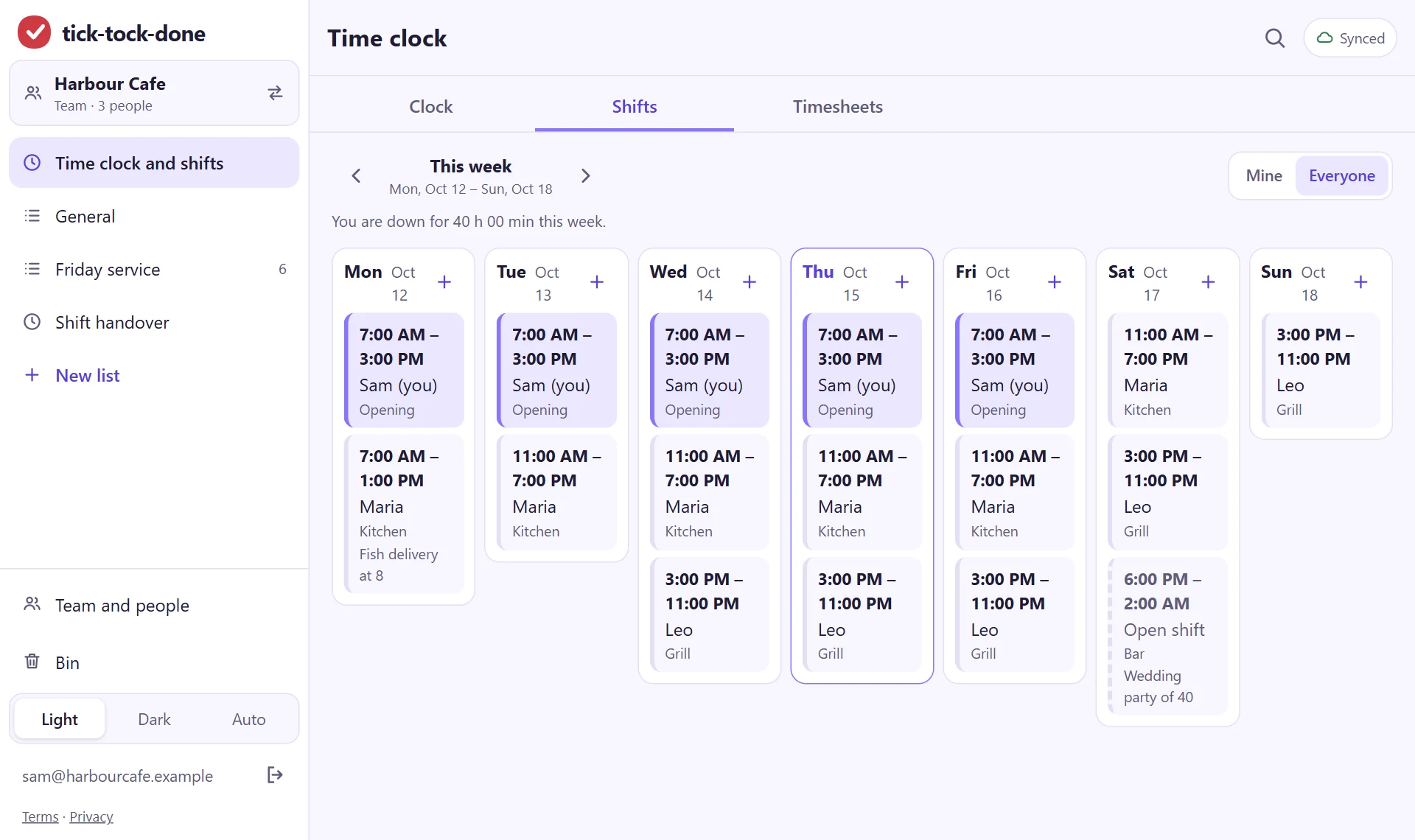
In tick-tock-done a team's shift plan sits next to the time clock. A split day is two shifts on the same day for the same person, so the gap is visible in the week view, and the time clock keeps the real clock-in and clock-out for each half: the times New York's spread of hours rule and California's records rule both depend on. The app does not work out spread of hours pay or the split shift premium for you; take the clocked times to your payroll.
Plan your crew's shifts and keep real clock times for every half of a split day.
See it for restaurantsWhat the research does not show
There is little research on split shifts in restaurants. The studies we found are on other jobs. A study of 235 urban bus drivers (Work, 2017) found no difference in stress, health or psychosocial factors between the 146 on split shifts and the 83 on regular shifts. But the 36% who said splits caused them problems reported worse sleep, more persistent fatigue, more clash with social life, and less say over their working hours. A Spanish time-use study (González Chapela, 2014) found split-shift workers spent more time on paid work, sleep and meals and less on housework, childcare and leisure, and women on split shifts more often felt overwhelmed. Neither is about kitchens, and both are observational.
Control seems to matter as much as the pattern. In the bus driver study, the drivers who struggled with splits also had less control over their hours, and a study of 166 Australian nurses linked a say over the rota to less fatigue. That supports "ask, don't assign", but neither is a test of offering splits by choice.
Our commute and cost figures are examples, built from the IRS rate and assumed distances, not measured. Your crew's real costs depend on where they live and how they travel.
The law summary is ours, as of October 2026. We read the New York regulation, the Department of Labor's 2026 hospitality poster, California Wage Order 5 and the Labor Commissioner's split shift page. Other states have their own rules, and local minimum wages change; check the official pages before you change how you pay.
Sources
New York State Department of Labor, Hospitality Industry Minimum Wage Order, 12 NYCRR Part 146, including 146-1.6 (spread of hours). PDF
New York State Department of Labor, Minimum Wage Poster, Hospitality Industry (LS 207.3), rates effective 1/1/2026 to 12/31/2026. PDF
California Industrial Welfare Commission, Wage Order 5-2001 (public housekeeping industry), sections 2(R) and 4(C). PDF
California Labor Commissioner (DLSE), Split shift. Page
California Labor Commissioner (DLSE), Minimum wage FAQ ($16.90 from January 1, 2026). Page
IRS, "IRS sets 2026 business standard mileage rate at 72.5 cents per mile, up 2.5 cents" (IR-2025-128, December 29, 2025). Page
Split shifts and urban bus drivers: stress, health and psychosocial work factors (235 drivers), Work 56(4):531-538 (2017), doi 10.3233/WOR-172520. Article
González Chapela J., "Split or straight? Some evidence on the effect of the work shift on Spanish workers' well-being and time use", MPRA Paper 57301 (2014). Paper
Team climate, roster control and work-life conflict in shift workers' fatigue, a longitudinal study of Australian nurses, Griffith University repository. Record