A line cook or framing carpenter arrives at 7:00 AM for an 8-hour shift. Thirty minutes in, the walk-in cooler compressor dies or heavy rain floods the footings. At 8:30 AM, the supervisor tells the crew to pack up and go home.
How many hours of pay does the employer owe? Under federal law, only the 90 minutes actually worked. But in nine US states and jurisdictions, sending an hourly crew member home early triggers reporting-time pay—often called show-up pay or call-in pay. This guide lays out the state rules, the arithmetic, what counts as an emergency exception, and how to record the hours on the crew schedule.
The federal rule: FLSA has no show-up pay
Under the federal Fair Labor Standards Act (FLSA), 29 CFR Part 785 only requires employers to pay non-exempt employees for hours actually worked. If an employee reports for an eight-hour shift and you dismiss them after twenty minutes, federal law requires paying only for those twenty minutes. There is no federal requirement for minimum daily shift hours or show-up compensation.
However, the FLSA establishes a floor, not a ceiling. Where state regulations or city wage orders require reporting-time pay, employers must comply with the stricter local rule.
Reporting-time pay by state
Nine jurisdictions have statewide reporting-time pay rules or mandatory predictability pay for cut shifts. Each calculates minimum hours and pay rates differently:
California (IWC Wage Orders § 5): If an employee reports to work as scheduled and is given less than half of their usual or scheduled day's work, the employer must pay for half the scheduled shift, with a minimum of 2 hours and a maximum of 4 hours, at the employee's regular rate of pay. If required to report a second time in one workday (such as a split shift) and furnished less than 2 hours, they must be paid for 2 hours.
New York (12 NYCRR § 146-1.5 & § 142-2.3): In the hospitality industry (restaurants and hotels), an employee reporting to work must be paid for at least 3 hours, or the scheduled hours if scheduled for less, at the basic minimum hourly wage. No tip credit may be deducted from reporting pay. In miscellaneous non-hospitality industries, the minimum is 4 hours (or scheduled shift if less) at minimum wage.
Massachusetts (454 CMR 27.04(1)): Under the "three-hour rule," an employee scheduled for 3 or more hours who reports on time must be paid for at least 3 hours. Time worked is paid at the employee's regular rate, and any unworked balance up to 3 hours is paid at no less than the state basic minimum wage.
New Jersey (N.J.A.C. 12:56-5.5): An employee who reports for work at the employer's request must be paid for at least 1 hour at their regular applicable wage rate, unless notified before reporting that work is unavailable.
Connecticut (Conn. Agencies Regs. §§ 31-62-E1, 31-62-D2): Minimum daily calls depend on trade: restaurants and hotels require at least 2 hours of pay at minimum wage or regular rate; mercantile (retail) and cleaning trades require at least 4 hours at the regular wage rate (unless regularly scheduled for fewer hours in advance).
New Hampshire (N.H. Rev. Stat. Ann. § 275:43-a): An employee who reports to work at an employer's request must receive at least 2 hours of pay at their regular rate, unless the employer made a good-faith effort to notify them prior to reporting.
Rhode Island (R.I. Gen. Laws § 28-12-3.2): An employee who reports to work by request or permission must be paid for at least 3 hours at their regular rate of pay.
District of Columbia (7 DCMR § 907): An employee reporting to work must receive at least 4 hours of pay (or regularly scheduled shift length if under 4 hours), combining regular rate for hours worked with minimum wage for unworked hours.
Oregon (ORS 653.455 - Fair Workweek Act): In retail, hospitality, and food service establishments with 500+ employees worldwide, if an employer cuts or cancels a shift after the 14-day advance schedule window, the employer must pay one-half (50%) of the regular rate of pay for all scheduled hours not worked, in addition to wages for hours worked.
A worked calculation: 90 minutes worked on an 8-hour shift
To see how these rules change payroll, take a crew member scheduled for an 8-hour shift at $18.00 per hour. The worker clocks in at 7:00 AM and is sent home at 8:30 AM (1.5 hours worked):
Federal / No-rule state: 1.5 hours worked @ $18.00 = $27.00.
California: Scheduled 8 hours; half is 4 hours (hits the 4-hour cap). 1.5 hours worked ($27.00) + 2.5 hours reporting pay ($45.00) = $72.00.
New York (Restaurant): 1.5 hours worked @ $18.00 ($27.00) + 1.5 hours unworked balance to 3 hours @ $16.00 NY minimum wage ($24.00) = $51.00.
Massachusetts: 1.5 hours worked @ $18.00 ($27.00) + 1.5 hours unworked balance to 3 hours @ $15.00 MA minimum wage ($22.50) = $49.50.
Rhode Island: 1.5 hours worked @ $18.00 ($27.00) + 1.5 hours reporting pay @ $18.00 ($27.00) = $54.00.
New Hampshire: 1.5 hours worked ($27.00) + 0.5 hours reporting pay to meet 2-hour minimum ($9.00) = $36.00.
New Jersey: 1.5 hours worked exceeds the 1-hour statutory minimum = $27.00 (if sent home immediately at 0 min, owed 1 hour = $18.00).
District of Columbia: 1.5 hours worked @ $18.00 ($27.00) + 2.5 hours unworked balance @ $17.50 DC minimum wage ($43.75) = $70.75.
Oregon (Covered large chain): 1.5 hours worked @ $18.00 ($27.00) + 6.5 unworked scheduled hours @ half-pay $9.00/hr ($58.50) = $85.50.
Weather, power cuts and emergencies: when exceptions apply
State laws recognize that employers cannot control every circumstance. Reporting-time pay is usually excused when operations cannot continue due to:
Public utility failure: Electricity, municipal water, natural gas, or sewer service fails outside the employer's control (e.g. a blown city transformer or municipal water main break).
Acts of God / natural disaster: Severe blizzards, floods, earthquakes, or hurricanes that make work impossible or travel dangerous.
Civil authority orders: Police, fire departments, or public health authorities order premises evacuated or closed.
Threats to safety: Active threats to workers or property.
Advance notice: The employer made a verifiable, good-faith attempt to notify the worker before they left home (for example, calling or texting at least an hour before the shift start).
What does not count as an exception: slow customer traffic, quiet dining rooms, light rain that makes outdoor work uncomfortable but not hazardous, or routine material delivery delays. Those are standard business risks, not Acts of God.
What to record on the timesheet and schedule
Handling reporting-time pay poorly can cause messy wage disputes and flawed overtime calculations. Follow four practical record-keeping rules:
Never alter clock punches. If the worker clocked in at 7:00 and out at 8:30, preserve those exact times. Do not artificially extend the clock-out to 11:00 to satisfy a 4-hour rule.
Keep reporting pay as a distinct earnings line. Under 29 CFR 778.216, reporting-time pay for unworked hours does not count toward the 40-hour weekly threshold for federal overtime. If a worker works 38 actual hours and receives 4 hours of reporting pay, their gross pay reflects 42 hours at straight-time rates, with zero overtime premium due. Blending worked hours and reporting pay together can result in calculating unnecessary overtime.
Document the reason on the shift card. Log whether the dismissal was volume-related or an exempt emergency. If a utility blackout occurred, note the power company ticket number or outage time in your shift handover notes.
Notify before departure. If weather forecasts show rain that will shut down an outdoor site, message the crew at 5:30 AM rather than waiting for them to show up at 7:00 AM.
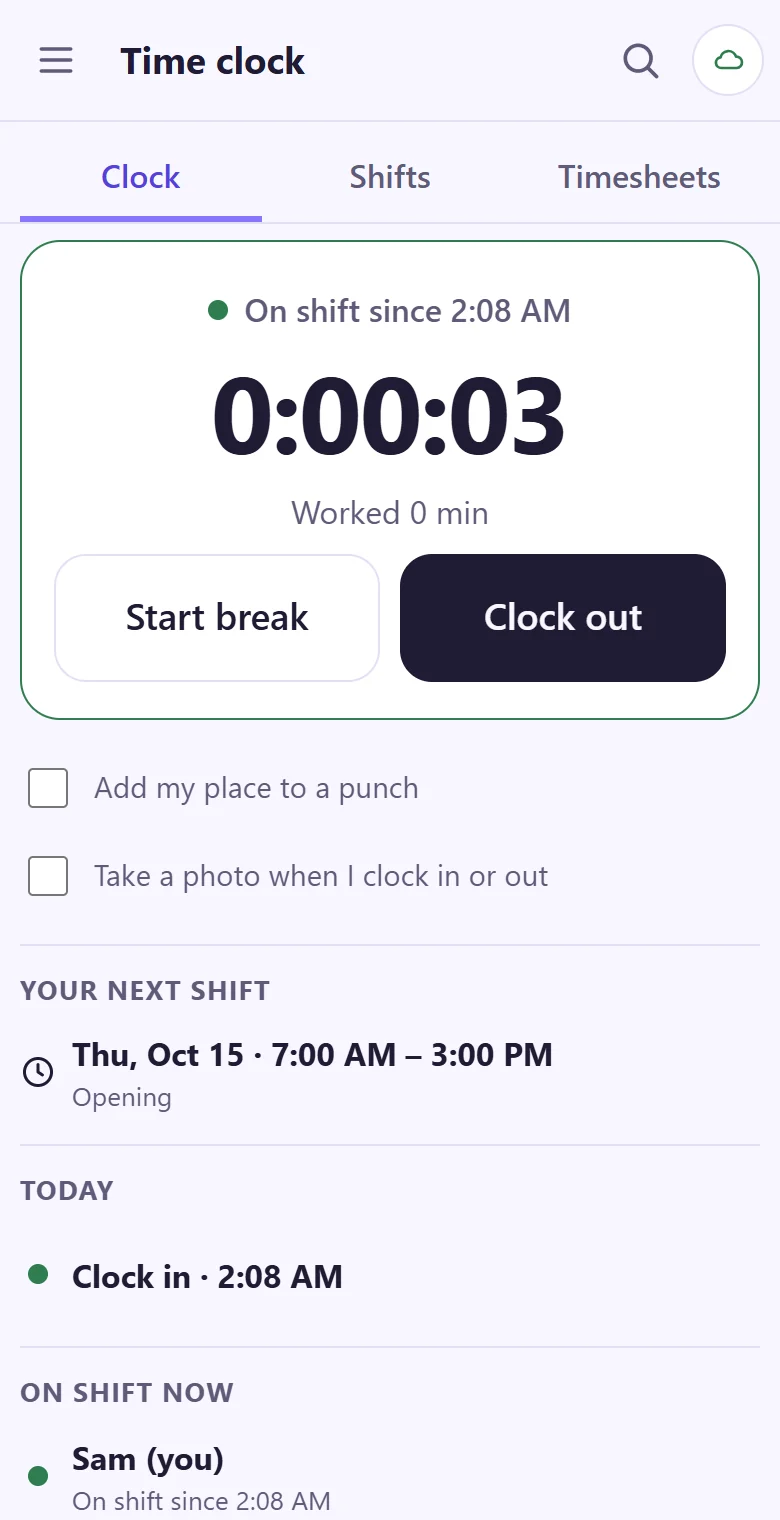
For setting up shifts and handling pre-shift briefs, our guide on what counts as hours worked details prep and waiting time, while time clock rounding explains why exact minute punches protect employers from wage claims.
Give your crew an exact, minute-by-minute time clock with clear shift plans and transparent logs.
Explore tick-tock-done shiftsWhat this does not cover
This article is for informational purposes and is not legal advice. Consult your state Department of Labor or employment counsel for industry-specific wage orders.
City and municipal ordinances: Cities including San Francisco, Seattle, Chicago, New York City, and Philadelphia enforce municipal fair workweek ordinances that impose predictability pay on shifts cut without advance notice.
Collective bargaining agreements: Union contracts frequently specify custom show-up guarantees (such as 4 hours for reporting and 8 hours if work commences) that supersede statutory minimums.
Sources
29 CFR Part 785, Hours Worked under the Fair Labor Standards Act. US Department of Labor
29 CFR 778.216, Payments not for hours worked: show-up pay and call-back pay. US Department of Labor
California Industrial Welfare Commission Wage Order No. 5-2001 (Public Housekeeping Industry), Section 5, Reporting Time Pay. California Department of Industrial Relations
New York State Department of Labor, Hospitality Industry Wage Order, 12 NYCRR § 146-1.5, Call-in Pay. NYSDOL
Code of Massachusetts Regulations, 454 CMR 27.04(1), Reporting Pay. Mass.gov
New Jersey Administrative Code, N.J.A.C. 12:56-5.5, Reporting for work. New Jersey Department of Labor and Workforce Development
Connecticut Department of Labor, Regulations of Connecticut State Agencies, §§ 31-62-E1 (Restaurant) and 31-62-D2 (Mercantile). CT.gov
New Hampshire Revised Statutes Annotated, RSA 275:43-a, Minimum Period of Employment. New Hampshire General Court
State of Rhode Island General Laws, § 28-12-3.2, Minimum daily hours. Rhode Island General Assembly
District of Columbia Municipal Regulations, 7 DCMR § 907, Minimum Daily Wage. DC Office of Documents and Administrative Issuances
Oregon Revised Statutes, ORS 653.455, Compensation for work schedule changes. Oregon State Legislature