At 4:45 the kitchen stops for a few minutes before dinner. The chef says 140 covers, a party of 12 at 7:30 with two nut allergies, the halibut is 86'd, and the dish machine is leaking again, so mind the floor by the pass. At 7:00 on a building site, the foreman tells the crew the concrete truck is due at 9, the scaffold on the north side failed inspection and is tagged out, and it will be 34°C by the afternoon. Both are the same thing: a short meeting before the work starts, so everyone starts with the same picture.
Kitchens call it the line-up or pre-shift, sites call it the toolbox talk or the pre-start, hospitals call it the huddle or the briefing. This piece looks at what the evidence from operating rooms, cockpits and construction sites says these meetings do, a fixed ten-minute agenda that works for a kitchen or a crew, and the signs that a huddle has turned into a waste of everyone's time.
What briefings did in operating rooms
Surgery has the best evidence, because researchers can sit in the room and count what goes wrong.
Fewer communication failures. Lorelei Lingard and colleagues introduced a short checklist-guided briefing for surgeons, nurses and anaesthetists at a Canadian teaching hospital, held before 302 operations. Trained observers counted communication failures (information that came too late, was wrong, was never resolved, or left someone out) in 86 operations before and 86 after. The average fell from 3.95 per operation to 1.31. About a third of the briefings (34%) changed something on the spot: a problem spotted, a knowledge gap closed, a decision made, a follow-up action agreed.
Fewer deaths, in one big trial. The WHO Surgical Safety Checklist, which includes a team briefing before the first incision, was tried in eight hospitals in eight cities around the world. Deaths after surgery fell from 1.5% to 0.8% and complications from 11% to 7% (Haynes et al., 2009).
And no change, when it became paperwork. When Ontario made the same checklist mandatory in all its hospitals, Urbach and colleagues compared about 109,000 operations in the three months before with about 106,000 in the three months after, across 101 hospitals. Deaths went from 0.71% to 0.65%, complications from 3.86% to 3.82%; neither change was statistically meaningful. Hospitals reported near-total compliance. The common reading, including the study's authors and the commentary alongside it, is that a briefing which is mandated and ticked off does little; one a team actually uses is what made the difference in the earlier studies.
A briefing a team actually uses changes things. One that is mandated and ticked off does very little.
What cockpits and building sites add
Airline crews brief before every flight and every approach, and the FAA's guidance on crew resource management (Advisory Circular 120-51E) describes what a good one looks like in plain terms: it "addresses coordination, planning, and problems", it covers "the most threatening safety and security situations", and it is interactive. The captain asks for questions, answers them directly, "does not rush through the briefing", and uses "we" language. The point is less the information than making it normal for the most junior person to speak up later.
On sites the toolbox talk is the same idea, and there is at least one controlled test of how to run it. NIOSH researchers (Eggerth et al., 2018) wrote eight toolbox talks for construction workers in two versions: the usual information, or the same information wrapped in a short true-to-life story with discussion questions. Workers were randomly given one version. The story-and-questions version produced more knowledge gain and more reported impact, especially among less experienced workers. Neither version changed the crew's overall safety climate, which is a fair warning about what one talk can do.
A fixed ten-minute agenda
A huddle stays short when it has the same five parts every day, in the same order, and the lead knows what goes under each before the crew gathers. Roughly two minutes each:
1. Numbers. Covers and bookings, large parties, the delivery window. On a site: what is being poured or lifted today, inspections, the crane or hoist slot, who is visiting.
2. Changes. What is different from yesterday. 86'd items, specials, allergens in the specials, a new supplier. On a site: a revised drawing, a new subcontractor, an area closed.
3. One hazard, made specific. Not "be safe out there". The wet floor by the dish machine; the fresh fryer oil; the open edge on level 3; the heat after 2 p.m. Tell it as a short story when there is one ("last month someone..."); that is the version that stuck in the NIOSH test.
4. Who is on what. Stations, who runs the pass, who covers breaks, who is the first aider today. On a site: which pair is on which task, who signs off the permit.
5. One question to the crew. "What could go wrong today?" or "What do you need that you don't have?" Then wait. Anything raised gets an owner before the huddle ends.
Then one line to close: what happens first. The huddle ends when the work starts, not when the lead runs out of things to say.
A few rules that keep it useful
Same time, same place, standing up. It starts on time, even if someone is late; they catch up from the board.
The lead talks for less than half of it. If nobody else spoke, it was a speech.
It is paid time. People are at work for the huddle; clock in before it, not after. Our piece on time clock rounding explains why the safety briefing counts as work.
What was raised is written down. Two lines on the board or in the team list, with a name next to each, so the question from today is answered by tomorrow.
It is not a handover. The handover passes what one shift knows to the next person; the huddle sets up the whole crew. Our shift handover checklist covers the first.
When a huddle is a waste
Huddles go bad in recognisable ways:
The same speech every day. If the numbers, changes and hazard are the same as yesterday, the crew stops listening, and that is the Ontario result in miniature. Cut it to the one thing that changed, or skip it on a day when nothing did.
Nothing anyone says changes anything. In the Lingard study two out of three briefings changed nothing visible, and that is normal; the third that catches a problem pays for the rest. But if weeks go by and nothing raised gets an owner, people stop raising things.
It is used for telling people off. Public criticism at the huddle teaches the crew to say nothing at the one moment you want them to talk.
It runs past 15 minutes. Long items (a new procedure, training on a machine) need their own time.
The information could be on the board. The specials, the delivery times and the station list can be read; the huddle is for what needs talking about.
Using the team board as the huddle's list
In tick-tock-done a team shares lists and a board with columns such as To do, Doing, Stuck and Done. Before the huddle the lead can open today's list on a phone or a screen in the kitchen: what is stuck and why, who is on what, the photo of the leaking dish machine from the morning. Anything raised in the huddle becomes a task with a name on it, and the updates on that task are where the answer arrives, instead of in someone's memory.
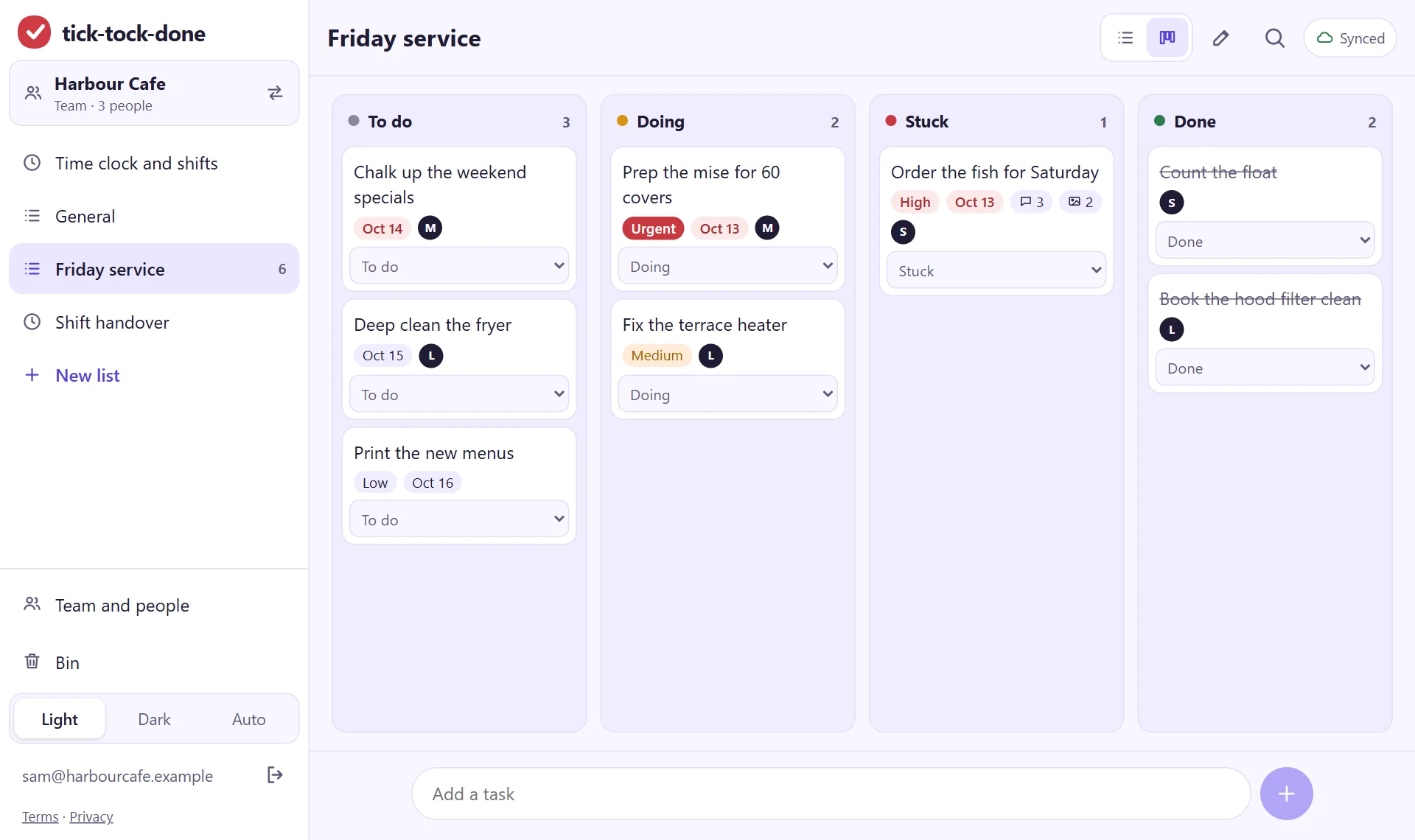
Give your crew one board for the huddle: who is on what, what is stuck, and what was raised.
See it for restaurantsFor building crews, the same board works for the morning pre-start; see tick-tock-done for construction.
What the research does not show
We found no controlled study of kitchen line-ups or restaurant pre-shift meetings. The evidence here is from operating rooms, aviation guidance and construction toolbox talks, and transferring it to a dinner service is our judgment.
The surgical studies are mostly before-and-after comparisons. Lingard's was in one hospital without a control group, and the WHO trial bundled the briefing with the rest of a checklist and other changes, so it cannot say how much the briefing alone did.
The Ontario result cuts both ways. It may show that mandated briefings do little, or that three months was too short to see an effect, or that reported compliance was not real compliance. The study cannot tell these apart.
Ten minutes and five parts are our recommendation, drawn from these sources, not a tested formula.
Sources
Lingard L. et al., "Evaluation of a preoperative checklist and team briefing among surgeons, nurses, and anesthesiologists to reduce failures in communication", Archives of Surgery 143(1):12-17 (2008). PubMed
Haynes A.B. et al., "A surgical safety checklist to reduce morbidity and mortality in a global population", New England Journal of Medicine 360:491-499 (2009). Article
Urbach D.R. et al., "Introduction of surgical safety checklists in Ontario, Canada", New England Journal of Medicine 370:1029-1038 (2014). Article
Federal Aviation Administration, Advisory Circular 120-51E, Crew Resource Management Training (2004). PDF
Eggerth D.E., Keller B.M., Cunningham T.R., Flynn M.A., "Evaluation of toolbox safety training in construction: the impact of narratives", American Journal of Industrial Medicine 61(12):997-1004 (2018). CDC Stacks