In the two years 2023 and 2024, US private employers reported 1,834,600 injuries and illnesses serious enough to keep someone off work for at least a day. One in three of those people, 610,120, had been with their employer for less than a year. Workers in their first year are about one in five of the workforce.
Insurers see the same thing from the claims side. In Travelers' 2025 Injury Impact Report, people in their first year with an employer made about 36% of the claims and 34% of the cost over five years of claims. Its 2026 report puts the restaurant figure at about half of all claims, and construction at 44%. The risk does not spread evenly over that first year either: Canadian compensation data shows it is highest in the first month.
This piece is for the owner or crew lead in a kitchen, on a building site or on a cleaning crew who is about to start someone new. It covers what the numbers show, what US rules require before a new person touches certain work, and a five-day plan with a sign-off sheet you can copy. It is written as of October 2026 and it is not legal advice.
What the numbers show
One injury in three is a first-year worker
The Bureau of Labor Statistics publishes, every two years, the cases with days away from work by how long the person had been with the employer (table R71). For private industry:
Less than 3 months: 204,800 cases in 2023-24, 11.2% of the total, median 7 days away from work. (2021-22: 277,840, 12.4%.)
3 to 11 months: 405,320 cases, 22.1%, median 7 days. (2021-22: 21.0%.)
1 to 5 years: 646,780 cases, 35.3%, median 7 days. (2021-22: 32.9%.)
More than 5 years: 507,990 cases, 27.7%, median 12 days. (2021-22: 30.5%.)
All cases: 1,834,600 (2021-22: 2,246,900). The rest of the cases have no length of service recorded.
Now put that next to the workforce. BLS's Employee Tenure survey found 22.2% of wage and salary workers had been with their employer for a year or less in January 2024 (20.6% in January 2026). So:
Share of cases with days away, first year: 33.3% (610,120 of 1,834,600).
Share of workers in their first year: about 22%.
Ratio: 33.3 / 22.2 = 1.5. A first-year worker is about one and a half times as likely to be among the injured as their share of the workforce would suggest.
That is the average across all private industry. Crews with high turnover have far more people in their first year: in January 2026, 74.1% of employed 16- to 19-year-olds and 45.9% of 20- to 24-year-olds had been with their employer a year or less. In a kitchen staffed by people in their teens and early twenties, the first-year worker is often half the line.
The first month is the worst of it
The US tables stop at "less than 3 months", so for the first weeks we have to look north. The Institute for Work & Health in Toronto matched Ontario workers' compensation claims with labour force data. In the first study (Breslin and Smith, 2006), workers in their first month on a job were more than four times as likely to have a lost-time claim as workers who had been there over a year. A follow-up on ten years of claims, 1999 to 2008 (Morassaei and others, 2013), still found more than three times the risk in the first month, higher in construction and manufacturing. It is not only a young-worker effect: in the 2006 study the first-month excess was stronger for older workers, so an experienced 45-year-old starting a new job carries it too.
A worked example of what that means for a small crew. A restaurant with 20 staff that replaces 15 people a year (75% turnover, unremarkable for the industry) has, on average, 15 / 12 = 1.25 people in their first month at any time, and about 3.75 in their first three months. Those three or four people are where most of the next year's injuries are likely to come from. The first week is the cheapest place to act.
What hurts new people on a crew
BLS does not split injuries by both industry and length of service, so the industry figures below are for all workers. They are still the right list of things to show a new person first (cases with days away from work, 2023-24):
Restaurants and other eating places (96,250 cases): cuts and punctures 25.0%, sprains and strains 18.1%, heat burns 11.1%; by cause, slips, trips and falls on the same level 26.4%. Restaurants account for about 38% of all private-industry burn cases while having about 5% of all cases.
Construction (142,560 cases): cuts and punctures 16.3%; falls to a lower level 14.7% (20,930 cases).
Janitorial services (16,350 cases): slips, trips and falls 42.4%.
For teenagers in kitchens the pattern has been known a long time. A NIOSH review in 1999 counted about 44,800 emergency room visits by restaurant workers aged 14 to 17 over two years, 63% of them in fast food; teens in restaurants had six times the burn risk of teens in other jobs, and more than half of their falls involved a wet or greasy floor. The figures are old; the fryer and the wet floor are not.
What the rules require before day one ends
No US rule says "onboard for five days". Several say what has to happen before a new person does certain work:
Construction, 29 CFR 1926.21(b)(2): "The employer shall instruct each employee in the recognition and avoidance of unsafe conditions and the regulations applicable to his work environment." Every new person, before they work.
Chemicals, 29 CFR 1910.1200(h)(1), Hazard Communication: training on the hazardous chemicals in the work area "at the time of their initial assignment", and again whenever a new hazard comes in. A cleaning crew's degreaser and a kitchen's oven cleaner both count. The SDS binder is part of day one.
Specific tasks: forklifts, respirators, lockout, ladders and scaffolds, fall protection and more each have their own training rule; OSHA lists them in publication 2254, Training Requirements in OSHA Standards. A new hire does not use that equipment until that training is done and recorded.
For workers under 18 the federal child labor rules (29 CFR 570, summarized in the Department of Labor's Fact Sheet #2A for restaurants) take whole tasks off the table:
14 and 15 year olds: may cook only on electric or gas grills with no open flame, and on deep fryers that lower and raise the baskets automatically; no broilers, rotisseries or pressure fryers; no baking; no power-driven slicers, grinders, choppers or mixers; cleaning cooking equipment or handling oil only when it is at or below 100°F.
16 and 17 year olds: no power-driven meat slicers or meat processing machines, including cleaning or adjusting them (Hazardous Order 10); no dough or batter mixers, sheeters or bread slicers, except countertop mixers of half a horsepower or less with a bowl of 5 quarts or less (Hazardous Order 11); no balers or compactors (Order 12); no driving on the job under 17.
States: many add hours limits and work permits on top.
Write the new person's age-restricted tasks into their first-week list as "not you" lines. The slicer is where these rules get broken: someone busy asks the new 16-year-old to clean it, and neither of them knows it is not allowed.
One more first-week rule for outdoor crews: new workers need to build up to a full shift in the heat. The state rules and a day-by-day schedule are in Heat on outdoor crews, and the heat check card works out the hours for a given shift length.
Shown, then watched: how to teach a task
Most first-week plans fail the same way: someone is "shown around" on day one, given a stack of papers to sign, and then left at a station. The method that works is old. The US government's Training Within Industry program taught it to wartime supervisors in the 1940s as Job Instruction, and it still fits on a pocket card:
1. Prepare the worker: put them at ease, find out what they already know about the job.
2. Present the task: do it yourself, one step at a time, and say the key points out loud ("knife tip down when you walk", "three points of contact on the ladder").
3. Try out: they do it while you watch, explaining each key point back to you. Correct on the spot. Repeat until they get it right without prompting.
4. Follow up: leave them on their own, say who to ask, check back often and less and less often as the days go on.
Its motto is the rule for a crew lead: "If the worker hasn't learned, the instructor hasn't taught." The sign-off below follows step 3: a task is signed off when someone has watched the new person do it right, not when it was shown to them.
The first week, day by day
Here is a five-day plan for a kitchen or a site. It assumes a buddy: one experienced person, named in advance, who works the same shifts as the new hire all week and is the one they ask. Hours are paid; clock in for all of it.
Day 1: the place, the dangers, the buddy
Before they arrive: buddy named and told; schedule for the week given; uniform, boots or PPE sized; paperwork ready so it takes 20 minutes, not the morning.
Walk the place with the buddy: exits and assembly point, fire extinguishers, first aid kit, eye wash, who the first aider is today, how to call for help.
The three things that hurt people here: in a kitchen, knives, hot oil and the wet floor; on a site, edges and openings, moving plant, and whatever is being lifted today; on a cleaning crew, wet floors, chemicals and ladders. Show each one where it is.
Chemicals: the SDS binder or app, the two or three products they will use, their labels, gloves and goggles (Hazard Communication).
"Not you" tasks: the slicer, the fryer, the forklift, the roof, until trained; under-18 restrictions if they apply.
Work: one simple task, shown, then watched. They end the day having done something real.
Before they leave: "What was confusing today?"
Day 2: the station and the core tasks
At the pre-shift huddle: introduce them by name; say who their buddy is. (The ten-minute pre-shift huddle covers how to run one.)
Teach two or three core tasks of their station with the four steps above. Sign each off only after watching it done right.
Hand tools and equipment they will use daily: shown, watched, signed off.
The opening or closing checklist for their station: walk it with them once.
Day 3: doing it, watched
They run their station with the buddy next to them, not instead of them.
Teach the next tasks. In a kitchen: the dish machine and its chemicals, receiving a delivery, temperature checks. On a site: the tools of the trade, material handling, the daily log or toolbox talk.
Report something: have them report a small thing (a near miss, a broken tile, a low stock item) the way the crew does, so the first report they ever make is not the injury.
Day 4: a busy shift
A rush or a full production day with the buddy close by. This is where shortcuts get learned; the buddy names them out loud ("we don't carry the fryer oil, we use the caddy").
Emergency drill, five minutes: where is the gas shutoff, the fire blanket, the nearest exit from here; what do you do if someone is hurt.
Day 5: check and sign
Go through the sign-off sheet together. Anything not watched yet gets a date next week.
Ask three questions: what still feels unsafe, what nobody showed you, who do you go to when the buddy is off?
Agree the next three weeks: the buddy stays on call through the first month, since that is where the risk stays highest; one check-in with the lead at the end of each week; no working alone or opening alone in the first month.
The sign-off sheet, and why to keep it
Write the first week as one checklist per new hire, with one line per task and three things on each line:
Task: "Use and clean the fryer", "Use the 6 ft step ladder", "Mix the floor cleaner from the dispenser".
Shown by: the name of who taught it.
Watched doing it right: the name of who watched, and the date.
That sheet does three jobs. The new hire and the buddy can both see what is left. The next lead who takes over the shift knows what the new person may and may not do. And if someone is hurt, it is the record that the training happened: OSHA's construction rule says "instruct each employee"; the sheet is how you show you did, by name and date, task by task.
A note on the other kind of first-month risk: people decide early whether to stay. In a 2023 BambooHR survey of 1,565 US office workers, 70% said they decided whether a job was a fit within the first month and 29% within the first week. That survey is about desk jobs, not crews, but a week where nobody shows you anything and you cut your hand on day three is not one people stay for.
Running it in tick-tock-done
In tick-tock-done the first week can be a team checklist called "First week: Jordan", one line per task, assigned to the buddy. Each tick shows who ticked it and when, which is the "watched, by whom, on what date" the sign-off needs; a line can ask for a photo where one helps (the PPE on, the chemical station set up). The rest of the crew sees what the new person has been signed off on, and the lead can copy the list for the next hire instead of writing it again. To build the station lists themselves, start from the opening and closing checklist builder.
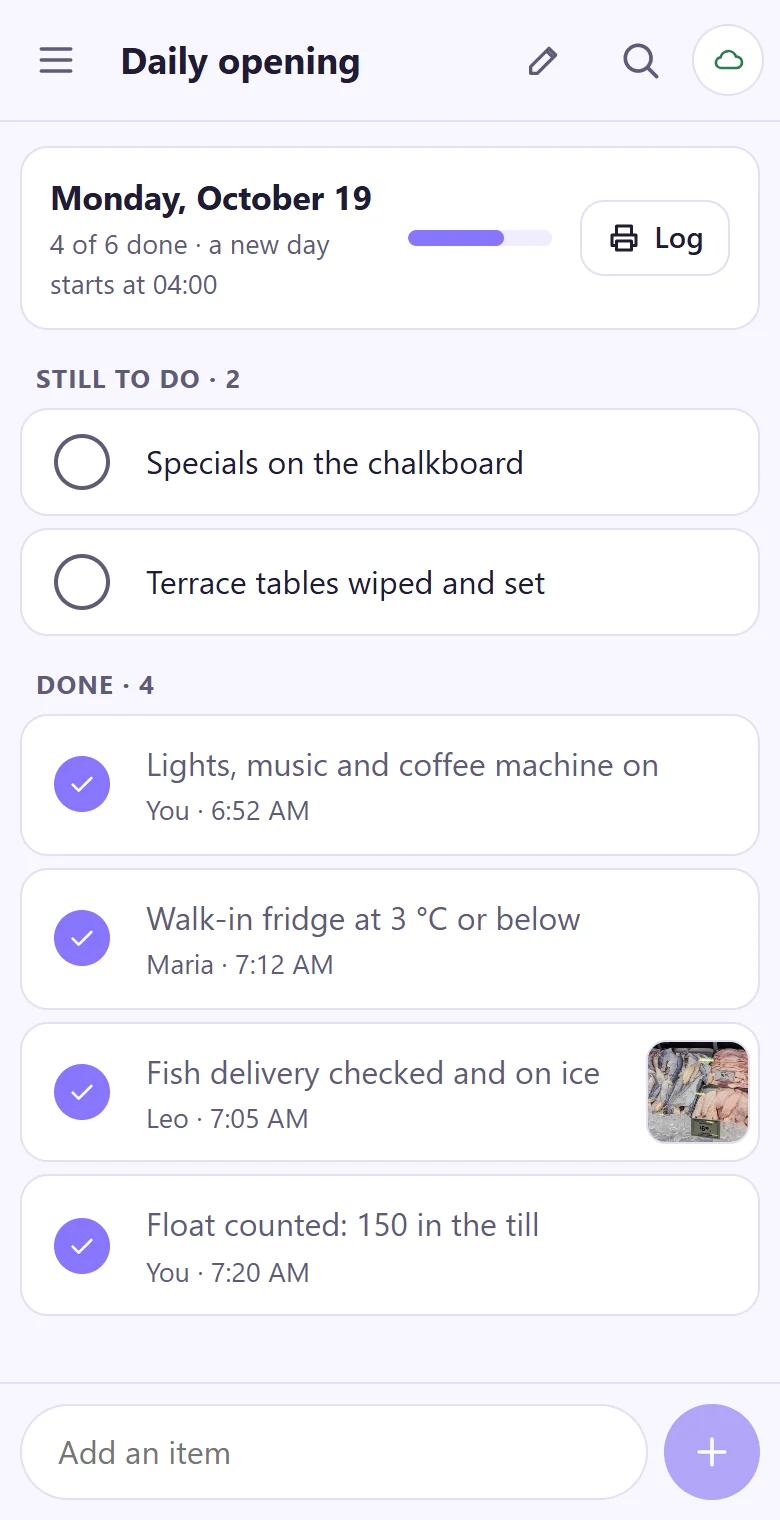
What it does not do: it does not check that the training was any good, and it is not a training-records system for certifications with expiry dates (forklift, first aid). Keep those where your insurer or regulator expects them.
A first-week list per new hire, with the name and time on every sign-off, that the whole crew can see.
Open tick-tock-doneWhat this piece does not show
No US figure for the first month. BLS's shortest band is "less than 3 months"; the month-by-month risk comes from Ontario, where the workforce and compensation rules differ.
No industry-by-tenure split. BLS does not publish injuries by both industry and length of service, so we cannot say what share of restaurant or construction injuries are first-year workers from government data; the 51% and 44% are Travelers' own claims (2026 report, as reported in the trade press).
The 1.5 ratio is rough. The injury counts are private industry; the tenure share includes government workers. It is a fair comparison of size, not a rate.
Some of the excess may not be the training. New hires are younger on average and are often given the worst tasks. The Ontario studies found the first-month excess in older workers too, so age does not explain it away, but no study we found separates how much is the job and how much is the person being new.
We found no study that tests a five-day plan. The plan above is built from the rules and the Job Instruction method, not from a trial that compared it with something else.
It is not legal advice. Federal rules as of October 2026; state plans and state child labor laws add to them.
Sources
Bureau of Labor Statistics, Survey of Occupational Injuries and Illnesses, case and demographic characteristics, table R71 (by length of service), 2023-2024 and 2021-2022; tables R1 and R4 (by nature and event, by industry), 2023-2024. BLS
Bureau of Labor Statistics, Employee Tenure (January 2024 and January 2026 releases). BLS
Travelers, 2025 Injury Impact Report (June 3, 2025). Travelers
Business Insurance on the Travelers 2026 Injury Impact Report (May 2026). Business Insurance; Claims Journal (May 11, 2026). Claims Journal
Institute for Work & Health: Breslin and Smith, Trial by fire, Occupational and Environmental Medicine 2006;63:27-32. IWH; Morassaei, Breslin, Shen and Smith, OEM 2013;70:171-178. IWH
29 CFR 1926.21, Safety training and education. eCFR via Cornell LII
29 CFR 1910.1200(h), Hazard Communication, employee information and training. Cornell LII
OSHA 2254, Training Requirements in OSHA Standards (2015). OSHA
29 CFR 570.33, 570.34, 570.61 and 570.62, child labor occupations and Hazardous Orders 10 and 11. Cornell LII; Department of Labor, Fact Sheet #2A, Child Labor Provisions for Restaurants. DOL
NIOSH, Preventing Injuries to Young Workers in Restaurants (Update, December 1999). CDC archive
Lean Enterprise Institute, TWI Job Instruction card. lean.org
BambooHR, new hire survey (September 20, 2023). BambooHR