In 2012 and 2013, OSHA cited 20 employers for heat illness under the General Duty Clause; 13 of the cases were deaths. When CDC researchers went through them, nine of the 13 workers had died in their first three days on the job, and four on their very first day. Twelve of the 20 employers had no heat program at all; 13 gave no shaded place to rest. Every case happened at a heat index between 84 and 106°F, the kind of day most crews work through every summer (Arbury and others, MMWR, August 2014).
Heat illness is one of the most preventable ways to lose someone on a job, and the prevention is plain: water, rest, shade, and easing new people in. This piece gives the numbers for construction and landscaping, the water and rest amounts the rules use, a day-by-day plan for new workers, the state heat rules in force as of October 2026, where the federal proposal stands, and how to turn it all into lines on the day's task list. It is written for small US crews, outdoors or in hot buildings. It is not legal or medical advice.
The numbers
Deaths from environmental heat at work, from the Bureau of Labor Statistics' Census of Fatal Occupational Injuries:
2011 61 · 2012 31 · 2013 34 · 2014 18 · 2015 37 · 2016 39 · 2017 32
2018 49 · 2019 43 · 2020 56 · 2021 36 · 2022 43 · 2023 55 · 2024 48
That is about 42 a year, 1,042 from 1992 to 2022 by OSHA's count. BLS changed how it codes events from 2023, so the last two years don't line up perfectly with the earlier ones, and both OSHA and the construction research group CPWR say the official counts are likely low: heat often shows up on a death certificate as a heart attack.
Construction carries far more than its share. In CPWR's August 2025 data bulletin:
About 7% of the workforce, more than a third of heat deaths: 17 of 43 in 2022, 18 of 55 in 2023.
A death rate nearly four times other industries: 0.15 versus 0.04 per 100,000 full-time workers.
71.4% of construction heat deaths fall in June, July and August.
Nonfatal cases with days away from work fell from 1,500 in 2011-12 to 620 in 2021-22, but construction still ranks among the top industries.
Landscaping and groundskeeping workers, construction laborers and roofers spend 99.5% of their work time exposed to the outdoors, against 33% for all workers (BLS, 2023 data). Heat isn't only an outdoor problem: a commercial kitchen in July or an attic in a renovation can be worse than the yard.
Water, rest, shade
Water
NIOSH's advice for moderate work in the heat lasting under two hours: 1 cup (8 oz) of water every 15 to 20 minutes, which is 24 to 32 oz an hour, and generally not more than 6 cups (48 oz) an hour, since drinking far more than that can drop blood sodium. For longer stretches of sweating, add drinks with electrolytes. Thirst is a late signal; the point of a schedule is that people drink before they feel it.
The state rules turn that into a supply figure: California, Washington, Oregon and Maryland all require access to at least 1 quart (32 oz) per worker per hour, cool, free and close to the work. For a crew, the arithmetic for the cooler is simple:
5 people x 10 hours x 1 quart = 50 quarts, 12.5 gallons. That is more than two standard 5-gallon coolers, so either bring three or plan a refill run at midday. A 2-gallon jug per person covers only 8 hours.
Rest
Rest breaks in the heat are for cooling down, in the shade, not working. The state rules that set numbers line up closely:
Washington: at 90°F, a 10-minute paid cool-down every 2 hours; at 100°F, 15 minutes every hour.
Maryland: at a heat index of 90°F, 10 minutes every 2 hours; at 100°F, 15 minutes every hour.
Oregon (three options at a heat index of 90°F): the minimum employer-adjusted schedule is 10 minutes every 2 hours at 90°F and 15 minutes every hour at 100°F. Its simplified schedule asks for more: 10 minutes every 2 hours at 90°F, 20 minutes every hour at 95°F, 30 at 100°F, 40 at 105°F. Oregon OSHA reads "20 minutes every hour" as 40 minutes of work, then 20 of rest.
California: for agriculture, a 10-minute preventive cool-down every 2 hours at 95°F; for everyone, the right to a cool-down rest in the shade whenever a worker feels they need one.
The federal proposal: a paid 15-minute break every 2 hours at a heat index of 90°F.
The heavy rest at the top of Oregon's simplified table is the honest message of the science: at a heat index of 105°F, hard physical work for a full hour is not safe for most people. Moving the heavy work to the morning is cheaper than resting 40 minutes in every hour in the afternoon.
Shade
Shade means blocked sunlight, big enough for everyone on a break to sit at once, and close to the work. Oregon OSHA's test: objects don't cast a shadow in it. A parked car in the sun doesn't count unless it is running with the air conditioning on; a wide-brimmed hat doesn't count as shade. A pop-up canopy for every 4 or 5 people, set up before the heat arrives, is the usual answer.
New workers: the first week
The pattern in the 2014 study is the strongest single finding in heat safety. OSHA's guidance on new workers says almost half of heat deaths happen on the first day, or the first day back after time away, and more than 70% in the first week. The body adapts to heat over 7 to 14 days (more sweat, earlier, and a lower heart rate), and until it has, the same work at the same temperature is far more dangerous.
NIOSH's schedule: a new worker spends no more than 20% of the usual time in the heat on day 1, and adds no more than 20% a day. A worker coming back after a week or more away, already used to the work, goes 50%, 60%, 80%, then 100%. On an 8-hour day that is:
New worker: day 1, 1 h 36 min in the heat · day 2, 3 h 12 min · day 3, 4 h 48 min · day 4, 6 h 24 min · day 5, the full 8 h.
Returning worker: day 1, 4 h · day 2, 4 h 48 min · day 3, 6 h 24 min · day 4, the full 8 h.
The rest of the day is work in the shade or indoors: loading in the shop, paperwork, tool maintenance, training. The federal proposal would use the same 20-40-60-80% steps over four days for new workers, or treat them under the high-heat rules for their whole first week. California asks for new workers in a high-heat area to be closely watched for their first 14 days.
The same applies to a heat wave. When the temperature jumps 10°F or more above what the crew has been working in, everyone is effectively new to it for a few days.
Reading the heat index
The heat index combines air temperature and relative humidity into what the heat feels like. The National Weather Service computes it with the Rothfusz regression. A few values, worked with that formula, for shade and a light breeze:
86°F and 50% humidity: heat index 88°F.
90°F and 50%: 95°F.
94°F and 45%: 100°F.
85°F and 70%: 93°F.
100°F and 20%: 97°F.
Two cautions. First, the heat index assumes shade. Oregon OSHA's guidance, following the NWS charts, adds up to 13°F for full sun: its own example turns 80°F at 50% humidity, a heat index of 81, into 99°F in full sun. Second, OSHA's old four-band scale (under 91°F lower risk, 91 to 103 moderate, 103 to 115 high, over 115 very high) was set too high: a CDC review found 6 of 14 outdoor heat deaths happened below 91°F, and OSHA's 2026 emphasis program notes deaths below 80°F. That is why the state rules and the federal proposal start at 80.
The rules: which states have one, and the federal proposal
States with a heat rule
California (Title 8 section 3395, outdoors, since 2005; current text 2015): shade from 80°F, 1 quart per worker per hour, high-heat procedures at 95°F for agriculture, construction, landscaping, oil and gas, and heavy-materials transport (observation, a buddy system or one supervisor per 20 workers, pre-shift meetings). Indoors (section 3396, since July 23, 2024): applies from 82°F; full measures at 87°F, or 82°F with heat-trapping clothing or radiant heat.
Washington (WAC 296-62-095, updated July 17, 2023): from 80°F, or 52°F in non-breathable clothing; shade and 1 quart an hour; the 90°F and 100°F cool-downs above; close watch on new and returning workers for 14 days.
Oregon (OAR 437-002-0156, since June 15, 2022; indoors and out): from a heat index of 80°F, shade, 32 oz an hour, a written plan, acclimatization, training; at 90°F a written rest schedule and someone watching for symptoms.
Maryland (COMAR 09.12.32, since September 30, 2024; indoors and out): from a heat index of 80°F, 32 oz an hour, acclimatization over up to 14 days at no more than 20% a day; the 90°F and 100°F rest tiers above.
Nevada (regulation R131-24, enforced since April 29, 2025): employers with more than 10 employees do a one-time job hazard analysis of heat for job types where most people are exposed, and write a plan if it finds a risk.
Colorado has heat rules for agriculture only (shade from 80°F; no more than 2 hours without rest at 95°F); a 2026 law (HB26-1272) orders data collection and a model plan, with no employer rules yet.
Virginia passed a law in 2026 directing its safety board to adopt a heat standard by May 2028; New Mexico's proposed rule has been postponed to 2027.
The federal rule: proposed, not final
OSHA proposed "Heat Injury and Illness Prevention in Outdoor and Indoor Work Settings" in the Federal Register on August 30, 2024 (89 FR 70698, docket OSHA-2021-0009). It would cover about 36 million workers. At a heat index of 80°F: 1 quart of water per worker per hour, a shaded or air-conditioned break area, paid rest breaks as needed, the acclimatization schedule above, and two-way contact with workers. At 90°F: a paid 15-minute break every 2 hours, a buddy system or one observer per 20 workers, contact every 2 hours with anyone working alone, and a pre-shift heat alert. Employers with more than 10 employees would need a written heat plan.
Where it stands: comments closed January 14, 2025; an informal public hearing ran from June 16 to July 2, 2025; post-hearing comments closed October 30, 2025. The latest regulatory agenda still lists it at the proposed rule stage, with a supplemental proposal planned for December 2026 and final action for October 2027. The Congressional Research Service wrote in August 2026 that "no further action has been taken". There is no federal heat standard in force.
That does not mean nothing is enforced. OSHA cites heat cases under the General Duty Clause, and on April 10, 2026 it replaced its 2022 National Emphasis Program on heat with a new one running up to five years. It names 55 industries for inspections, including restaurants (NAICS 7225), landscaping services (5617) and most construction trades, treats any day with a forecast heat index of 80°F or more as a "heat priority day", and sends inspectors out when the Weather Service issues a heat advisory. Two 2024 Florida cases show the stakes: a 26-year-old farmworker who died of heatstroke on his first day on the job at a heat index of 97°F ($27,655 proposed penalty), and a 41-year-old orange picker who collapsed at about 92°F ($30,651).
A heat plan on the day's task list
A heat plan that lives in a binder doesn't get used at 2 p.m. in July. The parts that matter fit on the day's task list for the crew lead, triggered by the forecast:
The evening before: check the forecast high and humidity and work out the heat index (or use the OSHA-NIOSH Heat Safety Tool app, or our heat check card, which also works out the water, the rest schedule and the new workers' hours for your state); add 13°F for work in full sun. Note anyone new or back from a week or more off.
Heat index 80°F or more: water loaded, 1 quart per person per hour for the shift (count the coolers); shade up before the first break; tell the crew where the shade is and that anyone can take a cool-down when they need it.
Heat index 90°F or more: post the rest schedule (at least 10 minutes every 2 hours; more as it climbs); pair people as buddies; move the heaviest tasks before 11 a.m.; a check-in with anyone working alone every 2 hours (see lone worker check-ins).
New and returning workers: their hours in the heat for today, from the schedule above, and what they do the rest of the day.
Emergency: the site address for 911, who drives, where the nearest cold water or ice is. For signs of heat stroke (confusion, slurred speech, collapse, hot skin), call 911 and cool the person at once with cold water or ice; don't wait for the ambulance to start cooling.
A worked day
A five-person landscaping crew in Oregon, a 10-hour day, forecast 94°F and 45% humidity: a heat index of about 100°F in the shade, more in the sun. Under the simplified Oregon schedule, from 100°F that is 30 minutes of rest in every hour; under the minimum employer-adjusted schedule, 15 minutes an hour. Water: 5 x 10 x 1 quart = 12.5 gallons. One worker started Monday; today is day 3, so 60% of a normal 10-hour day in the heat, 6 hours, the rest in the shop.
The plan that follows: start at 6 a.m., do the mowing and hardscape while the heat index is under 90°F (around 86°F and 50% humidity at mid-morning, a heat index near 88), shift to irrigation repair and trimming in partial shade after noon, and stop the heavy work by 2 p.m. The rest schedule goes on the list as tasks with times, so it happens instead of being remembered.
Running it in tick-tock-done
In tick-tock-done a daily checklist starts fresh every morning, so the heat lines above can be a team checklist ("Heat: water loaded, shade up, rest schedule posted, buddies named") that the crew lead ticks before the first job. Each tick shows who did it and when, a line can need a photo (the coolers in the truck, the canopy up), and the time clock shows who is on site. Task updates on the day's job carry the rest times and the new worker's hours, dated and named.
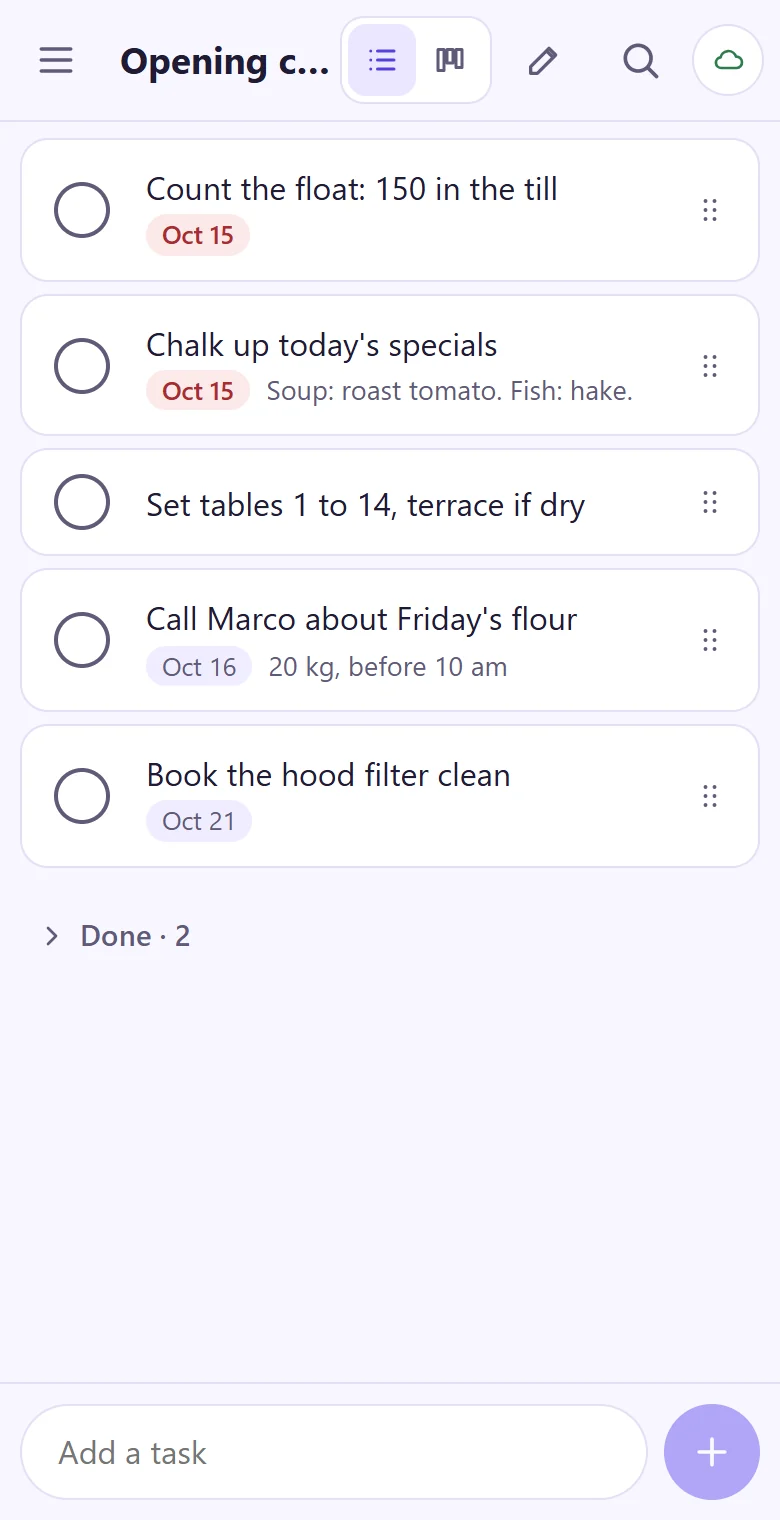
What it does not do: it does not read the weather or the heat index, and it does not raise an alarm when it gets hot. The forecast check and the decisions are the crew lead's; the checklist makes sure they happen and leaves a record that they did. More on a crew's morning routine: The ten-minute pre-shift huddle.
Daily checklists with names, times and photos on every tick, a time clock on each phone and the day's jobs in one place, for building and landscaping crews.
See it for constructionWhat this piece does not show
It is not legal or medical advice. Rule details are summarized from the state texts and agency guidance as we read them in October 2026. State-run OSHA programs (California, Washington, Oregon, Nevada, Maryland and others) enforce their own rules, and some cities add more.
The death counts are low estimates. Heat is often missed as a cause, and 2023 onward is coded differently from earlier years.
The acclimatization percentages are guidance, from NIOSH and the state rules, not a schedule tested in a trial; people with heart disease, on some medications, or after illness adapt more slowly.
The heat index examples are shade values from the NWS formula; sun, wind, work rate and clothing change the real heat load. A wet bulb globe temperature reading is more accurate where a job can measure it.
The federal rule may change before it is final, or may not be finished at all.
Sources
Arbury S. and others, Heat Illness and Death Among Workers, United States, 2012-2013, MMWR 63(31), August 8, 2014. CDC
Tustin A. W. and others, Evaluation of Occupational Exposure Limits for Heat Stress in Outdoor Workers, United States, 2011-2016, MMWR 67(26), July 6, 2018. CDC
Bureau of Labor Statistics, 36 work-related deaths due to environmental heat exposure in 2021 (with 2011-2021), and fatal occupational injuries by event, 2024. BLS and BLS chart
Bureau of Labor Statistics, It's summer and it's hot on the job (June 2024). BLS
CPWR, Heat-related deaths and injuries in construction, Data Bulletin, August 2025. CPWR
Congressional Research Service, OSHA's proposed heat rule, IN11701, updated August 18, 2026. EveryCRSReport
OSHA, Heat Injury and Illness Prevention in Outdoor and Indoor Work Settings, proposed rule, 89 FR 70698, August 30, 2024, and the rulemaking page. Federal Register and OSHA
Regulatory agenda entry, RIN 1218-AD39. Reginfo.gov
OSHA, National Emphasis Program on heat, CPL 03-00-024, April 10, 2026, and news release. OSHA
OSHA, Protecting new workers, and Water. Rest. Shade. OSHA
NIOSH, Heat stress: workplace recommendations (water, acclimatization). CDC/NIOSH
National Weather Service, The heat index equation. NWS WPC
California Code of Regulations, Title 8, sections 3395 and 3396. DIR 3395 and DIR 3396
Washington Administrative Code 296-62-09530 to 296-62-09547 (outdoor heat exposure). WA Legislature
Oregon OSHA, Frequently asked questions: heat illness prevention (OAR 437-002-0156), 440-5866, May 2023. Oregon OSHA
Maryland Occupational Safety and Health, heat stress standard key requirements (COMAR 09.12.32). Maryland Labor
Nevada Department of Business and Industry, Nevada OSHA heat regulation enforcement begins April 29, 2025. Nevada B&I
Colorado General Assembly, HB26-1272. Colorado Legislature
OSHA news releases, April 15, 2024 (Belle Glade, Florida) and June 26, 2024 (Arcadia, Florida). OSHA