A line cook works 30 hours one week and 50 the next. That averages 40, and many small owners would call it a normal fortnight. Under federal law it is 10 hours of overtime: "The Act takes a single workweek as its standard and does not permit averaging of hours over 2 or more weeks" (29 CFR 778.104). Put the same cook in California on a 13-hour Saturday and one of those hours is double time, whatever the weekly total.
Overtime is rarely a payroll surprise because someone broke a rule on purpose. It comes from a pick-up shift nobody added up, a close that ran long, or a cook who also washes dishes at a lower rate. This piece covers when time and a half starts under federal law and in the four states with daily overtime, how to work out the rate for someone on two rates, and how to read next week's schedule for overtime before it happens. It is for hourly, non-exempt crews in the US, as of October 2026, and it is not legal advice. What counts as a paid hour in the first place (setup, travel between sites, waiting) is in What counts as hours worked.
The federal rule: 40 hours in a fixed workweek
The Fair Labor Standards Act asks for 1.5 times the regular rate for every hour over 40 in a workweek. Three details decide most real cases:
The workweek is fixed. It is "a fixed and regularly recurring period of 168 hours, seven consecutive 24-hour periods". It can start on any day and at any hour, but once set it stays put "regardless of the schedule of hours worked", and it may be changed only for good, not to dodge overtime (29 CFR 778.105).
Each week stands alone. No averaging over two weeks, whether pay is weekly, biweekly or monthly (778.104).
All the hours count, at every job for you. If someone does two unrelated jobs for the same employer in one week, all the hours go into one total (778.103). Hours at a second, unrelated employer do not, unless the two are joint employers.
Federally, there is no daily overtime. A 14-hour day in a 38-hour week owes no overtime under the FLSA. Some states disagree.
Breaking the rule is expensive: the unpaid overtime plus an equal amount in liquidated damages (29 USC 216(b)), going back two years, or three if the violation was willful (29 USC 255). In fiscal year 2025 the Labor Department's Wage and Hour Division recovered about $259 million in back wages for nearly 177,000 workers, more than $184 million of it under the FLSA (DOL news release, January 8, 2026).
Why the workweek start matters
Say a restaurant's workweek runs Sunday 00:00 to Saturday 23:59, and a server works a heavy stretch from Thursday to the following Wednesday: four 10-hour shifts Thursday to Sunday, then three 10-hour shifts Monday to Wednesday. Thursday to Saturday is 30 hours in week one; Sunday to Wednesday is 40 hours in week two. No overtime in either week. If the workweek started on Thursday instead, the same 70 hours over seven days would fall in one week: 30 hours of overtime. The schedule is identical; the fixed start decides. That is why you pick it once, write it down, and plan against it.
The four states with daily overtime
Most states follow the federal 40-hour week. Four add a daily limit (Puerto Rico also has one), and where state and federal rules differ, the employee gets whichever pays more.
California (Labor Code 510): 1.5x after 8 hours in a workday and after 40 in a workweek; 2x after 12 hours in a workday. On the seventh consecutive day worked in a workweek, the first 8 hours are 1.5x and anything after 8 is 2x. Alternative workweek schedules (four 10s, three 12s) are allowed only after a secret-ballot vote of the affected employees.
Alaska (AS 23.10.060): 1.5x after 8 hours a day and after 40 a week, for employers with four or more employees. Hours already paid as daily overtime are left out when counting toward 40.
Nevada (NRS 608.018): 1.5x after 8 hours in any 24-hour period, but only for employees paid less than 1.5 times the minimum wage. The minimum wage stays $12.00 from July 1, 2026 (Labor Commissioner bulletin, June 29, 2026), so daily overtime applies below $18.00 an hour. Everyone non-exempt gets the 40-hour rule. A written agreement for four 10-hour days can take the daily rule off.
Colorado (COMPS Order #39, Rule 4): 1.5x after 40 hours a week, after 12 hours in a workday, or after 12 consecutive hours even across midnight, whichever pays more.
One week, five rule books
The same planned weeks, read under each set of rules (federal is the floor everywhere):
Week A: 10, 10, 10, 10 and 4 hours (44 in 5 days).
Federal: 4 h overtime (44 - 40).
California: 8 h overtime (2 a day on the four 10-hour days); the remaining 36 hours don't reach 40, so nothing more.
Alaska: 8 h, the same way.
Nevada, paid under $18: 8 h. Paid $18 or more: 4 h.
Colorado: 4 h (no day over 12).
Week B: 6 hours a day, 7 days in a row (42 hours).
Federal, Alaska, Nevada, Colorado: 2 h overtime.
California (with a Monday-to-Sunday workweek): 6 h at 1.5x, all of Sunday, because it is the seventh consecutive day worked in the workweek. Counting it again toward 40 would pay it twice, so the weekly rule adds nothing more.
Week C: three 13-hour shifts (39 hours).
Federal: none.
California: per shift, 4 h at 1.5x and 1 h at 2x: 12 h at 1.5x and 3 h at 2x for the week.
Alaska and Nevada under $18: 15 h at 1.5x (5 per shift).
Colorado: 3 h at 1.5x (the 13th hour of each shift).
At $20 an hour, Week C costs $780 in straight pay federally. In California it costs $780 + 12 x $10 + 3 x $20 = $960, 23% more for the same 39 hours. Three 12-hour shifts instead (36 hours) would cost $720 + 12 x $10 = $840 in California, with no double time.
Two jobs, two rates: the regular rate
Small crews do this all the time: a line cook who covers the dish pit, a cleaner who also does a supervisor shift, a laborer who runs the excavator some days. Overtime is not paid at whichever rate was in force when the 41st hour happened. Federal rule (29 CFR 778.115): the regular rate for the week is the weighted average of the rates, total straight-time earnings divided by total hours.
A worked example
Marco works 30 hours on the line at $18 and 15 hours in the dish pit at $15: 45 hours.
Straight-time pay: 30 x $18 + 15 x $15 = $540 + $225 = $765.
Regular rate: $765 / 45 = $17.00.
Overtime premium: the straight time already pays every hour once, so the 5 overtime hours add half the regular rate: 5 x 0.5 x $17.00 = $42.50.
Total for the week: $765 + $42.50 = $807.50.
Two common mistakes: treating the two roles as separate jobs, each under 40, so no overtime at all ($42.50 short a week, about $2,200 a year for one person, before the equal amount in damages); or paying the overtime at $15 because the last shift was dish.
There is one alternative. If Marco agrees in advance (29 CFR 778.419), his overtime hours can be paid at 1.5x the rate of the work he is doing in those hours, as long as that is the rate he really gets for that work in non-overtime hours. If his last 5 hours were dish, that is a premium of 5 x $7.50 = $37.50 instead of $42.50. Without the advance agreement, the weighted average applies.
Bonuses go in too
A non-discretionary bonus (attendance, a shift premium promised in advance, a weekly production bonus) is part of the regular rate (29 CFR 778.209). Add a $50 perfect-attendance bonus to Marco's week: ($765 + $50) / 45 = $18.11; premium 5 x 0.5 x $18.11 = $45.28. A bonus paid later for a month or a quarter has to be spread back over the weeks it was earned, and the extra half-rate paid on each week's overtime hours. A true gift at the owner's discretion, like an unannounced holiday bonus, stays out. Tips are not part of the regular rate.
Reading next week's schedule for overtime
Overtime is cheapest to deal with before the week starts, when it is a scheduling choice rather than a payroll fact. A ten-minute check on the posted schedule:
1. Total each person's planned hours for the workweek, by your fixed start, not by the calendar week the schedule happens to show.
2. Flag anyone at 36 or more, not just over 40. Closes run long and people pick up shifts; 4 hours of headroom is about one late close and a half.
3. Add up people on two roles across both, and anyone who works at two of your locations.
4. In California, Alaska, and Nevada (under $18), flag every shift over 8 hours. In California also flag shifts over 12 (double time) and anyone on 7 days in a row in the workweek. In Colorado flag shifts over 12 hours, and a close followed by an early open with no real break, since 12 consecutive hours counts.
5. Decide each flag on purpose (the overtime week check does most of steps 1 to 4 for a crew): move a shift to someone under 32, split a long day, or accept the overtime and know what it costs.
6. Mid-week, check again: hours so far plus hours still planned. Wednesday is when a Saturday overtime problem can still be fixed.
7. Shift swaps and pick-ups get the same check before they're approved. A swap that pushes someone over 40 is a cost the person approving it should see.
Two rules stay whatever you plan. Overtime worked without permission is still paid if you knew or should have known (29 CFR 785.11 to 785.13). And you may not give time off later instead of overtime pay: for private employers, comp time in place of the 1.5x premium is not allowed under the FLSA, and Colorado says so outright.
What overtime costs a small crew
One cook at $18 doing 5 hours of overtime a week costs 5 x $9 = $45 a week in premium on top of the straight pay, or $2,340 a year. Across a kitchen of six where four people each run 3 hours over, it is 12 x $9 = $108 a week, $5,616 a year. Sometimes that is the cheapest answer, cheaper than hiring and training another person. The point of reading the schedule is that it is a choice, made on Monday, not a number found on payday.
Planning the week in tick-tock-done
In tick-tock-done the Plan tab lays the team out with people down the side and the week across, so each person's shifts for the week are in one row before you post them. Everyone clocks in and out on their own phone, and the timesheets show each person's hours for the week as they build up, so the Wednesday check is a glance rather than a phone call. Requests for a different shift or time off come in through the app, where the manager sees the week they would change.
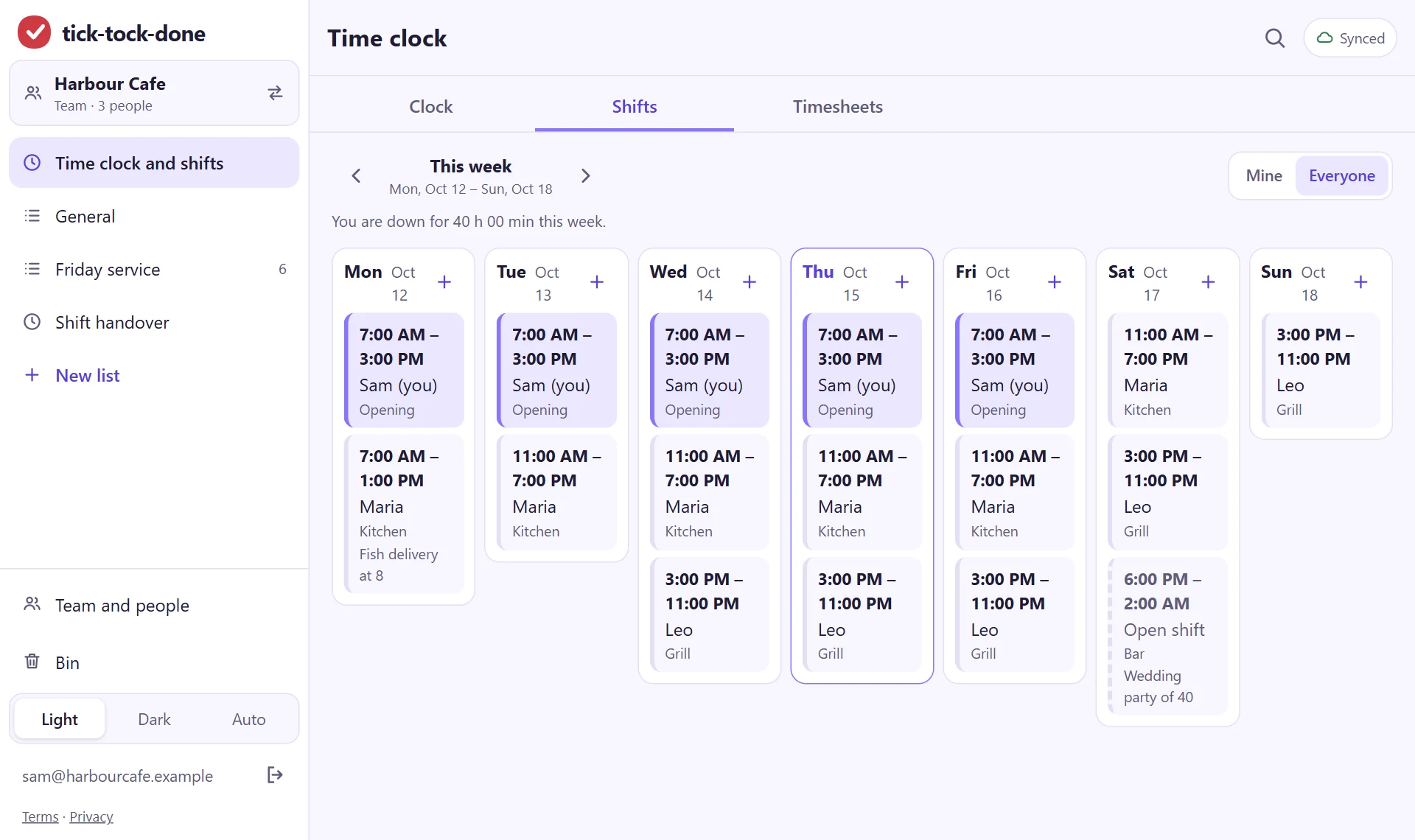
What it does not do: the app itself does not calculate overtime or pay rates. For that, our overtime week check takes each person's planned hours for the week, at one or two pay rates, under the federal rule or California, Alaska, Nevada or Colorado, and shows the hours at time and a half and double time, the weighted regular rate and what the overtime costs, before the schedule goes out. Which minutes count as hours in the first place is the job of the hours worked checker.
A week's shift plan with one row per person, a time clock on each phone and weekly timesheets, for restaurant and building crews.
See it for restaurantsWhat this piece does not cover
It is not legal advice. It summarizes the FLSA regulations (29 CFR Part 778) and four state rules as we read them in October 2026. Cities and counties do not usually change overtime, but union contracts and prevailing wage jobs often do.
Exempt and salaried staff, and special rules (hospital 8-and-80 schedules, agriculture, ski areas in Colorado, the motor carrier exemption) are left out.
Puerto Rico has daily overtime too, and some states set their own rules for public employees and specific industries.
California's alternative workweeks need an election with written disclosure and a filing with the state; this piece does not walk through it.
Nevada's 4-10 agreement and the exact way state and federal overtime combine in edge cases depend on the statute text and your payroll provider's reading of it.
Sources
29 CFR 778.103 (the workweek as the basis), 778.104 (each workweek stands alone), 778.105 (determining the workweek), 778.115 (two or more rates), 778.209 (bonuses), 778.419 (hourly workers at two or more jobs). eCFR Part 778
29 CFR 785.11 to 785.13 (work suffered or permitted). eCFR Part 785
U.S. Department of Labor, Fact Sheet #23: Overtime pay requirements of the FLSA. DOL
U.S. Department of Labor, news release, January 8, 2026: more than $259 million in back wages recovered in fiscal year 2025. DOL
California Labor Commissioner, Overtime FAQ (Labor Code 510). DIR
Alaska Statutes 23.10.060, payment for overtime. Justia
Nevada Labor Commissioner, annual bulletin: daily overtime and minimum wage from July 1, 2026 (NRS 608.018). Nevada Labor Commissioner
Colorado Department of Labor and Employment, COMPS Order #39 (7 CCR 1103-1), Rule 4, and its poster. CDLE