Teresa Amabile and Steven Kramer asked 669 managers, from dozens of companies, to rank five things that motivate people at work: recognition, incentives, interpersonal support, clear goals, and support for making progress. Recognition came first. Only 35 of the 669, about 5%, put progress first; most put it last.
Their own data said the opposite. In a diary study of 238 people, the single most common feature of a good day at work was making progress on something that mattered, even a small step. They called it the progress principle, and published it in the Harvard Business Review in May 2011 and in a book the same year. This piece goes through what the study did and found, what counted as progress, why setbacks weighed more than wins, what other research adds, and what the honest limits are for a crew in a kitchen or on a site rather than an office.
The study: 12,000 end-of-day diaries
Who: 238 people in 26 project teams at 7 companies, in chemicals, high tech and consumer products. All did knowledge work: projects like a new line of kitchen gadgets, cleaning-tool products, solving IT problems for a hotel chain.
How: an email questionnaire at the end of every working day, Monday to Friday, for the length of the team's project: 9 to 38 weeks, about 19 weeks on average ("just over four months").
What it asked: ratings on a 1 to 7 scale of the day's emotions, mood and motivation and of the work environment, then one open question: briefly describe one event from today that stands out in your mind.
How much: nearly 12,000 diary entries. In the peer-reviewed paper on the same data (Amabile, Barsade, Mueller and Staw, Administrative Science Quarterly, 2005), 222 people with usable response rates gave 11,471 daily reports, about 52 each, a 75% average response rate.
When: collected in the late 1990s and early 2000s.
The design is the strength. Most workplace motivation research asks people once, in a survey, how they generally feel. This one caught each day while it was fresh, and then let the researchers line up what happened with how people felt.
What the diaries showed
Amabile and Kramer sorted the days by how people rated their mood, then looked at what had happened on the best and the worst days:
Best-mood days: progress on 76% of them, setbacks on 13%.
Worst-mood days: setbacks on 67% of them, progress on 25%.
Progress was not the only thing that mattered, but it was the most frequent. And it did not need to be big. In their words, "a notable proportion (28%) of incidents that had a minor impact on the project had a major impact on people's feelings about it". A bug finally fixed, a sample approved, a stuck order released.
Setbacks weigh more than wins
The other side was stronger. In the book, the effect of a setback on happiness was more than twice as strong as the effect of progress, and its effect on frustration more than three times as strong. Amabile summed it up in an interview as setbacks being "two to three times stronger". That fits a much wider pattern: Baumeister and colleagues' review "Bad Is Stronger Than Good" (2001) found bad events, feedback and impressions outweighing good ones across almost every area they looked at.
The practical point for a crew lead: removing one daily setback (the missing part, the prep that wasn't done, the equipment nobody reported broken) may do more for the day than adding one more win.
Catalysts, nourishers, inhibitors, toxins
The diaries also showed what made progress possible. Amabile and Kramer named four kinds of event:
Catalysts support the work itself: clear goals, autonomy, the resources and enough time, help with the work, learning from problems, letting ideas flow.
Nourishers support the person: respect and recognition, encouragement, emotional support, a sense of belonging to the team.
Inhibitors are the reverse of catalysts: unclear goals, missing resources, no time, no help.
Toxins are the reverse of nourishers: disrespect, discouragement, ignoring people's problems.
One condition runs under all of it: "For the progress principle to operate, the work must be meaningful to the person doing it." Meaningful here does not mean noble. It means the person can see that the work counts for someone: the customer gets the right order, the floor passes the inspection, the wall is ready for the next trade.
Why writing it down helps
Amabile's study described what made good days; it did not test whether recording progress causes anything. Other research comes closer.
Monitoring progress works, and works better on paper or in public. Harkin and colleagues' meta-analysis in Psychological Bulletin (2016) pooled 138 randomized studies with 19,951 people. Interventions that got people to check their progress more often improved goal attainment, with an average effect of d = 0.40 (95% CI 0.32 to 0.48), a small-to-medium effect. The effect was larger "when the outcomes were reported or made public, and when the information was physically recorded". Most of those studies were about health goals (weight, exercise, blood pressure), not work.
Reflecting on the day helped trainees learn. In a field experiment at a Wipro call center in Bangalore, trainees who spent the last 15 minutes of each training day writing about what they had learned scored 22.8% higher on the final test than those who kept working those 15 minutes (Di Stefano, Gino, Pisano and Staats, Harvard Business School working paper 14-093, 2014, revised 2023). Treat it with care: it is a working paper, not a peer-reviewed article, and one of its authors, Francesca Gino, lost her Harvard tenure in 2025 after a misconduct finding on other papers. As far as we found, this paper is not among those flagged.
Closer to shift work: Harris, Daniels and Briner (2003) followed call-center staff with a two-week daily diary and found that reaching the day's work goals went with feeling more energized at the end of the day, more so for goals the person cared about. It is small, but it is a frontline job rather than a research lab.
A done column for the crew
Taken together: progress is the most common feature of good working days, small steps count, setbacks hurt more, and recording progress where people can see it helps. For a crew, that turns into a few habits that cost minutes:
1. Keep a team done list for the day, not just a to-do list. On a board, the Done column is the progress record; leave the day's ticks there until tomorrow's huddle instead of clearing them at once.
2. Make the steps small enough to finish in a shift. "Kitchen deep clean" never moves; "hood filters soaked", "walk-in shelves wiped", "floor drains cleared" do. Weick's 1984 paper on small wins defined one as "a concrete, complete, implemented outcome of moderate importance": finished, not started.
3. Look back for two minutes at the end of the shift or in the next huddle. What got done, what got stuck. Read the done list out loud; it takes less time than it sounds. More on the huddle itself: The ten-minute pre-shift huddle.
4. Write down setbacks as tasks, not complaints. "Slicer blade dull" goes on the list with a name on it. A setback that someone owns becomes the next small win.
5. Say who did it. Recognition was the managers' favorite motivator, and the diaries show it matters too, as a nourisher. A done list with names on it does it without a speech.
What a day's done list looks like
A small cafe's team list at the end of a Saturday:
Done: delivery checked in and put away (Ana, 7:40) · cold brew batch for Sunday (Ben, 9:15) · espresso grinder recalibrated (Ana, 11:05) · broken chair fixed (Jo, 14:30) · close checklist, all 18 lines (Ben, 17:50).
Stuck: milk order short 6 gallons, supplier called, redelivery Monday (Jo).
Tomorrow: prep for the 20-person booking at 11.
Nothing on it is impressive. That is the point the 28% figure makes: small, finished, visible.
The same idea in tick-tock-done
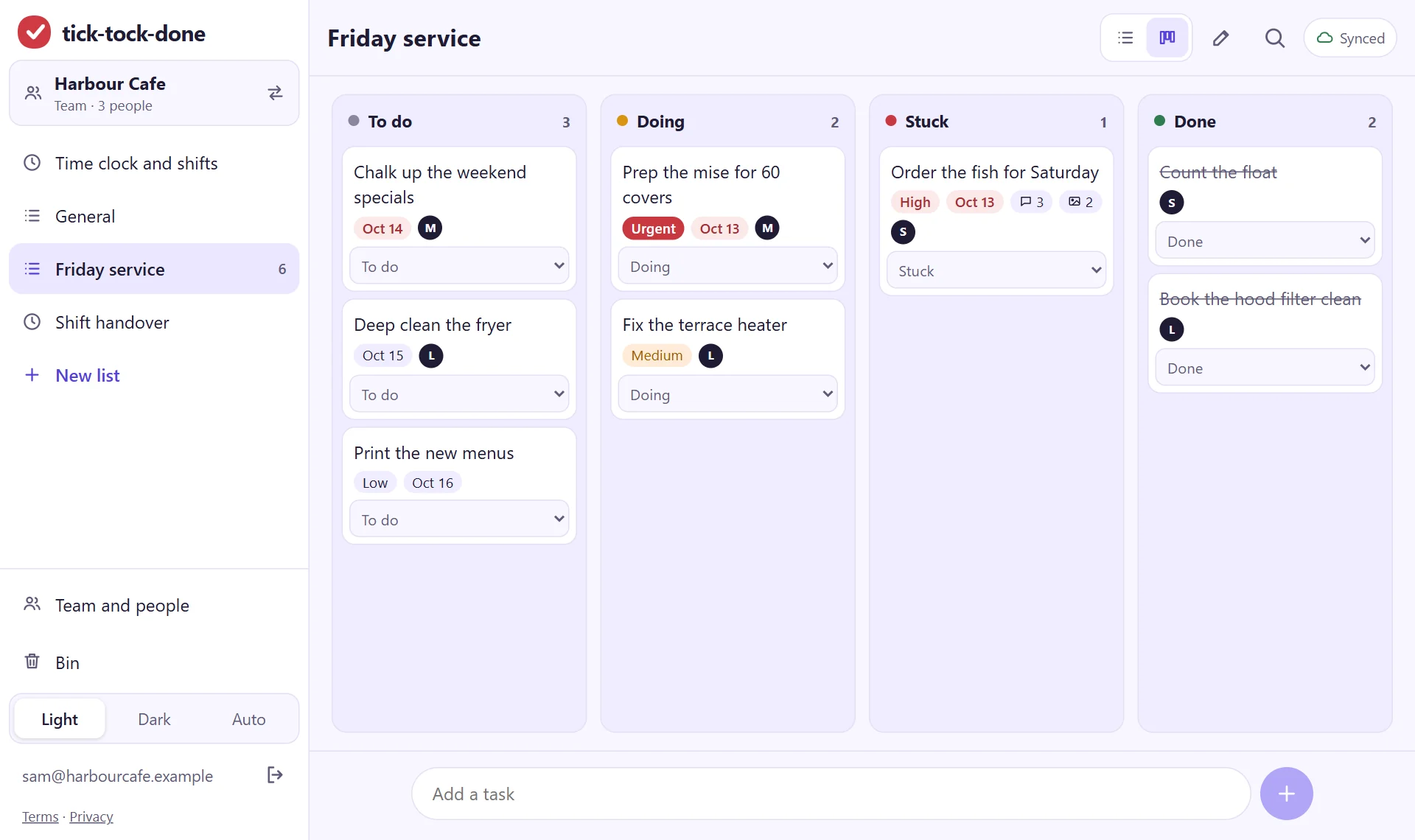
In tick-tock-done each team list can be a board with columns its manager names, and ticked tasks land in Done. The board below has a Stuck column too, which is where setbacks go, with a name on each. Every tick keeps who did it and when, and every update on a task is dated and named, so the done list for the day and the setbacks written on tasks are already in one place when the huddle starts. Daily checklists start fresh each morning, so yesterday's closing list doesn't hang around half-ticked.
Why ticking a task off feels good in the moment is a separate question, covered in Dopamine and the tick; and why people speed up as the end of a list comes in sight is in the goal-gradient piece.
A team board with a done column, names and times on every tick, and daily checklists that start fresh each morning.
See how it worksWhat the research does not show
It is correlation, not cause. Amabile and Kramer say so themselves: their analyses "establish correlations but do not prove causality", and the causality "almost certainly" runs both ways: people in a good mood may also make more progress.
The people were office knowledge workers, mostly men and college graduates, working on creative projects. No kitchen, site or cleaning crew was in the sample. The call-center diary study is the nearest frontline evidence, and it is small.
The headline numbers are not peer-reviewed. The 76%, 13%, 67%, 25%, 28%, the 669 managers and the "twice as strong" figure come from the HBR article and the book. The peer-reviewed paper on the same data is about mood and creativity.
We found no direct replication of the progress principle and no experiment showing that a done list makes a crew happier or more productive. The monitoring meta-analysis is the strongest support for writing progress down, and it is mostly about health goals.
Self-report: moods were rated by the people themselves, at the end of a long day.
Sources
Teresa M. Amabile and Steven J. Kramer, The Power of Small Wins, Harvard Business Review, May 2011 (with the sidebar on the 669 managers). HBR
Teresa M. Amabile, Sigal G. Barsade, Jennifer S. Mueller and Barry M. Staw, Affect and Creativity at Work, Administrative Science Quarterly 50(3), 2005, 367-403. PDF via NBER
Teresa M. Amabile and Steven J. Kramer, The Progress Principle (Harvard Business Review Press, 2011); excerpt on the power of negative events. SmartBrief
Carmen Nobel, How Small Wins Unleash Creativity (interview with Teresa Amabile), HBS Working Knowledge, September 2011. HBS
Karl E. Weick, Small Wins: Redefining the Scale of Social Problems, American Psychologist 39(1), 1984, 40-49.
Roy F. Baumeister, Ellen Bratslavsky, Catrin Finkenauer and Kathleen D. Vohs, Bad Is Stronger Than Good, Review of General Psychology 5(4), 2001, 323-370. PDF
Benjamin Harkin, Thomas L. Webb, Betty P. I. Chang and others, Does Monitoring Goal Progress Promote Goal Attainment? A Meta-Analysis of the Experimental Evidence, Psychological Bulletin 142(2), 2016, 198-229. White Rose eprints
Giada Di Stefano, Francesca Gino, Gary P. Pisano and Bradley R. Staats, Making Experience Count: The Role of Reflection in Individual Learning, HBS working paper 14-093 (2014; revised 2023). SSRN and HBS Working Knowledge summary
Claire Harris, Kevin Daniels and Rob B. Briner, A daily diary study of goals and affective well-being at work, Journal of Occupational and Organizational Psychology 76(3), 2003, 401-410. UEA eprints
The Harvard Crimson, Harvard revokes Francesca Gino's tenure, May 27, 2025. Crimson