On a March night in 2005, Grant De Patie, 24, was working alone at a gas station in Maple Ridge, British Columbia. A driver left without paying for $12 of fuel; De Patie, trying to write down the licence plate as his employer had told him to, was struck and dragged to his death. Three years later the province changed its safety rules: every employer with someone assigned to work alone must now have a written check-in procedure, and late-night retail shops (11 p.m. to 6 a.m.) must add a locked barrier, a second worker or a violence prevention program. People in BC still call it Grant's Law.
Most small crews have someone working alone without calling it that: the cleaner finishing an office floor at midnight, the cook who stays to close the kitchen, the security guard on an empty site, the landscaper sent to a job across town. This piece covers who counts as a lone worker, what US, UK and Canadian rules ask for, how long a check-in schedule really leaves someone without help, and a routine light enough that a crew keeps doing it. It is written for small employers and crew leads, as of October 2026, and it is not legal advice.
Who counts as a lone worker
The definitions are short. The UK's Health and Safety Executive: people "who work by themselves without close or direct supervision". Canada's Centre for Occupational Health and Safety: a person is alone at work "when they cannot be seen or heard by another person". British Columbia's regulation: working where help "would not be readily available" if there is an emergency, an injury or an illness.
By those tests, the lone workers on a typical small crew are:
Restaurants: the last person closing (cash count, fryer cleaning, mopping, the walk-in), the first person opening at 5 a.m., a prep cook working before the doors open.
Cleaning: night cleaners in offices, warehouses, schools and shops; a single cleaner on a site while the building is locked.
Construction and trades: the person left to finish a punch item or wait for a delivery, a site security guard overnight, a service tech in a plant room or a crawl space.
Building and property: night porters, concierges, maintenance staff doing rounds.
Field work: a landscaper or arborist sent to a job alone, anyone driving between sites.
Working alone is not illegal anywhere in these rules. HSE says plainly that it is often safe. What changes is that the usual safety net, a coworker who sees you fall or hears the shout, is gone, so the employer has to put something else in its place.
What the rules say
United States: no general rule, a few hard ones
Federal OSHA has no standard on working alone. Its own words, in a 1999 interpretation: outside electric power work "there is no general OSHA Standard that deals with the situation of an employee 'working alone' except in specific situations such as emergency response, interior structural firefighting, or working in permit required confined spaces". Those specific situations are absolute:
Permit-required confined spaces (29 CFR 1910.146): at least one attendant stays outside for the whole entry.
Interior structural firefighting (1910.134(g)(4)): "two in, two out".
Electric power lines (1910.269(l)(1)): at least two trained workers for work on lines over 600 volts and certain live-line work.
Everything else falls under the General Duty Clause (section 5(a)(1) of the OSH Act): the employer must keep the workplace free of recognized hazards likely to cause death or serious harm. A lone close with cash in a high-crime area, or a night cleaner on a ladder in an empty building, is the kind of situation where that duty bites.
One more federal rule matters more than it looks. Under 29 CFR 1910.151(b), if no clinic or hospital is in "near proximity", someone on site must be trained in first aid. OSHA has long read "near proximity" as care within 3 to 4 minutes where falls, suffocation, electrocution or heavy bleeding are possible, and up to 15 minutes in an office-type workplace (interpretation letter of February 5, 2007). A person working alone at night is, by definition, the case where nobody is there in 3 to 4 minutes. That number is the yardstick for everything below.
Some states go further. California's workplace violence law (Labor Code 6401.9, in force since July 1, 2024) requires most California employers to have a written workplace violence prevention plan, with training and a log of incidents, and Cal/OSHA's guidance lists "working alone" and "working at night and during early morning hours" among the factors that raise the risk.
United Kingdom: assess it, keep in touch
There is no lone-working act in Great Britain either. The duty comes from the Management of Health and Safety at Work Regulations 1999: assess the risks, then control them. HSE's guidance (INDG73, and its "Protect those working alone" pages, updated February 2025) says the employer must "train, supervise and monitor lone workers" and "keep in touch with them and respond to any incident". It lists the ways: supervisors visiting, "pre-agreed intervals of regular contact, using phones, radios, email", alarms worked by hand or automatically, and "a reliable system to ensure a lone worker has returned to their base". It asks employers to test those systems regularly. And it names work that needs at least one other person: confined spaces, work near exposed live conductors, diving, vehicles carrying explosives and fumigation.
British Columbia: the most specific rule
BC's Occupational Health and Safety Regulation, section 4.21, is the clearest model for a check-in routine anywhere, so it is worth reading in full. The employer must:
1. write down a procedure for checking on anyone assigned to work alone;
2. put in it the time between checks, and what happens if the worker cannot be reached, including emergency rescue;
3. name a person to make contact at those times, and have that person record the result of every check;
4. add a check at the end of the shift, on top of the regular ones;
5. agree the intervals with the worker who will be alone (and with the safety committee or representative, if there is one).
WorkSafeBC's guideline for the section adds two points: "high-risk activities require shorter time intervals between checks", and a check that sees or hears the worker (a visit, two-way voice) is better than a one-way signal. A phone app or alarm service is fine as long as a missed signal sets off a response and the checks are documented.
How long a check-in schedule leaves someone alone
A check-in does not bring help in 3 to 4 minutes. It caps the worst case: how long someone could lie hurt before anybody starts looking. That time is the interval between check-ins plus the grace period before the buddy acts. If something happens just after a check-in, nobody knows until the next one is missed and the grace runs out:
Every 30 minutes, 10 minutes' grace: worst case 40 min, average about 25 min.
Every hour, 15 minutes' grace: worst case 1 h 15 min, average about 45 min.
Every 2 hours, 15 minutes' grace: worst case 2 h 15 min, average about 1 h 15 min.
Start and end of shift only (an 8-hour night): worst case 8 h or more, average about 4 h.
Nobody expecting a call: until the morning crew arrives.
(The average assumes the accident is equally likely at any moment between check-ins: half the interval, plus the grace.)
A worked example: the late office clean
Dana cleans a three-floor office alone from 9 p.m. to 1 a.m., and slips on a wet stairwell at 11:05. With check-ins on arrival, at 10, 11 and 12, and a final "locked up, leaving" at 1, the 12:00 check-in is missed; by the ladder below the buddy calls at 12:10 and 12:15, sends the manager on call at 12:20, and someone is at the door by about 12:35. That is about an hour and a half on the floor. With check-ins every two hours (9, 11 and 1), the next one due is 1:00, and help gets there around 1:35: two and a half hours. With only a "home safe" text expected at 1:30, Dana's partner might start calling around 1:45, and it could be well after 2 before anyone reaches the building.
Two things follow. First, the interval is a real safety decision, not paperwork, and it should shrink as the risk grows, which is exactly what BC asks for. Second, no workable interval gets near 3 to 4 minutes, so the tasks with that kind of risk (ladders over head height, confined spaces, live electrical work, roofs) should not be done alone at all. Save them for when a second person is on site, and say so in the procedure.
Setting the schedule by risk
Here is a starting schedule we use as a template. It follows the logic of the BC rule; the intervals are our suggestion, to be agreed with the person who will be alone:
Low risk (locked building, no cash, no public, no ladders or machines; e.g. an office clean on one floor): check in on arrival, every 2 hours, and on leaving.
Medium risk (cash on site, public can get in, wet floors, step ladders, late night or very early, driving between sites; e.g. a restaurant close, a night porter, a solo landscaper): on arrival, every hour, after each risky step (cash counted and dropped, alarm set), and on leaving.
High risk (confined spaces, live electrical work, working at height where a fall would need a rescue, hot work, a history of violence at the location): not alone. A second person, or the task waits.
Move a job up a level for any of these: the worker is new to the site or the task, has a medical condition that could cause sudden illness (ask, don't assume, and keep the answer private), there is no phone signal, or there was an incident there before. HSE lists the person's "medical suitability to work alone" and the place itself (isolated or rural) among the risks to check.
When a check-in is missed
Most missed check-ins are a dead phone or someone with wet hands. The procedure has to work anyway, and the buddy has to know it by heart. A ladder with times works better than "use your judgment" at midnight:
Due time: the check-in is expected (a tap, a text, a tick).
+10 min: the buddy calls the worker's phone. No answer, a text.
+15 min: call again; call the site phone if there is one.
+20 min: call the second contact who can get there: the manager on call, the building's security desk, a coworker who lives nearby. They go, or send someone.
+30 min, or at once if anything sounded wrong: call 911 (999 in the UK), with the address, which entrance, who holds the keys or the alarm code, and the worker's name.
Write the ladder on one card with the real names and numbers. Agree a code word the worker can use on the phone if they are not free to talk (someone is in the shop with them). And close every missed check-in properly: when the worker turns up fine, the buddy notes the time and the reason. BC requires the result of each check to be recorded; a list of missed check-ins and why is also how you find out the interval or the method is wrong.
Keeping it light enough to last
A check-in routine that annoys people dies in a month. What keeps it going:
One tap, not a phone call. A tick on a list or a short text costs five seconds. Save voice calls for the missed ones.
Tie check-ins to the job, not the clock. "Arrived", "floor 2 done", "cash dropped", "alarm set, leaving" happen anyway, and they fall roughly hourly on most closes. Add a time-based one only where the gap is long.
A named buddy who is awake. The manager asleep at home is not a buddy. On a late close it can be the night manager at another location, a partner at home, or a coworker on the opposite shift.
Late but fine is fine. Nobody gets told off for a late check-in; otherwise people stop checking in when they're late.
Agree the intervals with the worker (BC makes it a legal step). People keep schedules they helped set.
Test it. HSE asks for regular tests. Once a month, the worker skips a check-in on purpose and you see if the ladder runs.
It is not surveillance. The point is the person, not their pace. Don't use check-in times to judge productivity, and say so.
Running check-ins in tick-tock-done
In tick-tock-done a daily checklist starts fresh every morning, so a lone close can be a team checklist called "Lone close: check-ins" with one line per check: "On site", "10 pm OK", "Cash dropped", "Alarm set, leaving". Each tick records who ticked it and when, and everyone in the team sees the ticks, so the buddy can glance at the list instead of waiting for texts. A manager can make the last line need a photo (the locked door, the alarm panel), which doubles as the lock-up record. The team's time clock shows who is clocked in right now, so the buddy knows who is on site.
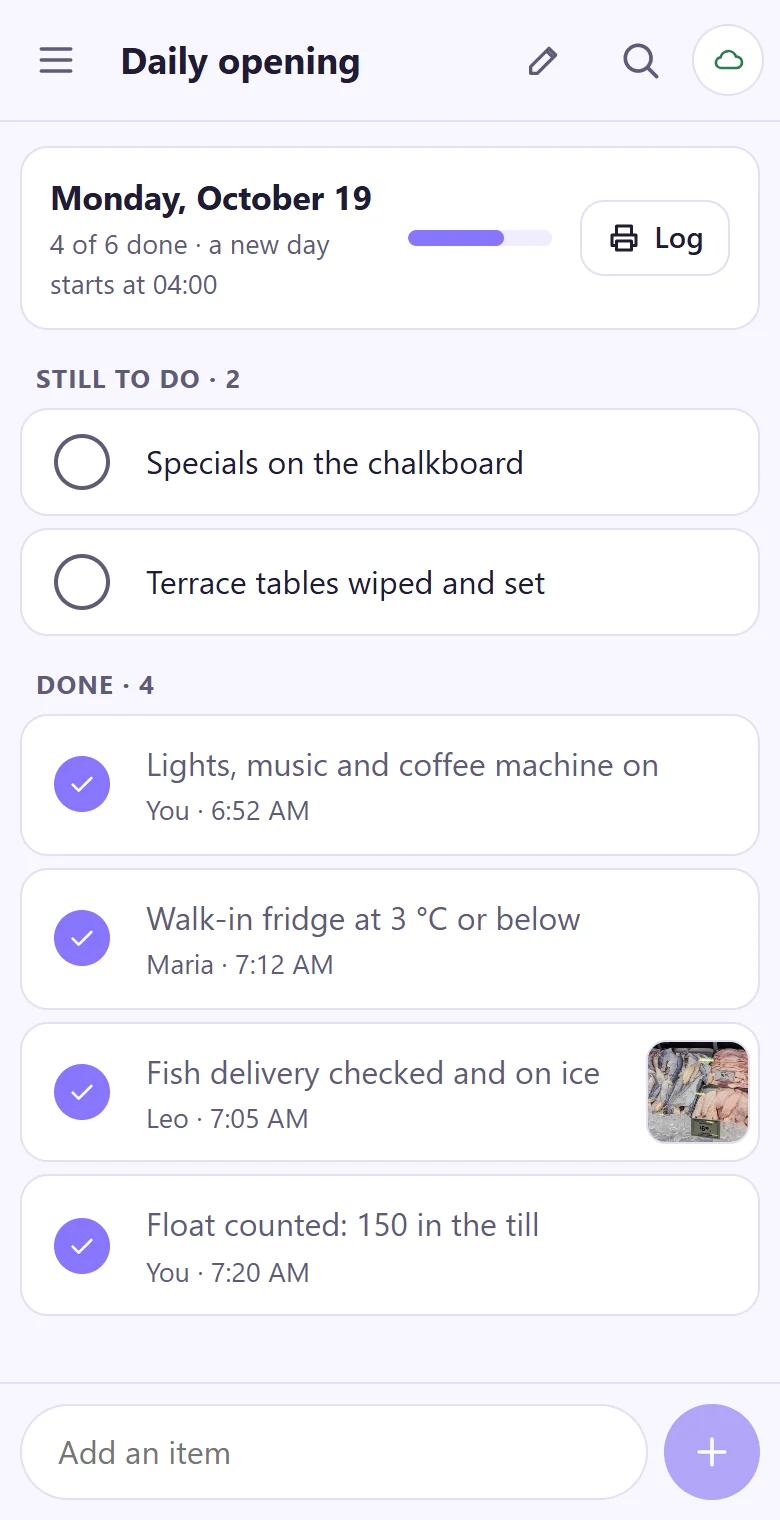
What it does not do: it does not raise an alarm when a tick is late, and it is not a lone-worker device with a panic button or fall detection. The buddy still sets their own phone alarm for each due time and runs the ladder above. For high-risk lone work, a monitored device or service is the right tool; the checklist is the record and the habit for everyday closes.
The same checklist idea runs the rest of the close: see Restaurant opening and closing checklists and, for night cleaning crews, Cleaning crew checklists by room.
Daily checklists for the close, with the name and time on every tick, a photo on the lock-up, and who is on shift right now.
See it for restaurantsWhat this piece does not show
There is no good count of lone-worker incidents. US injury statistics do not record whether the person was alone, so we cannot tell you how many injuries a check-in routine prevents or shortens. The time table above is arithmetic, not a study.
The intervals are a suggestion. No regulation we found sets a number of minutes; BC and HSE leave it to the risk assessment, made with the worker.
It is not legal advice. It summarizes federal OSHA, HSE's guidance and BC's regulation as we read them in October 2026. US state plans (California, Washington, Oregon and others) can add rules, and Canadian provinces each have their own working-alone sections.
Violence needs its own plan. Cash handling, late-night retail and threats from the public need more than check-ins: barriers, cash limits, lighting and training. California's workplace violence law and BC's late-night retail rules are where to start.
Sources
WorkSafeBC, OHS Guidelines Part 4: G4.21 Procedures for checking the well-being of workers (with section 4.21 of the Regulation) and G4.22.1-2 Late night retail (11:00 p.m. to 6:00 a.m.). WorkSafeBC
BC Labour Heritage Centre, Grant's Law (Grant De Patie, 2005). Labour Heritage Centre
OSHA, interpretation of February 22, 1999: CPR/first aid training and "working alone" provisions of 1910.269. OSHA
OSHA, interpretation of February 5, 2007: first aid under 1910.151(b), "near proximity" as 3 to 4 minutes. OSHA
29 CFR 1910.146 (permit-required confined spaces), 1910.134(g)(4) (two in, two out), 1910.269(l)(1) (two-person rule). eCFR
Health and Safety Executive, Lone working: Protect those working alone (updated February 2025): manage the risks; training, supervision and monitoring. HSE
Canadian Centre for Occupational Health and Safety, Working Alone - General (fact sheet revised July 2025). CCOHS
California Department of Industrial Relations, Workplace Violence Prevention in General Industry (Labor Code 6401.9). Cal/OSHA